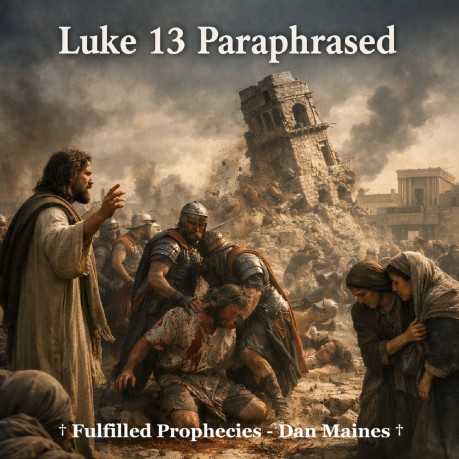
Luke 13
Paraphrased
By Dan Maines
Introduction
†
Jesus addresses real events happening in their time, correcting false
assumptions about sin and judgment
† He warns
that judgment is not random, it is directed at that generation unless
they repent
† The urgency throughout the
chapter points directly to the coming destruction of Jerusalem within
their lifetime (Luke 21:20-22)
Luke 13:1
Some
people told Him about Galileans whose blood Pilate had mixed with
their sacrifices
† This was a known recent
event, showing political violence under Roman authority (Josephus,
Antiquities)
† The people assumed these
victims must have been worse sinners
† Jesus
corrects this thinking, judgment was coming on all who refused to
repent
Luke 13:2
He answered and said they
were not worse sinners than all other Galileans because they suffered
this way
† Jesus rejects the idea that
suffering always equals greater sin (John 9:2-3)
†
The focus shifts from comparing others to examining oneself
†
Judgment was not selective, it was about to fall broadly
Luke
13:3
No, but unless you repent, you will all likewise
perish
† This is a direct warning to that
generation
† The word perish points to
physical destruction, fulfilled in AD 70 (Josephus, Wars of the
Jews)
† Repentance was the only escape from
that coming judgment
Luke 13:4
Or those
eighteen on whom the tower in Siloam fell and killed them, do you
think they were worse offenders than all others in Jerusalem
†
Another recent tragedy used to teach the same truth
†
Sudden death was not proof of greater guilt
†
The warning is universal to Jerusalem
Luke 13:5
No,
but unless you repent, you will all likewise perish
†
Repetition emphasizes urgency
† This is not
about distant events, it is about imminent covenant judgment
†
Jerusalem would fall just as suddenly
Luke 13:6
He
began telling this parable, a man had a fig tree planted in his
vineyard, and he came looking for fruit on it and did not find any
†
The fig tree represents Israel (Hosea 9:10)
†
God expected fruit, righteousness and obedience
†
Their failure showed covenant unfaithfulness
Luke
13:7
He said to the vineyard keeper, for three years I
have come looking for fruit on this fig tree without finding any, cut
it down, why does it even use up the ground
†
The three years reflect Christ's ministry
†
Israel had opportunity but remained unfruitful
†
Judgment was justified
Luke 13:8
He
answered, leave it alone this year too, until I dig around it and put
in fertilizer
† A final extension of mercy
†
This reflects the patience of God during the apostolic period
†
Time was limited
Luke 13:9
If it bears
fruit next year, fine, but if not, cut it down
†
The outcome was already clear, judgment would come
†
This was fulfilled in AD 70
† Israel as a
covenant system was removed
Luke 13:10
He
was teaching in one of the synagogues on the Sabbath
†
Jesus continued to confront religious leaders directly
†
Synagogues were centers of resistance to Him
†
The setting highlights their hypocrisy
Luke 13:11
There
was a woman who had a disabling spirit for eighteen years, she was
bent over and could not straighten up
† Her
condition shows bondage under the old system
†
Physical healing points to spiritual restoration
†
Eighteen years shows long suffering
Luke 13:12
When
Jesus saw her, He called her over and said she was freed from her
sickness
† Jesus initiates healing
†
He demonstrates authority over both physical and spiritual
oppression
† This reveals the kingdom already
present
Luke 13:13
He laid His hands on
her, and immediately she stood upright and glorified God
†
Immediate healing shows divine power
† Her
response contrasts the leaders' hardness
†
The people recognize God's work
Luke 13:14
The
synagogue official was indignant because Jesus healed on the Sabbath
and said there are six days for work, come then and be healed, not on
the Sabbath
† Religious leaders valued rules
over mercy
† Their system was exposed as
corrupt
† This reflects the failure of the
old covenant leadership
Luke 13:15
The
Lord answered and said hypocrites, does not each of you untie his ox
or donkey on the Sabbath and lead it to water
†
Jesus exposes their inconsistency
† They
cared more for animals than people
† Their
hypocrisy justified judgment
Luke 13:16
This
woman, a daughter of Abraham, bound for eighteen years, should she
not be set free on the Sabbath
† Jesus
affirms her covenant identity
† True Sabbath
rest is liberation
† He restores what the
system failed to do
Luke 13:17
His
opponents were humiliated, and the crowd rejoiced at all the glorious
things being done
† The people recognized
truth
† The leaders lost credibility
†
This tension builds toward the coming judgment
Luke
13:18
He said what is the kingdom of God like, and to
what shall I compare it
† Jesus explains the
nature of the kingdom
† It begins small but
grows
† It was already active in their
time
Luke 13:19
It is like a mustard seed
that a man planted, and it grew into a tree and birds nested in its
branches
† The kingdom starts small but
expands
† This was fulfilled through the
spread of the gospel
† It includes the
nations (Ezekiel 17:23)
Luke 13:20
Again
He said, to what shall I compare the kingdom of God
†
Emphasis through repetition
† The kingdom is
being revealed progressively
† It is not
future only, it is present
Luke 13:21
It
is like leaven hidden in flour until all of it was leavened
†
The kingdom works internally and thoroughly
†
It transforms everything over time
† This
shows its unstoppable growth
Luke 13:22
He
traveled from town to town teaching as He made His way to Jerusalem
†
Jerusalem is the focus
† Everything is
leading to its judgment
† His journey is
purposeful
Luke 13:23
Someone asked if
only a few are being saved
† This reflects
concern about salvation
† The question
assumes limited access
† Jesus redirects the
focus
Luke 13:24
Strive to enter through
the narrow door, many will try and will not be able
†
Effort is required
† Many in Israel would be
excluded
† The door was closing on that
generation
Luke 13:25
Once the master
shuts the door, people will stand outside knocking, but he will say
he does not know them
† This reflects
finality
† Opportunity was limited
†
This connects to the judgment on Jerusalem
Luke
13:26
They will say they ate and drank with Him and
heard Him teach
† Proximity to Jesus did not
guarantee acceptance
† Many heard Him but
rejected Him
† Religious familiarity was not
enough
Luke 13:27
He will say depart from
me, I do not know where you are from, you workers of wrongdoing
†
Rejection is based on lawlessness
† Covenant
identity without obedience is meaningless
†
This echoes Matthew 7:23
Luke 13:28
There
will be weeping when they see Abraham, Isaac, and Jacob in the
kingdom, but themselves thrown out
† This
shows reversal
† Many Jews would be
excluded
† Gentiles would be included
Luke
13:29
People will come from east and west and recline
in the kingdom of God
† The nations are
included
† This fulfills the promise to
Abraham
† The kingdom expands beyond
Israel
Luke 13:30
Some who are last will
be first, and first will be last
† Status is
reversed
† Those who seemed secure would
fall
† Those considered outsiders would
enter
Luke 13:31
Some Pharisees warned Him
that Herod wanted to kill Him
† Political
tension is rising
† Jesus is aware of the
threat
† Yet He continues His mission
Luke
13:32
He said tell that fox I cast out demons and
perform healings today and tomorrow, and the third day I finish
†
Jesus calls Herod a fox, exposing his weakness
†
His timeline is fixed
† His work will be
completed
Luke 13:33
I must continue today
and tomorrow and the next day, for a prophet cannot perish outside
Jerusalem
† Jerusalem is identified as the
place of judgment
† It is the city that kills
prophets
† This points directly to its coming
destruction
Luke 13:34
Jerusalem,
Jerusalem, who kills the prophets and stones those sent to her, how
often I wanted to gather your children, but you were unwilling
†
Jesus laments their rejection
† Their history
of violence sealed their fate
† Their
unwillingness brought judgment
Luke 13:35
Your
house is left to you desolate, and you will not see me until you say
blessed is He who comes in the name of the Lord
†
The temple would be destroyed
† Desolation
was imminent
† This was fulfilled in AD 70
(Josephus, Wars of the Jews)
Historical References
†
Josephus records the fall of Jerusalem and massive loss of life,
confirming the fulfillment of this warning
†
Eusebius describes the early Christians fleeing Jerusalem before its
destruction
† Clement of Alexandria speaks of
the transition from the old system to the new covenant reality
How
it applies to us today
† We don't
rely on outward religion, we walk in true repentance and obedience
†
We recognize that God's kingdom has already been established and
fulfilled
† We trust in Christ, not systems
or traditions that have already passed away
†
We live in the reality that judgment has already come and the kingdom
now stands
Q & A Appendix
Q:
Was Jesus talking about a future end of the world
A:
No, He was warning His generation of Jerusalem's destruction (Luke
21:20-22)
Q: What does perish mean here
A:
It refers to physical destruction in judgment, fulfilled in AD 70
(Luke 13:3)
Q: What is the fig tree
A:
It represents Israel failing to produce fruit (Hosea 9:10)
Q:
Who enters the kingdom
A: Those who respond in
faith and obedience, including the nations (Luke 13:29)
Q:
What is the desolate house
A: The temple and
Jerusalem left empty and destroyed (Luke 13:35)
† This
is the fulfilled perspective we proclaim at Fulfilled Prophecies †
©
Fulfilled Prophecies - Dan Maines.
Source Index
†
Luke 13
† Josephus, Wars of the Jews
†
Eusebius, Ecclesiastical History
† Clement of
Alexandria, Stromata
Links