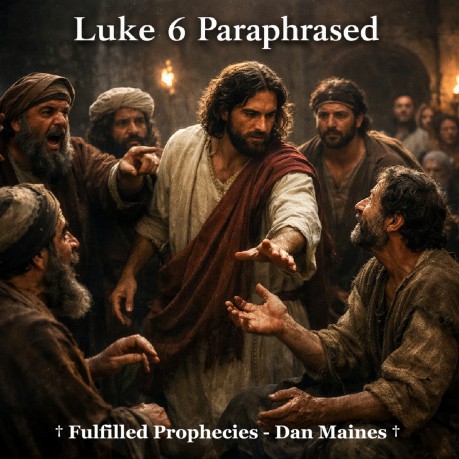
Luke 6
Paraphrased
By Dan Maines
Introduction
†
Luke 6 shows Jesus confronting tradition, revealing mercy, and
exposing the heart of the Law
† This chapter
reveals the condition of Israel and the coming reversal in that
generation
† It points directly to the
judgment that would fall when they rejected Him
Luke
6:1
On a Sabbath, Jesus was walking through fields, and
His disciples began picking grain, rubbing it in their hands, and
eating it as they went
† They were simply
feeding themselves, not violating God's intent
†
The issue came from added traditions, not the Law itself (Deuteronomy
23:25)
Luke 6:2
Some Pharisees said, Why
are you doing something that's not allowed on the Sabbath
†
Their focus was rules over people
† They
twisted the Law into control (Mark 7:8)
Luke 6:3
Jesus
answered them, Haven't you read what David did when he and his men
were hungry
† Jesus points them back to
Scripture they claimed to know (1 Samuel 21:6)
†
He exposes their misunderstanding
Luke 6:4
He
entered God's house, took the bread set apart for priests, ate it,
and shared it with those with him
† Need was
greater than ceremony
† God's Law always made
room for mercy
Luke 6:5
Then He said to
them, The Son of Man has authority over the Sabbath
†
Jesus declares Himself above the system
† The
Sabbath pointed forward to Him (Colossians 2:16-17)
Luke
6:6
On another Sabbath, He went into a synagogue and
taught, and there was a man there whose right hand was useless
†
This sets up another confrontation
† The need
was obvious, but their hearts weren't
Luke 6:7
The
scribes and Pharisees watched Him closely to see if He would heal on
the Sabbath so they could accuse Him
† They
weren't seeking truth, only a charge
† Their
hearts were hardened
Luke 6:8
But He knew
what they were thinking and told the man, Stand up and come here, and
he stood up
† Jesus reveals their thoughts
†
He brings everything into the open
Luke 6:9
Then
Jesus said, Is it right to do good or harm on the Sabbath, to save
life or destroy it
† The Law was always about
life (Deuteronomy 30:19)
† Their silence
exposed their guilt
Luke 6:10
He looked
around at them all, then told the man, Stretch out your hand, and he
did, and it was completely restored
†
Restoration shows God's true intent
† Mercy
fulfills righteousness
Luke 6:11
But they
were filled with rage and began discussing what they could do to
Jesus
† They responded to good with hatred
†
This leads directly to their judgment
Luke 6:12
During
those days, Jesus went up to a mountain to pray and spent the entire
night in prayer to God
† He models complete
dependence on the Father
† Prayer comes
before major decisions
Luke 6:13
When
morning came, He called His disciples and chose twelve of them,
naming them apostles
† The twelve represent
restored Israel (Luke 22:30)
† This marks
covenant transition
Luke 6:14
Simon, whom
He also named Peter, Andrew his brother, James, John, Philip, and
Bartholomew
† God uses ordinary men
†
The Kingdom isn't built on status
Luke 6:15
Matthew,
Thomas, James the son of Alphaeus, and Simon who was called the
Zealot
† Different backgrounds were brought
together
† The Kingdom breaks natural
divisions
Luke 6:16
Judas the son of
James, and Judas Iscariot, who later became a traitor
†
Even among the chosen was betrayal
† This
fulfilled prophecy (Psalm 41:9)
Luke 6:17
Jesus
came down with them and stood on a level place, and a large crowd
gathered from Judea, Jerusalem, and the coastal regions
†
The message was spreading throughout Israel
†
This gathering comes before judgment
Luke 6:18
They
came to hear Him and be healed, and those troubled by unclean spirits
were set free
† Authority over both body and
spirit
† The Kingdom was present among
them
Luke 6:19
Everyone tried to touch Him
because power was coming from Him and healing them all
†
Christ is the source of life
† His authority
was undeniable
Luke 6:20
Looking at His
disciples, He said, Blessed are you who are poor, because the Kingdom
of God belongs to you
† The poor are those
dependent on God
† The Kingdom was theirs in
that generation
Luke 6:21
Blessed are you
who are hungry now, because you will be satisfied, blessed are you
who weep now, because you will laugh
† A
reversal was coming soon
† Fulfilled in the
end of the old system
Luke 6:22
Blessed
are you when people hate you, exclude you, insult you, and reject
your name because of the Son of Man
† True
disciples were persecuted (Acts 5:41)
† This
marked the faithful
Luke 6:23
Rejoice in
that day and leap for joy, because your reward is great in heaven,
for their fathers treated the prophets the same way
†
They stood in line with the prophets
†
Judgment was coming on their persecutors
Luke 6:24
But
woe to you who are rich, because you've already received your
comfort
† Directed at Israel's elite
†
Their comfort would end in judgment
Luke 6:25
Woe
to you who are full now, because you will be hungry, woe to you who
laugh now, because you will mourn and cry
†
Fulfilled in the siege of Jerusalem
† A
complete reversal took place
Luke 6:26
Woe
to you when everyone speaks well of you, because that's how their
fathers treated the false prophets
†
Popularity often marked falsehood
† Truth
brought rejection
Luke 6:27
But I tell you
who are listening, love your enemies and do good to those who hate
you
† This defines Kingdom living
†
It opposes the natural response
Luke 6:28
Speak
blessings over those who curse you and pray for those who mistreat
you
† This reflects God's heart
†
It shows real transformation
Luke 6:29
If
someone strikes you on one cheek, offer the other, and if someone
takes your outer garment, don't hold back your inner garment
†
This exposes evil without retaliation
† It's
strength, not weakness
Luke 6:30
Give to
anyone who asks you, and if someone takes what belongs to you, don't
demand it back
† Trust replaces control
†
The Kingdom isn't built on possessions
Luke 6:31
Treat
others the way you want to be treated
† This
sums up righteous behavior
† It reflects
God's justice
Luke 6:32
If you only love
those who love you, what credit is that, even sinners do that
†
Kingdom love goes beyond natural love
† It
reveals a changed heart
Luke 6:33
If you
do good only to those who do good to you, what credit is that, even
sinners do the same
† True righteousness
stands apart
† It shows transformation
Luke
6:34
If you lend expecting to be repaid, what credit is
that, even sinners lend to get back what they gave
†
Kingdom giving expects nothing
† It reflects
grace
Luke 6:35
But love your enemies, do
good, and give without expecting anything back, then your reward will
be great, and you'll be sons of the Most High, because He is kind
even to the ungrateful and evil
† This
reflects God's nature
† It shows true
sonship
Luke 6:36
Be merciful, just as
your Father is merciful
† Mercy defines God's
character
† This is the standard
Luke
6:37
Don't judge, and you won't be judged, don't
condemn, and you won't be condemned, forgive, and you'll be
forgiven
† This addresses hypocritical
judgment
† The same measure returns (Matthew
7:2)
Luke 6:38
Give, and it will be given
back to you in full measure, pressed down, shaken together, and
overflowing, because the way you measure will be used for you
†
God responds to the heart
† Giving reveals
who we are
Luke 6:39
He told them a
parable, Can a blind person guide another blind person, won't they
both fall into a pit
† Blind leaders bring
destruction
† This applied to Israel's
leaders
Luke 6:40
A student isn't above
his teacher, but when fully trained, he'll be like his teacher
†
Disciples reflect their teacher
† This calls
for alignment with Christ
Luke 6:41
Why do
you see the small speck in your brother's eye but ignore the large
beam in your own
† Hypocrisy blinds
judgment
† Self-examination is required
Luke
6:42
How can you say, let me remove the speck from your
eye, when you don't see the beam in your own, you hypocrite, first
remove your own, then you'll see clearly
†
Correction starts with yourself
† Clarity
comes through humility
Luke 6:43
A good
tree doesn't produce bad fruit, and a bad tree doesn't produce good
fruit
† Fruit reveals nature
†
This exposes false leaders
Luke 6:44
Each
tree is known by its fruit, you don't gather figs from thorns or
grapes from bushes
† Results reveal truth
†
Nature can't be hidden
Luke 6:45
A good
person brings out good from what's stored in his heart, and an evil
person brings out evil, because the mouth speaks from what's inside
†
The heart determines the outcome
† Words
reveal the inner man
Luke 6:46
Why do you
call Me Lord but don't do what I say
† Empty
words mean nothing
† Obedience proves
truth
Luke 6:47
Everyone who comes to Me,
hears My words, and acts on them, I'll show you what he's like
†
Hearing must lead to action
† This defines
true discipleship
Luke 6:48
He's like a
man building a house who dug deep and laid the foundation on rock,
when the flood came, it couldn't shake it
† A
solid foundation stands in judgment
† Christ
is that foundation
Luke 6:49
But the one
who hears and doesn't act is like someone who built on the ground
without a foundation, when the flood came, it collapsed completely
†
Disobedience leads to destruction
† This was
fulfilled in that generation
Historical References
†
Josephus recorded the famine, chaos, and destruction of Jerusalem
†
Eusebius confirmed believers saw these events as fulfillment
†
Clement of Alexandria taught Christ fulfilled the Law and exposed
false righteousness
How it applies to us today
†
We live in the fulfilled Kingdom, not under the old system
†
True righteousness comes from the heart, not outward rule keeping
†
Mercy, forgiveness, and love define Kingdom life
†
We must build on Christ, not tradition
† What
we produce reveals who we are
Q & A Appendix
Q:
Was Jesus opposing the Law
A: No, He was
correcting misuse and fulfilling it (Matthew 5:17)
Q:
Who were the woes directed toward
A: The
leaders and wealthy in Israel who rejected Him (Luke 11:52)
Q:
When did these warnings come to pass
A: In that
generation before AD 70 (Matthew 24:34)
Q: What
does building on rock mean
A: Living in
obedience to Christ (Matthew 7:24)
Q: Why did
the leaders reject Him
A: He exposed their
hypocrisy and authority (John 11:48)
† This is the
fulfilled perspective we proclaim at Fulfilled Prophecies †
©
Fulfilled Prophecies - Dan Maines.
Source Index
†
Luke 6
† Josephus, Wars of the Jews
†
Eusebius, Ecclesiastical History
† Clement of
Alexandria, Stromata
Links