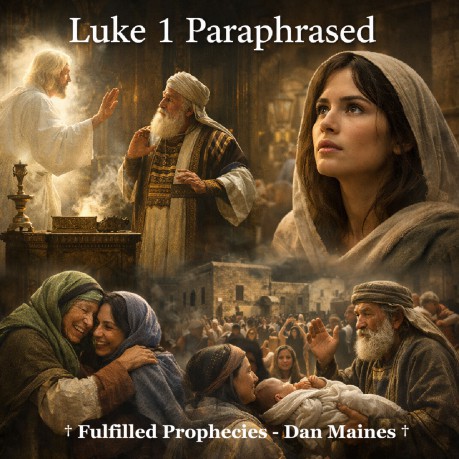
Luke 1
Paraphrased
By Dan Maines
Introduction
†
This chapter records the beginning of fulfillment as God brings His
promises into reality in their generation
†
It shows the preparation of the way through John and the arrival of
the Messiah
† Everything here is grounded in
eyewitness truth and fulfilled expectation
Luke 1:1
Many
have already written accounts about the things that have been
fulfilled among us
† This confirms
fulfillment was already happening in their time, not future (Matthew
24:34)
† The wording shows completion, not
anticipation
† The gospel is rooted in
fulfilled events, not predictions
Luke 1:2
These
were passed down by those who saw them firsthand and served the
message
† Eyewitness testimony confirms
historical reliability (2 Peter 1:16)
† The
message was preserved through direct witnesses
†
This removes speculation and anchors truth in reality
Luke
1:3
So I also decided, after carefully examining
everything from the beginning, to write it out in order for you, most
excellent Theophilus
† Luke emphasizes
careful investigation and accuracy
† This
shows God preserved an orderly account
† The
structure confirms intention, not randomness
Luke 1:4
So
you may know the certainty of what you've been taught
†
The purpose is assurance and clarity
† Truth
is confirmed through fulfilled reality
† The
message is meant to remove doubt
Luke 1:5
In
the days of Herod king of Judea, there was a priest named Zechariah
from the division of Abijah, and his wife Elizabeth was from the
daughters of Aaron
† This anchors the account
in real historical time
† The priestly line
connects this to covenant structure
† This
shows continuity with Israel's system
Luke 1:6
Both
were righteous before God, living faithfully in all the
commandments
† Righteousness existed under
the Old Covenant system
† Obedience defined
faithfulness before fulfillment
† This shows
God's people were still active within the system
Luke
1:7
But they had no child because Elizabeth was barren,
and they were both advanced in age
† God
often begins fulfillment through impossible situations (Genesis
21:1-2)
† Barrenness highlights the need for
divine action
† This prepares for a
miraculous intervention
Luke 1:8
While
Zechariah was serving as priest before God in the order of his
division
† The temple system was still
functioning
† This shows the Old Covenant was
still in operation
† Fulfillment begins while
the system is still standing
Luke 1:9
He
was chosen by lot to enter the temple and burn incense
†
This was a priestly responsibility tied to worship
†
Incense symbolizes prayers rising to God (Revelation 5:8)
†
God meets him at the center of covenant worship
Luke
1:10
The people were praying outside at the time of the
incense offering
† Worship was centered
around the temple
† The people remained under
the covenant system
† This shows corporate
participation in worship
Luke 1:11
An
angel of the Lord appeared to him standing at the right side of the
altar
† God intervenes directly within the
temple setting
† This signals a shift from
shadow to fulfillment
† The location
emphasizes covenant transition
Luke 1:12
Zechariah
was troubled and fear came over him
† Fear
accompanies divine revelation
† This shows
the seriousness of God's presence
† Human
response reveals the weight of the moment
Luke 1:13
The
angel said, do not be afraid, your prayer has been heard, your wife
will bear a son, and you will name him John
†
God answers long-standing prayers
† John is
divinely appointed for a purpose
† This
begins the preparation phase of fulfillment
Luke
1:14
You will have joy, and many will rejoice at his
birth
† This birth has national
significance
† Joy marks the arrival of
fulfillment
† It impacts more than just one
family
Luke 1:15
He will be great before
the Lord, drink no wine, and be filled with the Spirit even from the
womb
† John is set apart from birth
†
This shows divine calling and separation
†
His role is unique and prophetic
Luke 1:16
He
will turn many of Israel back to the Lord
†
This is a call to covenant restoration
† It
fulfills prophetic expectation (Malachi 4:5-6)
†
The focus is on Israel returning to God
Luke 1:17
He
will go before Him in the spirit and power of Elijah, turning hearts
and preparing people
† John fulfills the
Elijah prophecy
† This confirms the time of
fulfillment had arrived
† Preparation
precedes the Messiah's work
Luke 1:18
Zechariah
said, how will I know this, I'm old and my wife is advanced in age
†
Doubt appears even among the faithful
† Human
limitation questions divine promise
† This
shows the struggle between faith and sight
Luke 1:19
The
angel said, I am Gabriel who stands before God, sent to bring you
this message
† This confirms divine
authority
† The message comes directly from
God's presence
† This removes any doubt about
the source
Luke 1:20
You will be silent
until this happens because you did not believe
†
Unbelief brings consequence
† God still
fulfills His word despite doubt
† This serves
as a confirming sign
Luke 1:21
The people
were waiting and wondering why he delayed in the temple
†
The delay signals something unusual occurred
†
God's work often interrupts normal patterns
†
The people sense something significant happened
Luke
1:22
When he came out, he couldn't speak, and they
realized he had seen a vision
† The sign
confirms the encounter
† God's message is
visibly validated
† This removes uncertainty
about the event
Luke 1:23
When his service
ended, he went home
† Life continues but
everything has changed
† Fulfillment has now
begun
† God's plan is unfolding quietly
Luke
1:24
After this, Elizabeth became pregnant and stayed
in seclusion
† God fulfills His promise
†
This confirms divine intervention
† The
miracle is hidden but real
Luke 1:25
She
said the Lord has removed my disgrace among people
†
God's blessing removes shame
† This reflects
restoration and honor
† Fulfillment brings
personal healing
Luke 1:26
In the sixth
month, the angel Gabriel was sent to Nazareth
†
The focus shifts toward the Messiah
† God
moves from preparation to fulfillment
†
Nazareth becomes central to the plan
Luke 1:27
To
a virgin named Mary, engaged to Joseph from the house of David
†
This fulfills the Davidic covenant promise
†
Jesus comes through the royal line
† The
virgin birth is essential to the plan
Luke 1:28
The
angel said, greetings, favored one, the Lord is with you
†
Mary is chosen for divine purpose
† Favor is
given by God's will
† This marks her role in
fulfillment
Luke 1:29
She was troubled by
this greeting
† Divine encounters disrupt
normal expectations
† This shows human
reaction to divine presence
† God's work
often brings initial confusion
Luke 1:30
The
angel said, do not be afraid, you have found favor with God
†
God's grace removes fear
† Favor confirms
divine selection
† This reassures her of
God's plan
Luke 1:31
You will conceive and
bear a son, and name Him Jesus
† This is the
announcement of the Messiah
† The name
reflects His mission
† Fulfillment is now
directly declared
Luke 1:32
He will be
great and called the Son of the Most High, and will receive David's
throne
† This fulfills the covenant with
David (2 Samuel 7:12-13)
† Jesus is the
rightful King
† His authority is established
by God
Luke 1:33
He will reign over the
house of Jacob forever, and His kingdom will not end
†
This is the eternal kingdom
† It begins in
their generation
† It replaces the old
covenant system
Luke 1:34
Mary said, how
can this be since I am a virgin
† This
reflects natural questioning
† God's work
surpasses human understanding
† Faith seeks
understanding, not rejection
Luke 1:35
The
Spirit will come upon you, and the power of God will overshadow you
†
This is a divine conception
† God directly
brings forth the Messiah
† This confirms
supernatural origin
Luke 1:36
Even your
relative Elizabeth has conceived in old age
†
God confirms His power through another miracle
†
This strengthens faith through evidence
†
Nothing limits God's ability
Luke 1:37
Nothing
will be impossible with God
† This is a
universal truth
† God's power overrides
natural limits
† This anchors faith in His
ability
Luke 1:38
Mary said, I am the
Lord's servant, let it be done to me
† This
is full submission to God's will
† Faith
responds with obedience
† This models true
belief
Luke 1:39
Mary went quickly to a
city in Judah
† Action follows belief
†
Faith produces movement
† This shows urgency
in response
Luke 1:40
She entered
Zechariah's house and greeted Elizabeth
†
Both miracle accounts connect
† God's plan
unfolds together
† This confirms unity in
purpose
Luke 1:41
The baby leaped in
Elizabeth's womb, and she was filled with the Spirit
†
This confirms divine involvement
† Even the
unborn respond to fulfillment
† The Spirit
validates the moment
Luke 1:42
She cried
out, blessed are you among women
†
Recognition of God's work
† Mary is honored
for her role
† This affirms divine
selection
Luke 1:43
Why am I honored that
the mother of my Lord comes to me
† Elizabeth
recognizes Jesus as Lord
† This shows early
acknowledgment
† The identity of Christ is
revealed
Luke 1:44
When I heard your
greeting, the baby leaped with joy
† Joy
marks the arrival of fulfillment
† God's
presence brings life
† This confirms
spiritual awareness
Luke 1:45
Blessed is
she who believed what the Lord spoke
† Faith
receives God's promises
† Belief leads to
fulfillment
† This highlights the importance
of trust
Historical References
†
Josephus confirms temple practices and priestly divisions
†
Irenaeus affirms John as the prophetic forerunner
†
Eusebius records early understanding of fulfillment
†
Clement of Alexandria ties these events to prophecy
How
it applies to us today
† We stand on
fulfilled promises, not future expectation
†
God's word is certain and complete
† Faith
responds with obedience just like Mary
† We
live in the reality of what has already been accomplished
Q
& A Appendix
Q What does Luke 1
show
A That fulfillment had already begun (Luke
1:1)
Q Who was John
A The
forerunner fulfilling prophecy (Luke 1:17)
Q
What does Mary represent
A Faith and submission
to God's will (Luke 1:38)
Q What does this
chapter prove
A That prophecy was being
fulfilled in their generation (Matthew 24:34)
Q
What should we take from this
A Confidence in
completed promises (2 Corinthians 1:20)
† This is the
fulfilled perspective we proclaim at Fulfilled Prophecies †
©
Fulfilled Prophecies - Dan Maines.
Source Index
†
Luke 1
† Josephus, Antiquities of the Jews
†
Irenaeus, Against Heresies
† Eusebius,
Ecclesiastical History
† Clement of
Alexandria, Stromata
Links