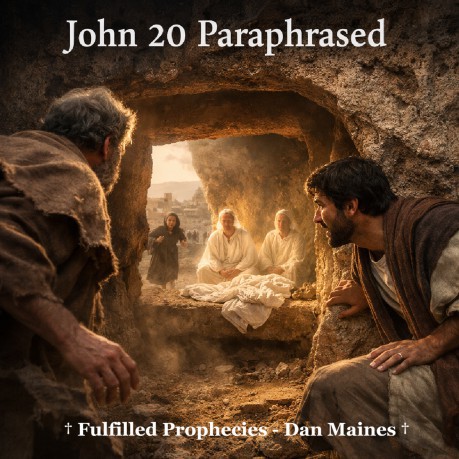
John 20
Paraphrased
By Dan Maines
Introduction
†
This chapter shows the turning point, the empty tomb, the risen
Christ, and the beginning of the fulfilled reality.
†
Everything Jesus promised comes into view here, not as future hope,
but as present reality for those who saw it.
†
This is where death is exposed as defeated, and the new covenant life
begins to be revealed (2 Timothy 1:10).
John 20:1
Early
on the first day of the week, while it was still dark, Mary Magdalene
came to the tomb and saw the stone had been taken away
†
The empty tomb wasn't discovered by rulers or priests, but by a
faithful follower.
† The removal of the stone
shows that what was sealed by men couldn't hold what God raised.
†
This moment begins the visible proof that death had no authority over
Him (Acts 2:24).
John 20:2
She ran and
came to Simon Peter and the other disciple whom Jesus loved and said
they've taken the Lord out of the tomb and we don't know where
they've laid Him
† At this point she assumes
theft, not resurrection.
† Even those closest
to Him didn't yet grasp what He had already told them.
†
This shows how unexpected the resurrection was, even to His
followers.
John 20:3
So Peter and the
other disciple went out and were going toward the tomb
†
The response is immediate, they run to see for themselves.
†
Faith often begins with investigation before understanding fully
develops.
† God allows evidence to be seen
before truth is fully realized.
John 20:4
The
two were running together and the other disciple ran ahead faster
than Peter and came to the tomb first
† John
outruns Peter, showing urgency and eagerness.
†
Their race reflects the intensity of the moment.
†
This wasn't casual curiosity, it was driven by shock and
confusion.
John 20:5
He stooped and looked
in and saw the linen wrappings lying there but he didn't go in
†
The grave clothes remain, showing no struggle or theft.
†
This detail proves the body wasn't taken in haste.
†
The scene itself testifies to something supernatural.
John
20:6
Simon Peter came following him and entered the
tomb and saw the linen wrappings lying there
†
Peter acts boldly and goes straight in.
† The
evidence is undeniable, the body is gone but everything else
remains.
† This begins to confront their
unbelief with reality.
John 20:7
And the
face cloth which had been on His head not lying with the wrappings
but folded up in a place by itself
† The
folded cloth shows order, not chaos.
† This
wasn't grave robbery, it was deliberate and calm.
†
The resurrection didn't disturb the grave, it passed through it.
John
20:8
So the other disciple who had first come to the
tomb also entered and he saw and believed
†
Seeing led to belief, the evidence was enough.
†
This is the first clear moment of recognition.
†
Faith here is grounded in what was seen, not imagined.
John
20:9
For they didn't yet understand the Scripture that
He must rise again from the dead
† They
believed before fully understanding.
†
Scripture often becomes clear after fulfillment, not before.
†
This shows that prophecy was fulfilled beyond their
expectations.
John 20:10
So the disciples
went away again to their own homes
† They
leave still processing what they've seen.
†
The full meaning hasn't settled in yet.
†
Fulfillment often takes time to fully grasp.
John
20:11
But Mary was standing outside the tomb weeping
and as she wept she stooped and looked into the tomb
†
Her grief keeps her near even after others leave.
†
Love and sorrow hold her in place.
† She's
about to witness something greater than she expected.
John
20:12
And she saw two angels in white sitting one at
the head and one at the feet where the body of Jesus had been lying
†
The presence of angels confirms divine activity.
†
The empty space between them highlights the absence of death.
†
Heaven is testifying that something has changed.
John
20:13
They said to her woman why are you weeping she
said because they've taken away my Lord and I don't know where
they've laid Him
† She still believes the
body was moved.
† Her focus is still on loss,
not resurrection.
† This shows how deeply
grief can cloud understanding.
John 20:14
When
she had said this she turned around and saw Jesus standing there and
didn't know it was Jesus
† The risen body
isn't immediately recognized.
† This shows a
transformation, not just resuscitation.
†
Recognition now depends on revelation, not just sight.
John
20:15
Jesus said to her woman why are you weeping whom
are you seeking thinking He was the gardener she said sir if you've
carried Him away tell me where you've laid Him and I'll take Him
away
† She still sees Him through natural
assumptions.
† Her devotion is evident, she's
willing to carry Him herself.
† Even in
misunderstanding, her love remains strong.
John
20:16
Jesus said to her Mary she turned and said to Him
Rabboni which means teacher
† Recognition
comes through His voice.
† Personal calling
brings clarity.
† The relationship is
restored instantly through recognition.
John 20:17
Jesus
said to her stop clinging to Me for I haven't yet ascended to the
Father but go to My brothers and say to them I ascend to My Father
and your Father and My God and your God
† He
redirects her from holding onto the physical.
†
The relationship is now shared, His Father is now their Father.
†
This marks the transition into the new covenant relationship (Hebrews
2:11).
John 20:18
Mary Magdalene came
announcing to the disciples I've seen the Lord and that He had said
these things to her
† She becomes the first
witness of the risen Christ.
† Her testimony
begins the spread of resurrection truth.
†
God uses unexpected people to declare fulfilled promises.
John
20:19
So when it was evening on that day the first day
of the week and the doors were shut where the disciples were for fear
of the Jews Jesus came and stood among them and said peace be with
you
† He appears despite locked doors,
showing a transformed body.
† Fear is met
with peace.
† His presence replaces anxiety
with assurance.
John 20:20
And when He had
said this He showed them both His hands and His side the disciples
then rejoiced when they saw the Lord
† The
wounds confirm identity.
† The same Jesus who
was crucified is now alive.
† Joy replaces
fear when truth is seen.
John 20:21
So
Jesus said to them again peace be with you as the Father has sent Me
I also send you
† Their mission now begins.
†
They are sent just as He was sent.
†
Fulfillment leads directly into purpose.
John 20:22
And
when He had said this He breathed on them and said receive the Holy
Spirit
† This echoes the creation of Adam,
new life is given.
† This marks the beginning
of spiritual life in fulfillment.
† The new
creation is now active (2 Corinthians 5:17).
John
20:23
If you forgive the sins of any their sins have
been forgiven them if you retain the sins of any they have been
retained
† Authority is given concerning
forgiveness.
† This reflects the message of
the gospel being proclaimed.
† Forgiveness is
now declared through the fulfilled work of Christ.
John
20:24
But Thomas one of the twelve called Didymus
wasn't with them when Jesus came
† Thomas
misses the first appearance.
† His absence
sets up a deeper lesson on belief.
† Not all
witnesses saw at the same time.
John 20:25
So
the other disciples were saying to him we've seen the Lord but he
said unless I see in His hands the mark of the nails and put my
finger into the place of the nails and put my hand into His side I
won't believe
† Thomas demands physical
proof.
† His doubt represents many who
require evidence.
† This sets up a powerful
confirmation of truth.
John 20:26
After
eight days His disciples were again inside and Thomas with them Jesus
came the doors having been shut and stood among them and said peace
be with you
† Jesus meets Thomas where he
is.
† The same greeting is repeated, peace
remains central.
† His patience shows grace
toward doubt.
John 20:27
Then He said to
Thomas reach here with your finger and see My hands and reach here
your hand and put it into My side and don't be unbelieving but
believing
† Jesus addresses Thomas
directly.
† The invitation removes all
doubt.
† Belief is now grounded in undeniable
reality.
John 20:28
Thomas answered and
said to Him my Lord and my God
† This is a
full confession of His identity.
† Thomas
moves from doubt to complete belief.
† The
resurrection confirms His divinity.
John 20:29
Jesus
said to him because you've seen Me have you believed blessed are they
who didn't see and yet believed
† This
extends beyond the first witnesses.
† Future
believers are included in the blessing.
†
Faith now rests on testimony, not physical sight.
John
20:30
Therefore many other signs Jesus also performed
in the presence of the disciples which aren't written in this book
†
Not everything was recorded.
† What is
written is selective and purposeful.
† The
focus is on what leads to belief.
John 20:31
But
these have been written so that you may believe that Jesus is the
Christ the Son of God and that believing you may have life in His
name
† The purpose of the account is clear,
belief leading to life.
† Life is found in
His name, not in future expectation.
† This
is the fulfilled reality offered to all who believe.
Historical
References
† Josephus, Antiquities
of the Jews, confirms the historical context of Jerusalem and the
events surrounding that generation.
†
Irenaeus, Against Heresies, affirms the resurrection as central to
the faith delivered to the early church.
†
Eusebius, Ecclesiastical History, records the spread of belief in the
risen Christ throughout the first century.
†
Clement of Alexandria, Stromata, speaks of the knowledge of Christ as
fulfilled truth, not future speculation.
How It Applies
To Us Today
† We're not waiting for
life, it's already been given through the risen Christ (John 5:24).
†
We don't need physical proof, we have the completed testimony.
†
Fear is replaced with peace when we understand what has been
fulfilled.
† Our mission continues just as He
sent them, to proclaim what has already been accomplished.
†
The resurrection isn't future, it's the foundation of our present
life in Him.
Q & A Appendix:
Q:
When did the resurrection life begin?
A: It
began when Christ was raised and revealed Himself to His disciples
(John 20:22; 2 Timothy 1:10).
Q: Why didn't
they recognize Him immediately?
A: His body was
transformed, requiring revelation to recognize Him (John 20:14; Luke
24:16).
Q: What does believing without seeing
mean?
A: It means trusting the testimony that
has been given (John 20:29; Romans 10:17).
Q:
Did the disciples fully understand right away?
A:
No, understanding came after seeing fulfillment (John 20:9; Luke
24:45).
Q: What does this mean for us today?
A:
It means we live in the reality of what has already been accomplished
(John 20:31; 1 John 5:11-12).
† This is the fulfilled
perspective we proclaim at Fulfilled Prophecies †
©
Fulfilled Prophecies - Dan Maines.
Source Index
†
John 20
† Josephus, Antiquities of the Jews
†
Irenaeus, Against Heresies
† Eusebius,
Ecclesiastical History
† Clement of
Alexandria, Stromata
Links