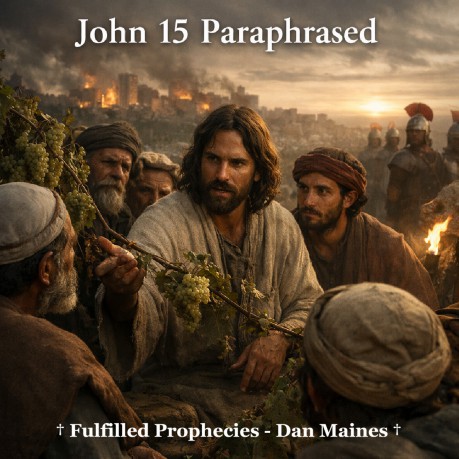
John 15 Paraphrased Introduction John 15:1 John 15:2 John 15:3 John 15:4 John 15:5 John 15:6 John 15:7 John 15:8 John 15:9 John 15:10 John 15:11 John 15:12 John 15:13 John 15:14 John 15:15 John 15:16 John 15:17 John 15:18 John 15:19 John 15:20 John 15:21 John 15:22 John 15:23 John 15:24 John 15:25 John 15:26 John 15:27 Historical References How it applies to us today Q & A Appendix: † This is the fulfilled perspective we proclaim at
Fulfilled Prophecies † Source Index
By Dan Maines
† Jesus is
speaking to His disciples about covenant life, not future
speculation, but present reality that was being fulfilled in their
generation
† The imagery of the vine and
branches points to Israel as the old vineyard and Christ as the true
source of life now replacing it (Isaiah 5:1-7)
†
This chapter shows the transition from the old covenant system to
life fully rooted in Christ
I am the true vine, and My Father
is the one who tends it
† Israel was called
God's vine, but failed, now Christ stands as the true and faithful
vine (Psalm 80:8-16)
† The Father tending the
vine shows active covenant oversight and judgment happening in that
generation
† Irenaeus wrote that Christ
recapitulates Israel, becoming what Israel failed to be
Every branch in Me that does not
bear fruit He removes, and every branch that bears fruit He cleans so
it produces more
† Fruitlessness points to
unbelieving Israel, especially leadership that rejected Christ
†
Removal is covenant judgment, fulfilled in AD 70 when the unfruitful
were cut off
† Josephus records the
destruction and removal of that generation as judgment upon them
You are already clean because of
the word I have spoken to you
† The disciples
were set apart through Christ's teaching, not temple rituals
†
Cleansing here replaces the old purification system with the word of
Christ
† Clement of Alexandria taught that
the word of Christ purifies the soul
Remain in Me, and I will remain in
you, just as a branch cannot bear fruit by itself unless it remains
in the vine
† Remaining is covenant union,
not mystical future language, but present obedience and faith
†
Life flows from Christ alone, not from law or temple
†
Eusebius notes the early believers separated from temple reliance and
remained in Christ
I am the vine, you are the
branches, the one who remains in Me bears much fruit, apart from Me
you can do nothing
† This shows total
dependence on Christ, not partial reliance
†
The fruit is covenant fruit, righteousness, faithfulness, obedience
†
Tertullian emphasized that apart from Christ, all works are empty
If anyone does not remain in Me,
he is thrown away like a branch and dries up, then they gather them
and burn them
† This is judgment language
tied directly to that generation
† Burning
reflects the destruction of Jerusalem and the old covenant system
†
Josephus describes the literal burning of Jerusalem in AD 70
If you remain in Me and My words
remain in you, ask whatever you wish and it will be done
†
This promise is tied to alignment with Christ's will, not personal
desires
† The disciples were empowered for
their mission before the covenant ended
†
Early church writings show prayers centered on kingdom fulfillment
My Father is glorified when you
bear much fruit and prove to be My disciples
†
Fruit was the visible evidence of true covenant identity
†
This replaced lineage identity under the old covenant
†
Irenaeus taught that true discipleship is shown through fruit
Just as the Father has loved Me, I
have also loved you, remain in My love
† This
is covenant love, consistent, active, and relational
†
Remaining in love means obedience and faithfulness
†
Clement of Alexandria emphasized love as the mark of the new covenant
If you keep My commandments, you
will remain in My love
† Obedience is the
evidence of remaining, not the cause of salvation
†
This shifts focus from law to Christ's commands
†
Tertullian wrote that obedience flows from faith, not from law
I have spoken these things so My
joy may be in you and your joy may be complete
†
Joy here is covenant fulfillment, not emotional feeling
†
The completion of joy comes with the completion of the old covenant
age
† Eusebius connects this joy to the
establishment of the church
This is My commandment, that you
love one another just as I have loved you
†
Love replaces the law as the central command
†
This command defined the new covenant community
†
Early writers consistently pointed to love as the defining mark
Greater love has no one than
this, that one lays down his life for his friends
†
This directly points to Christ's sacrifice
†
It also sets the standard for His followers
†
Irenaeus highlights Christ's death as the ultimate act of love
You are My friends if you do what
I command
† Friendship with Christ is based
on obedience
† This is relational, not
ritualistic
† Clement wrote that obedience
reveals true friendship with God
I no longer call you slaves, but
friends, because I have made known everything I heard from My
Father
† This marks a shift from servant to
covenant partner
† Revelation of truth
replaces hidden mysteries
† Early church
writings emphasize this new relationship
You did not choose Me, but I
chose you and appointed you to bear fruit that remains
†
This is about their mission to bring the gospel before AD 70
†
Lasting fruit is the establishment of the new covenant people
†
Eusebius records the spread of the gospel before Jerusalem fell
This I command you, that you love
one another
† The command is repeated to show
its importance
† Love is the defining mark of
the new covenant
† Tertullian noted how the
early church was known for love
If the world hates you, know that
it has hated Me before it hated you
† The
world here refers to the unbelieving Jewish system
†
Their rejection of Christ extended to His followers
†
Josephus records intense persecution during this time
If you were of the world, the
world would love you, but I chose you out of the world
†
Separation from the old system brought persecution
†
The disciples were no longer part of that covenant structure
†
Early believers were cast out of synagogues
A slave is not greater than his
master, if they persecuted Me, they will persecute you
†
This prepares them for coming suffering
†
Persecution confirms alignment with Christ
†
Eusebius documents the persecution of early Christians
They will do all these things
because they do not know the One who sent Me
†
Ignorance of God led to rejection of Christ
†
This applies directly to that generation
†
Irenaeus said they rejected the Son because they did not know the
Father
If I had not come and spoken,
they would not have sin, but now they have no excuse
†
Christ's presence exposed their sin fully
†
Judgment came because of revealed truth
†
This aligns with covenant accountability
The one who hates Me hates My
Father also
† Rejecting Christ is rejecting
God
† This destroys the idea that they were
still in covenant favor
† Clement emphasized
unity between Father and Son
If I had not done the works among
them, they would not have sin, but now they have seen and hated both
Me and My Father
† Miracles confirmed His
identity
† Their rejection was willful, not
ignorant
† This sealed their judgment
They hated Me without a cause
†
This fulfills what was written in the law (Psalm 35:19)
†
Their hatred was unjustified and revealed their hearts
†
Early writers saw this as clear prophetic fulfillment
When the Helper comes, whom I
will send from the Father, He will testify about Me
†
The Spirit would empower their witness before judgment came
†
This was fulfilled in Acts as the gospel spread rapidly
†
Eusebius records the spread of testimony across nations
You will also testify because you
have been with Me from the beginning
† The
disciples were eyewitnesses, their testimony carried authority
†
Their mission was completed before the end of that age
†
The historical record confirms their testimony spread before AD 70
†
Josephus, Wars of the Jews, records the destruction of Jerusalem and
burning of the city
† Irenaeus, Against
Heresies, explains Christ as the true vine replacing Israel
†
Eusebius, Ecclesiastical History, documents early church persecution
and expansion
† Clement of Alexandria,
Stromata, teaches purification through the word
†
Tertullian, Apology, describes the fruit and love of early believers
†
We are not connected to God through systems or traditions, but
through Christ alone
† Fruit still matters,
not for earning life, but as evidence of being in Him
†
Love remains the defining mark of those who belong to Christ
†
We don't fear judgment like they did, because that covenant judgment
has already been fulfilled
† We live in the
reality of the completed work, not waiting for it
Q What
does the vine represent
A Christ as the true
source of covenant life replacing Israel (Isaiah 5:1-7)
Q
What does it mean to be cut off
A Covenant
judgment on unbelieving Israel fulfilled in AD 70 (Luke 21:20-22)
Q
What is the fruit
A Righteousness and obedience
flowing from union with Christ (Galatians 5:22-23)
Q
Who is the world that hates them
A The
unbelieving Jewish system that rejected Christ (John 1:11)
Q
When was this fulfilled
A In that generation
leading up to the destruction of Jerusalem (Matthew 24:34)
© Fulfilled Prophecies - Dan
Maines.
† John 15
†
Josephus, Wars of the Jews
† Irenaeus,
Against Heresies
† Eusebius, Ecclesiastical
History
† Clement of Alexandria, Stromata
†
Tertullian, Apology
Links