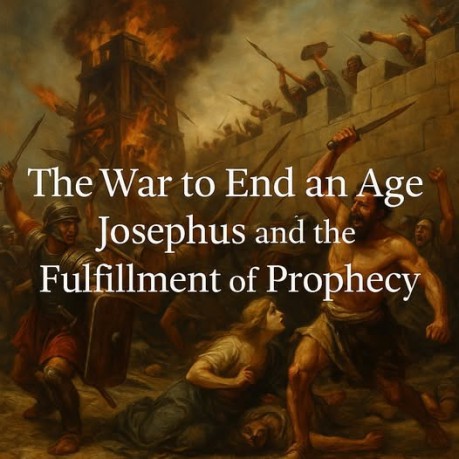
The
War to End an Age – Josephus and the Fulfillment of Prophecy
Brothers and sisters, as a Preterist, I often point to Scripture to
show how the words of Jesus and the prophets were fulfilled in the
events surrounding the destruction of Jerusalem in 70 AD. But today
I want to highlight something often overlooked: even secular history
confirms the magnitude of what took place. One of the most important historical
sources we have is The Works of Flavius Josephus. He was a
first-century Jewish historian and eyewitness to the Jewish-Roman
War. His testimony adds powerful weight to the fulfillment of Jesus'
words. Let me share with you some of
Josephus' most famous quotes, alongside the scriptures they affirm. "The Greatest War Ever
Fought" Josephus writes: "Whereas the war which
the Jews made with the Romans hath been the greatest of all those,
not only that have been in our times, but, in a manner, of those
that ever were heard of; both of those wherein cities have fought
against cities, or nations against nations."
–
Josephus, Wars of the Jews, Book I, Preface, Section 1 "For then there will be a
great tribulation, such as has not occurred since the beginning of
the world until now, nor ever will again."
–
Matthew 24:21 Josephus, without intending to affirm
prophecy, ends up confirming exactly what Jesus said. "One Stone Upon Another" Josephus describes the
complete devastation of the Temple: "Caesar gave orders that
they should now demolish the entire city and temple... it was so
thoroughly laid even with the ground by those that dug it up to the
foundation, that there was left nothing to make those that came
thither believe it had ever been inhabited."
–
Josephus, Wars of the Jews, Book VII, Chapter 1, Section 1 This is exactly what Jesus foretold: "Do you not see all these
things? Truly I say to you, not one stone here will be left upon
another, which will not be torn down."
–
Matthew 24:2 This wasn't vague prophecy. It was
precise, and Josephus confirms its exact fulfillment. "Internal Division and
Civil War" Josephus reports on the chaos
within Jerusalem during the siege: "It was God who condemned
the whole nation, and turned every course that was taken for their
preservation to their destruction. For the Jews rose up against each
other."
– Josephus, Wars of the Jews, Book V,
Chapter 6, Section 2 Jesus also foretold this
internal strife: "And because lawlessness
is increased, most people's love will become cold."
–
Matthew 24:12 "False Prophets and False
Hope" Josephus tells of deception
among the people: "A false prophet was the
occasion of these people's destruction, who had made a public
proclamation in the city, that very day, that God commanded them to
get up upon the temple, and that there they should receive
miraculous signs of their deliverance."
–
Josephus, Wars of the Jews, Book VI, Chapter 5, Section 2 This aligns perfectly with
Jesus' warning: "For false christs and
false prophets will arise and will provide great signs and wonders,
so as to mislead, if possible, even the elect."
–
Matthew 24:24 "The Fires of Gehenna" Josephus even uses the term
"Gehenna," the valley outside Jerusalem that Jesus often
referred to in His warnings of judgment. "And now the Romans, upon
the flight of the seditious into the city, and upon the burning of
the holy house itself, and of all the buildings round about it,
brought the fire to the gates and burned them also... so that the
hill [Zion] was on fire as far as Gehenna."
–
Josephus, Wars of the Jews, Book VI, Chapter 8, Section 5 When Jesus spoke of Gehenna,
He was not speaking of a far-off fiery pit in some distant realm. He
was warning of a judgment about to fall on that very generation: "But I say to you that
everyone who is angry with his brother shall be guilty... and
whoever says, 'You fool,' shall be guilty enough to go into the
fiery hell [Gehenna]."
– Matthew 5:22 "It was God Himself who
brought the Romans" "It is God Himself who is
bringing on this fire to purge the city and temple by means of the
Romans, and is going to pluck up this city to the very
foundations."
– Josephus, Wars of the Jews,
Book VI, Chapter 2, Section 1 Josephus confirms exactly what Jesus
foretold, God used the Roman armies as His judgment tool to destroy
Jerusalem. The city's fall wasn't random, it was divine justice
fulfilled. "But when you see
Jerusalem surrounded by armies, then recognize that her desolation
is near."
– Luke 21:20 "No pity, no distinction,
not even for infants" "They slew them, even
those that begged for mercy. They made no distinction between the
old and the young, but went on in slaughter till they had killed
almost the entire population."
– Josephus, Wars
of the Jews, Book VI, Chapter 8, Section 5 Jesus warned of wrath on that
generation, and Josephus records it in chilling detail, no mercy,
not even for the innocent. Prophecy fulfilled in blood. "Woe to those women who
are pregnant, and to those who are nursing babies in those days, for
there will be great distress upon the land, and wrath to this
people."
– Luke 21:23 "Starving mothers ate
their own children" "There was a certain
woman that dwelt beyond Jordan... she took up her child, being then
a baby at her breast, and said, 'O miserable infant! For whom shall
I preserve thee in this war...?' and she slew her son, and then
roasted him, and ate one half of him."
–
Josephus, Wars of the Jews, Book VI, Chapter 3, Section 4 The curses of the Law came to life in
70 AD. What Moses warned, Josephus witnessed. Jesus' generation
reaped the full fury of covenant wrath. "You will eat the flesh
of your sons, and you will eat the flesh of your daughters."
–
Leviticus 26:29
"The refined and delicate woman
among you... will secretly eat her own children."
–
Deuteronomy 28:56-57 "The fire could not be
quenched" "Caesar gave orders that
they should now demolish the entire city and temple... yet was the
fire not restrained even after all this... it appeared that the
destruction of the temple was not from man's hands, but from God."
–
Josephus, Wars of the Jews, Book VI, Chapter 4, Section 5 The unquenchable fire was God's
judgment, not Rome's rage. As Jesus warned, those who rejected Him
faced a fate worse than pagan cities, destruction by divine fire. "But if you do not
repent, it will be more tolerable for Tyre and Sidon on the day of
judgment than for you... and you, Capernaum, will be brought down to
Hades."
– Matthew 11:21-23 "The blood reached up to
the horses' bridles" "The number of those that
perished during the whole siege was computed to be 1,100,000... the
multitude of the slain made the whole city run down with blood to
such a degree that the fire of many of the houses was quenched with
the blood."
– Josephus, Wars of the Jews, Book
VI, Chapter 9, Section 3 Revelation's imagery was no
exaggeration, Josephus saw it fulfilled. Rivers of blood in
Jerusalem matched the vision, proving the judgment was real, not
symbolic. "And the wine press was
trampled outside the city, and blood came out of the wine press, up
to the horses' bridles, for a distance of about 200 miles."
–
Revelation 14:20 "The Jews were themselves
the cause of their miseries" "It was, I suppose, owing
to the justice of God Himself that all the people were deluded, both
by their madness and by false prophets, and that they did not listen
to those who warned them. For the Jews were the cause of their own
miseries."
– Josephus, Wars of the Jews, Book
VI, Chapter 5, Section 4 Jesus wept over their stubbornness,
and Josephus confirms it—their own rebellion brought the ruin.
Judgment came because they would not listen. "Jerusalem, Jerusalem,
who kills the prophets and stones those who have been sent to her!
How often I wanted to gather your children together... and you were
unwilling."
– Matthew 23:37 Conclusion Josephus did not write as a Christian.
He did not set out to prove the words of Jesus. But through his
witness, God preserved a historical confirmation of the Lord's
words. This war was no ordinary conflict. It was the end of the age,
the fulfillment of Jesus' prophecy, the great tribulation. And as a Preterist, I declare to you
with boldness:
Jesus was right.
The time was near.
The
judgment came.
And the kingdom, the true heavenly kingdom, was
established and remains forever. Let history be our witness, Scripture
our authority, and the fulfilled kingdom our confidence. Amen.
By Dan Maines
Links