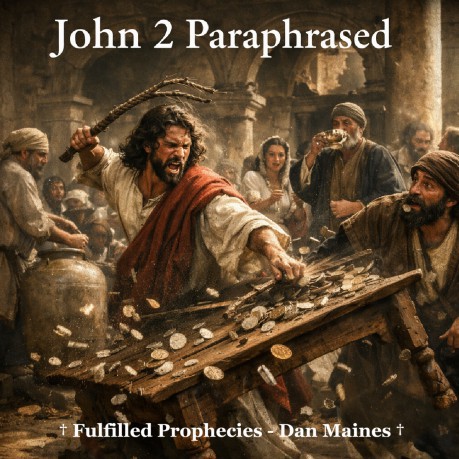
John 2
Paraphrased
By Dan Maines
Introduction
†
This chapter reveals the beginning of Jesus' public signs, showing
His authority over creation and the temple system.
†
The turning of water into wine points to the transformation from the
old covenant purification to the new covenant fulfillment.
†
The cleansing of the temple shows judgment coming upon the corrupt
system that had replaced true worship.
John 2:1
On
the third day there was a wedding in Cana of Galilee, and Jesus'
mother was there
† This places the event in a
real historical setting, not symbolic fiction
†
The third day echoes themes of revelation and manifestation (Exodus
19:11)
† Mary is present, showing family
connection and social involvement
John 2:2
and
Jesus and His disciples were invited to the wedding
†
Jesus participates in normal life events, showing His humanity
†
His disciples are already following Him early in His ministry
†
This shows His work begins among the people, not isolated from
them
John 2:3
When the wine ran out, the
mother of Jesus said to Him, They have no wine
†
Running out of wine would bring shame to the host in that culture
†
Mary brings the need to Jesus, recognizing His ability to act
†
This reflects dependence on Him for provision
John
2:4
And Jesus said to her, Woman, what does that have
to do with us, My hour has not yet come
†
Jesus makes clear His mission is governed by divine timing
†
The phrase My hour points forward to His death and glorification
(John 12:23)
† He is not acting under human
pressure but according to the Father's will
John 2:5
His
mother said to the servants, Whatever He says to you, do it
†
This shows trust in Jesus' authority
†
Obedience is the condition for witnessing His power
†
This principle applies throughout His ministry
John
2:6
Now there were six stone waterpots set there for
the Jewish custom of purification, containing twenty or thirty
gallons each
† These vessels represent the
old covenant purification system
† The large
capacity shows abundance within the old system, yet still
insufficient
† The number six often
represents incompleteness
John 2:7
Jesus
said to them, Fill the waterpots with water, So they filled them up
to the brim
† Full obedience is shown,
leaving no room for doubt
† Filling to the
brim removes any suspicion of trickery
† This
prepares for a complete transformation
John 2:8
And
He said to them, Draw some out now and take it to the headwaiter, So
they took it to him
† The servants act in
faith without knowing the outcome
† The
miracle occurs between the filling and the drawing
†
This reflects unseen transformation by Christ
John
2:9
When the headwaiter tasted the water which had
become wine, and did not know where it came from, but the servants
who had drawn the water knew, the headwaiter called the bridegroom
†
The transformation is complete, not partial
†
Those who serve witness what others do not
†
This shows hidden revelation given to the faithful
John
2:10
and said to him, Every man serves the good wine
first, and when the people have drunk freely, then he serves the
poorer wine, but you have kept the good wine until now
†
The best is saved for last, showing the superiority of what Christ
brings
† This contrasts the old covenant with
the new
† The fulfilled kingdom brings what
was better all along (Hebrews 8:6)
John 2:11
This
beginning of His signs Jesus did in Cana of Galilee, and manifested
His glory, and His disciples believed in Him
†
This is the first public sign revealing His identity
†
His glory is not political but divine
† Faith
grows through witnessing His works
John 2:12
After
this He went down to Capernaum, He and His mother and His brothers
and His disciples, and they stayed there a few days
†
Movement between regions shows the spread of His ministry
†
His family remains connected to Him at this stage
†
This sets up His broader mission in Galilee
John
2:13
The Passover of the Jews was near, and Jesus went
up to Jerusalem
† Passover connects to
deliverance and covenant themes
† Jesus
enters Jerusalem as the true Passover Lamb (1 Corinthians 5:7)
†
This timing is intentional and prophetic
John 2:14
And
He found in the temple those who were selling oxen and sheep and
doves, and the money changers seated at their tables
†
The temple had become a marketplace instead of a place of worship
†
This reflects corruption within the religious system
†
The leaders had turned worship into profit
John 2:15
And
He made a scourge of cords, and drove them all out of the temple,
with the sheep and the oxen, and He poured out the coins of the money
changers and overturned their tables
† Jesus
acts with authority and righteous judgment
†
This is not uncontrolled anger but purposeful action
†
It foreshadows the coming destruction of that system in AD 70
John
2:16
and to those who were selling the doves He said,
Take these things away, stop making My Father's house a place of
business
† He identifies the temple as His
Father's house, claiming divine authority
†
Worship had been replaced with commerce
†
This exposes the failure of Israel's leadership
John
2:17
His disciples remembered that it was written, Zeal
for Your house will consume me
† This
fulfills Psalm 69:9
† His zeal is tied to
judgment and restoration
† Scripture confirms
His actions as righteous
John 2:18
The
Jews then said to Him, What sign do You show us as your authority for
doing these things
† They demand proof
instead of recognizing truth
† Their focus is
on authority, not repentance
† This shows
their hardened condition
John 2:19
Jesus
answered them, Destroy this temple, and in three days I will raise it
up
† He speaks of His body, not the physical
building
† This points to His death and
resurrection
† The true temple is Christ
Himself (John 1:14)
John 2:20
The Jews
then said, It took forty six years to build this temple, and will You
raise it up in three days
† They
misunderstand His words literally
† This
reveals their blindness to spiritual truth
†
They are focused on the physical structure
John 2:21
But
He was speaking of the temple of His body
†
Jesus replaces the temple system entirely
†
Access to God is now through Him alone
† This
is the shift from old covenant to fulfilled reality
John
2:22
So when He was raised from the dead, His disciples
remembered that He said this, and they believed the Scripture and the
word which Jesus had spoken
† Understanding
comes after fulfillment
† Faith is
strengthened through fulfilled prophecy
†
This aligns with the fulfilled perspective of all prophecy
John
2:23
Now when He was in Jerusalem at the Passover,
during the feast, many believed in His name, observing His signs
which He was doing
† Belief based on signs is
often shallow
† Many are drawn by miracles
rather than truth
† This sets up a contrast
in the next verse
John 2:24
But Jesus, on
His part, was not entrusting Himself to them, for He knew all men
†
Jesus discerns true faith from superficial belief
†
He is not deceived by outward responses
† His
knowledge is complete and divine
John 2:25
and
because He did not need anyone to testify concerning man, for He
Himself knew what was in man
† He knows the
heart completely (Jeremiah 17:10)
† This
confirms His divine nature
† True faith is
inward, not just outward response
Historical
References
† Josephus records the
corruption and commercial activity within the temple before its
destruction, showing this was a real issue
†
Eusebius notes that Jesus' actions foreshadowed the coming judgment
on Jerusalem in AD 70
† Irenaeus affirms that
Christ replaced the temple system as the true dwelling of God
†
Clement of Alexandria taught that Christ's miracles revealed deeper
spiritual transformation beyond physical acts
How it
applies to us today
† We must
recognize that Jesus has already fulfilled the temple system, we
don't return to shadows
† True worship is not
tied to buildings but to Christ Himself (John 4:21-24)
†
We must examine our hearts, because He knows what is in us
†
Obedience brings revelation, just like the servants who followed His
command
† The fulfilled reality means we live
in the better covenant now, not waiting for it
Q & A
Appendix
Q: What does the water
turning into wine represent
A: It represents
the transformation from the old covenant purification to the new
covenant fulfillment (Hebrews 8:6)
Q: Why did
Jesus cleanse the temple
A: Because it had
become corrupt and was under judgment (Malachi 3:1-3)
Q:
What is the temple Jesus spoke about
A: His
body, showing He replaced the physical temple (John 1:14)
Q:
Why didn't Jesus trust those who believed in Him
A:
Because their belief was based on signs, not true faith (John
6:26)
Q: What does this chapter show about
fulfillment
A: It shows the transition from the
old system to the fulfilled reality in Christ (Colossians 2:16-17)
†
This is the fulfilled perspective we proclaim at Fulfilled Prophecies
†
© Fulfilled Prophecies - Dan Maines.
Source
Index
† John 2
†
Josephus, Antiquities of the Jews
† Irenaeus,
Against Heresies
† Eusebius, Ecclesiastical
History
† Clement of Alexandria, Stromata
Links