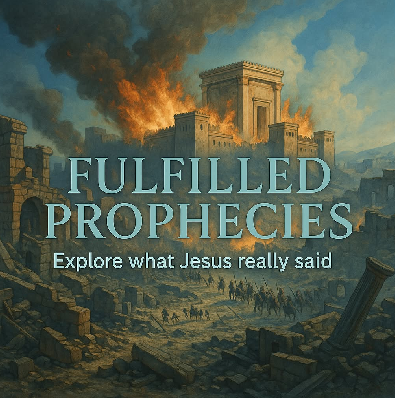
Josephus
and the Temple in 70 AD
In The Jewish War (Book 7, Chapter 1), Josephus recounts the Roman
destruction of Jerusalem and the Temple in 70 AD. Josephus reports that, when the Temple
was completely destroyed, there was nothing left of it except for
the western wall, which was left standing. This is often interpreted
as the Western Wall (or Wailing Wall) that remains today.
By Dan Maines
He
states that the Temple was set on fire by the Romans under Titus's
command, and that the fire spread, consuming the building. Josephus
describes how the Temple, which was one of the most magnificent
structures in the ancient world, was reduced to ashes. The temple's
walls and other significant parts of the structure were destroyed.
He also mentions that the Roman soldiers, driven by greed, attempted
to get the gold that had melted and seeped into the cracks of the
stone, leading them to dismantle the building stone by
stone.
According to Josephus, people attempted to swallow
gold to hide it from the Roman soldiers during the destruction of
Jerusalem. In The Jewish War (Book 7, Chapter 8.), Josephus
describes how, after the Temple was set on fire and looted, Roman
soldiers became desperate to find any gold or valuables that might
have been hidden within the Temple.
The intense heat from
the fire caused gold to melt, and it seeped into the cracks between
the stones. Soldiers then disassembled the stones in search of this
gold. In the midst of the chaos, many Jewish people tried to swallow
or conceal their gold, hoping to escape the Romans' greed.
Josephus
points out a gruesome scene where some individuals swallowed gold to
prevent it from being seized by the soldiers, and others were found
with gold in their mouths or hidden in their bodies. This attempt to
hide wealth ultimately led to tragedy, as the soldiers, in their
search for any remaining valuables, would sometimes torture or kill
the people in order to retrieve the gold.
This tragic
scene describes the dangerous circumstances that people faced during
the Roman siege and the destruction of the Temple. It also paints a
picture of the brutality of the Roman conquest, as well as the human
suffering caused by the desire for wealth.
Josephus
does emphasize that the Romans left no stone unturned in their
conquest of the sacred building. The statement that "not one
stone was left upon another" comes from the New Testament
(Matthew 24:2, Mark 13:2, Luke 21:6), and it's often associated with
the prophesy of Jesus regarding the Temple's destruction, which
aligns with the catastrophic events described by Josephus.
Links