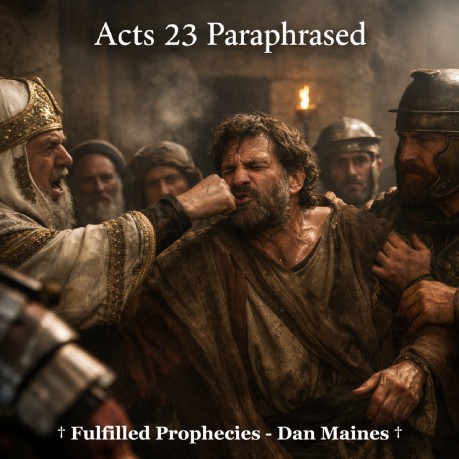
Acts 23 Paraphrased Introduction Acts 23:1 Acts 23:2 Acts 23:3 Acts 23:4 Acts 23:5 Acts 23:6 Acts 23:7 Acts 23:8 Acts 23:9 Acts 23:10 Acts 23:11 Acts 23:12 Acts 23:13 Acts 23:14 Acts 23:15 Acts 23:16 Acts 23:17 Acts 23:18 Acts 23:19 Acts 23:20 Acts 23:21 Acts 23:22 Acts 23:23 Acts 23:24 Acts 23:25 Acts 23:26 Acts 23:27 Acts 23:28 Acts 23:29 Acts 23:30 Acts 23:31 Acts 23:32 Acts 23:33 Acts 23:34 Acts 23:35 Historical References How it applies to us today Q & A Appendix † This is the fulfilled perspective we proclaim at
Fulfilled Prophecies † Source Index
By Dan Maines
† This
chapter shows Paul standing before the Jewish council, exposing their
hypocrisy and division
† It reveals God's
protection over Paul as the message continues moving toward Rome
†
It confirms that what Jesus said would happen in that generation was
unfolding in real time (Matthew 23:34-36)
Paul looked straight at the
council and said, I have lived my life before God with a completely
clear conscience up to this day
† Paul isn't
claiming sinlessness, he's saying he walked faithfully in what he
knew (Acts 24:16)
† His boldness shows
confidence in the truth of Christ, not fear of men (Philippians 1:20)
The high priest Ananias ordered
those standing near Paul to strike him on the mouth
†
This act shows corrupt authority, not righteous judgment (Micah
3:11)
† The leadership that claimed to defend
the law was breaking it openly (Deuteronomy 25:1-2)
Paul said to him, God is going to
strike you, you whitewashed wall, you sit judging me according to the
law, yet you break the law by commanding me to be struck
†
Paul exposes hypocrisy just like Jesus did (Matthew 23:27)
†
Judgment was coming on that leadership within that generation
(Matthew 23:36)
Those standing nearby said, do you
insult God's high priest
† They focused on
authority instead of truth
† This shows how
tradition blinded them from righteousness (Mark 7:8)
Paul said, I didn't know,
brothers, that he was the high priest, for it is written, you shall
not speak evil of a ruler of your people
†
Paul affirms the law even while exposing corruption (Exodus 22:28)
†
His response shows humility, not compromise
Paul realized one group were
Sadducees and the other Pharisees, so he cried out, brothers, I'm a
Pharisee, a son of Pharisees, I'm on trial for the hope and
resurrection of the dead
† Paul divides the
council by exposing their doctrinal conflict
†
The resurrection hope was the core issue of the gospel (Acts 24:15)
When he said this, a dispute broke
out between the Pharisees and Sadducees, and the assembly was
divided
† Truth exposes division where error
exists
† God uses even conflict to protect
His servant
The Sadducees say there is no
resurrection, nor angel, nor spirit, but the Pharisees acknowledge
them all
† This shows internal disagreement
within Judaism
† The denial of resurrection
was a major doctrinal error (2 Timothy 2:18)
A great uproar happened, and some
scribes of the Pharisees stood up and argued strongly, saying we find
nothing wrong with this man, what if a spirit or an angel has spoken
to him
† The Pharisees momentarily defend
Paul due to shared belief
† This again shows
division within the leadership
The dispute became so violent
that the commander feared Paul would be torn apart, so he ordered
soldiers to take him by force and bring him into the barracks
†
God uses Roman authority to preserve Paul
†
Even chaos serves God's purpose
That night the Lord stood near
Paul and said, take courage, as you have testified about Me in
Jerusalem, so you must also testify in Rome
†
Christ confirms the mission isn't finished yet
†
This ties directly to the spread of the gospel to the nations (Acts
1:8)
When it was day, the Jews formed
a conspiracy and bound themselves with an oath, saying they wouldn't
eat or drink until they killed Paul
† This
reveals the depth of hatred against the truth
†
Their zeal was completely misguided (Romans 10:2)
There were more than forty men
who formed this plot
† This wasn't a small
group, it shows organized opposition
† Large
numbers don't equal truth
They went to the chief priests
and elders and said, we've bound ourselves under a curse not to eat
until we've killed Paul
† Religious leaders
were involved in murder plots
† This exposes
the corruption Jesus warned about (Matthew 23:31-32)
Now you and the council request
the commander to bring him down, pretending to examine him more
closely, and we'll be ready to kill him before he arrives
†
Deception and murder were working together
†
This is the same pattern used against Jesus (Matthew 26:4)
But Paul's nephew heard of their
ambush, and he went and entered the barracks and told Paul
†
God provides protection through unexpected means
†
Even family plays a role in God's plan
Paul called one of the centurions
and said, take this young man to the commander, he has something to
report
† Paul acts wisely, not passively
†
Faith includes action when needed
So he took him and brought him to
the commander and said, Paul the prisoner called me and asked me to
bring this young man to you because he has something to tell you
†
God is working through Roman structure again
†
Authority is being used for protection, not harm
The commander took him by the
hand and stepping aside asked privately, what is it that you have to
tell me
† The situation shifts from chaos to
control
† God is directing events quietly
He said, the Jews have agreed to
ask you to bring Paul down to the council tomorrow as though they
were going to inquire more closely
† The plot
is fully exposed
† Darkness is brought into
the light
But don't listen to them, more
than forty men are lying in wait for him, they've bound themselves
with an oath not to eat or drink until they've killed him, and now
they're ready, waiting for your promise
† The
danger is real and immediate
† God's
intervention comes at the right time
So the commander let the young
man go, instructing him, tell no one that you've informed me of these
things
† Wisdom and discretion are used
†
Not everything needs to be publicly declared
He called two centurions and
said, prepare two hundred soldiers, seventy horsemen, and two hundred
spearmen to go to Caesarea at the third hour of the night
†
A massive escort shows how serious this was
†
God ensures overwhelming protection
Provide mounts to put Paul on and
bring him safely to Felix the governor
† Paul
is moved toward his next assignment
† God's
plan is advancing, not stopping
He wrote a letter to this
effect
† Official documentation protects Paul
legally
† God's providence works through
systems
Claudius Lysias, to the most
excellent governor Felix, greetings
† Roman
authority acknowledges the situation
† This
shows the political context of the gospel
This man was seized by the Jews
and was about to be killed by them, but I came with the troops and
rescued him, having learned that he is a Roman
†
Paul's Roman citizenship becomes a tool for protection (Acts
22:25-29)
† God uses earthly status for His
purpose
Wanting to know the reason they
accused him, I brought him down to their council
†
The commander sought truth, not mob justice
†
This contrasts with the Jewish leadership
I found that he was being accused
about questions of their law, but charged with nothing deserving
death or imprisonment
† Even Rome saw no real
crime
† The issue was purely religious
opposition
When I was informed of a plot
against the man, I sent him to you at once, also instructing his
accusers to bring their charges before you
†
The transfer shifts the case to a higher authority
†
God's plan moves Paul toward Rome step by step
So the soldiers, according to
their orders, took Paul and brought him by night to Antipatris
†
The journey continues under protection
†
God's timing avoids the ambush
The next day they let the
horsemen go on with him, while they returned to the barracks
†
The threat decreases as distance increases
†
The mission continues forward
When they came to Caesarea, they
delivered the letter to the governor and presented Paul also before
him
† Paul now stands before Roman
leadership
† This fulfills Christ's words
about testifying before rulers (Luke 21:12-13)
When he read the letter, he asked
what province he was from, and when he learned he was from Cilicia
†
Legal jurisdiction is established
† The
process continues orderly
He said, I'll give you a hearing
after your accusers arrive also, giving orders for him to be kept in
Herod's Praetorium
† Paul is preserved for
testimony, not execution
† God's plan is
still unfolding toward its completion
†
Josephus, Antiquities of the Jews, records corruption among high
priests like Ananias
† Tacitus, Histories,
confirms Roman governance structure during this time
†
Eusebius, Ecclesiastical History, affirms early church persecution
and apostolic testimony
†
God is still in control even when opposition rises
†
Truth will always expose division and hypocrisy
†
We can stand bold knowing Christ is with us
†
God uses unexpected people and systems to protect His purpose
†
The mission continues forward no matter the resistance
Q: Why
did Paul say he was a Pharisee
A: He used truth
to expose division and shift the situation, showing the central issue
was the resurrection (Acts 23:6)
Q: Was Paul
wrong to speak against the high priest
A: No,
he exposed hypocrisy, but he still honored the law when reminded
(Exodus 22:28)
Q: Why did God allow the plot to
happen
A: To reveal it and demonstrate His
protection over Paul (Psalm 34:19)
Q: What does
this chapter show about God's sovereignty
A:
God controls events, people, and outcomes to fulfill His purpose
(Proverbs 21:1)
Q: How does this connect to
fulfillment
A: It shows judgment falling on
corrupt leadership and the gospel moving outward just as Jesus said
(Matthew 23:36)
© Fulfilled Prophecies - Dan
Maines.
† Acts 23
†
Josephus, Antiquities of the Jews
† Tacitus,
Histories
† Eusebius, Ecclesiastical History
Links