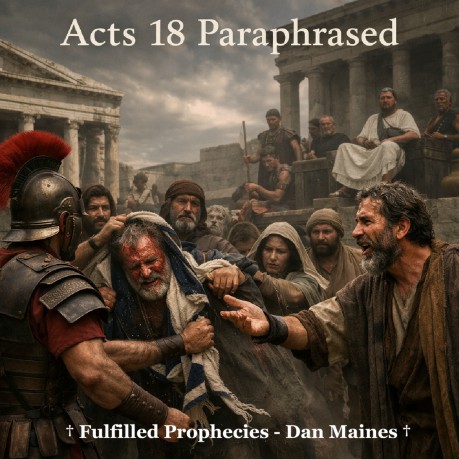
Acts 18
Paraphrased
By Dan Maines
Introduction
†
This chapter shows Paul entering Corinth and continuing the spread of
the gospel among Jews and Gentiles
† It shows
how God provided fellow workers, protection, and open doors in the
middle of opposition
† It also shows that
Christ's message kept moving forward even when many in Israel
resisted it
Acts 18:1
After this, Paul
left Athens and went to Corinth.
† Corinth
was a major city, full of trade, idolatry, and immorality, yet it
became another place where the gospel took root
†
Paul kept moving forward after Athens, showing that rejection or
mixed results never stopped the mission
† The
kingdom was spreading into the nations just as the prophets said it
would (Isaiah 49:6)
Acts 18:2
There he
found a Jew named Aquila, a native of Pontus, who had recently come
from Italy with his wife Priscilla, because Claudius had ordered all
the Jews to leave Rome. Paul went to see them.
†
God used political events and displacement to bring the right people
together for the work
† Aquila and Priscilla
became faithful laborers, and this meeting wasn't accidental, it was
providential
† The Lord often provides
support for His servants through ordinary circumstances that seem
unrelated at first
Acts 18:3
Because he
was in the same trade, he stayed with them and worked, for they were
tentmakers by trade.
† Paul was willing to
work with his hands while preaching the gospel, showing humility and
endurance
† He didn't depend on wealth,
comfort, or status to do the Lord's work
†
This also shows how ministry and ordinary labor can stand side by
side without conflict (1 Thessalonians 2:9)
Acts
18:4
And he was reasoning in the synagogue every
Sabbath and trying to persuade Jews and Greeks.
†
Paul continued going to the synagogue first because the message had
to go to the Jew first, and then to the Greek (Romans 1:16)
†
He reasoned from the Scriptures, showing that faith wasn't blind
emotion but truth grounded in God's word
†
Even at this stage, Greeks were already hearing and responding,
showing the widening reach of the gospel
Acts 18:5
But
when Silas and Timothy came down from Macedonia, Paul began devoting
himself completely to the word, solemnly testifying to the Jews that
Jesus was the Christ.
† Paul's central
message never changed, Jesus was the Christ promised in the Law and
the Prophets
† Once support arrived, he was
able to focus even more fully on preaching and teaching
†
This verse keeps the chapter centered on fulfillment, because the
issue was whether Jesus fulfilled what Israel had been given
Acts
18:6
But when they resisted and blasphemed, he shook
out his garments and said to them, Your blood be on your own heads! I
am clean. From now on I will go to the Gentiles.
†
This was a covenant warning, not a casual statement, because they
were accountable for rejecting the truth set before them (Ezekiel
33:4)
† Shaking out his garments showed
separation from their guilt in rejecting the message
†
The move to the Gentiles wasn't a failure of God's plan, it was part
of its fulfillment from the beginning
Acts 18:7
Then
he left there and went to the house of a man named Titius Justus, a
worshiper of God, whose house was next to the synagogue.
†
The gospel moved right next door, showing that opposition couldn't
block what God intended to do
† God
immediately provided another place for the message to continue
†
Even when one door closed, another was already open
Acts
18:8
Crispus, the leader of the synagogue, believed in
the Lord with all his household, and many of the Corinthians when
they heard were believing and being baptized.
†
Even with synagogue resistance, the leader of the synagogue himself
believed, showing the power of the truth
†
Whole households coming to faith shows the broad effect of the gospel
in daily life
† Belief and baptism continued
marking entrance into the covenant community under Christ
Acts
18:9
And the Lord said to Paul in the night by a
vision, Do not be afraid any longer, but go on speaking and do not be
silent.
† Even Paul needed encouragement,
which shows that bold servants still face real fear
†
Christ's answer to fear was not retreat, but continued speech
†
The command to keep speaking shows how important the proclamation of
the gospel was in that generation
Acts 18:10
for
I am with you, and no man will attack you in order to harm you, for I
have many people in this city.
† The Lord's
presence was Paul's confidence, not his own strength
†
God already had people in Corinth prepared to receive the message
†
This shows divine purpose behind evangelism, because the Lord knew
those who were His before Paul reached them
Acts
18:11
And he settled there a year and six months,
teaching the word of God among them.
† Paul
didn't only evangelize, he stayed to teach and establish believers in
the faith
† A year and a half in Corinth
shows how important grounding the church was
†
Strong churches are built through sustained teaching, not quick
excitement
Acts 18:12
But while Gallio was
proconsul of Achaia, the Jews with one accord rose up against Paul
and brought him before the judgment seat,
†
Opposition followed Paul again, just as Jesus said it would (John
15:20)
† The united resistance against Paul
shows how serious the rejection had become
†
Yet even this hostile move would be used by God to protect the
progress of the gospel
Acts 18:13
saying,
This man persuades men to worship God contrary to the law.
†
Their charge treated fulfillment as if it were rebellion
†
They couldn't see that the law pointed to Christ and found its goal
in Him (Matthew 5:17)
† This same blindness
often happens when tradition is placed above what Scripture actually
says
Acts 18:14
But when Paul was about to
open his mouth, Gallio said to the Jews, If it were a matter of wrong
or of vicious crime, O Jews, it would be reasonable for me to put up
with you;
† Before Paul even answered, God
moved the ruler to cut through the accusation
†
Gallio saw that this wasn't a civil crime but a religious dispute
†
The Lord's promise of protection was already unfolding
Acts
18:15
but if there are questions about words and names
and your own law, look after it yourselves, I am unwilling to be a
judge of these matters.
† Gallio treated the
issue as an internal dispute within Judaism
†
This gave the gospel room to continue spreading under Roman
oversight
† God used secular authority to
shield His servant without Paul needing to defend himself first
Acts
18:16
And he drove them away from the judgment seat.
†
Their public attempt to silence Paul failed
†
The judgment seat that they hoped would condemn him became the place
where their case collapsed
† God often turns
the enemy's plan back on itself
Acts 18:17
And
they all took hold of Sosthenes, the leader of the synagogue, and
began beating him in front of the judgment seat. But Gallio was not
concerned about any of these things.
† This
scene shows the confusion and disorder that erupts when truth is
rejected
† Sosthenes may be the same man
later mentioned with Paul, which would show another remarkable turn
of grace (1 Corinthians 1:1)
† What looked
like chaos on the surface still remained under God's sovereign
hand
Acts 18:18
Paul, having remained many
days longer, took leave of the brethren and put out to sea for Syria,
and with him were Priscilla and Aquila. In Cenchrea he had his hair
cut, for he was keeping a vow.
† Paul didn't
rush away in panic, he remained many days longer after the failed
accusation
† Priscilla and Aquila continued
with him, showing the value of faithful companions in ministry
†
The vow reflects Paul's Jewish background, but not bondage to the old
system, because the gospel message remained centered in Christ
Acts
18:19
They came to Ephesus, and he left them there. Now
he himself entered the synagogue and reasoned with the Jews.
†
Again Paul went first to the synagogue, staying consistent in his
pattern
† Ephesus would become another major
place of teaching and gospel influence
† He
kept reasoning with the Jews because the Scriptures they possessed
testified about Christ
Acts 18:20
When
they asked him to stay for a longer time, he did not consent,
†
Paul didn't let even good opportunities override the direction he
believed he needed to follow
† A servant of
God must be led by purpose, not just by demand
†
This reminds us that saying no can also be part of obedience
Acts
18:21
but taking leave of them and saying, I will
return to you again if God wills, he set sail from Ephesus.
†
Paul submitted his plans to God's will, showing humility and
dependence
† He made plans, but he held them
with open hands
† This is the right pattern
for believers, to live actively but always under the Lord's will
(James 4:15)
Acts 18:22
When he had landed
at Caesarea, he went up and greeted the church, and went down to
Antioch.
† Paul stayed connected to the wider
church, not isolated from other believers
†
Antioch remained an important home base in the spread of the gospel
†
The work across cities and regions was still one united mission under
Christ
Acts 18:23
And having spent some
time there, he left and passed successively through the Galatian
region and Phrygia, strengthening all the disciples.
†
Strengthening disciples is just as necessary as making disciples
†
The church needed ongoing teaching, encouragement, and correction
†
Paul wasn't content with initial belief alone, he wanted believers
firmly established
Acts 18:24
Now a Jew
named Apollos, an Alexandrian by birth, an eloquent man, came to
Ephesus, and he was mighty in the Scriptures.
†
God raised up more than one gifted teacher, showing that the work
didn't depend on Paul alone
† Apollos was
eloquent, but more importantly, he was mighty in the Scriptures
†
Alexandria was known for learning, and now that learning was being
brought into service for Christ
Acts 18:25
This
man had been instructed in the way of the Lord, and being fervent in
spirit, he was speaking and teaching accurately the things concerning
Jesus, being acquainted only with the baptism of John;
†
Apollos had real knowledge and zeal, yet his understanding was still
incomplete
† Sincerity is good, but believers
still need fuller instruction when light increases
†
John's baptism belonged to the preparatory stage, and Apollos needed
to understand what had now been fulfilled in Christ
Acts
18:26
and he began to speak out boldly in the
synagogue. But when Priscilla and Aquila heard him, they took him
aside and explained to him the way of God more accurately.
†
They corrected him privately and carefully, which is a model of
wisdom and humility
† Even a gifted teacher
needed further teaching, and that isn't weakness, it's growth
†
Truth must be sharpened, and faithful believers help one another
become more accurate
Acts 18:27
And when
he wanted to go across to Achaia, the brethren encouraged him and
wrote to the disciples to welcome him, and when he had arrived, he
greatly helped those who had believed through grace,
†
The brethren recognized his usefulness and supported his next step
†
Apollos became a great help to believers, showing the fruit of sound
correction
† Those in Christ had believed
through grace, keeping salvation rooted in God's work, not man's
merit
Acts 18:28
for he powerfully refuted
the Jews in public, demonstrating by the Scriptures that Jesus was
the Christ.
† The Scriptures were the
authority, and Apollos used them to prove that Jesus was the Christ
†
Public refutation mattered because false readings of Scripture had to
be answered openly
† This chapter closes the
same way it has moved all along, with fulfillment in Christ standing
at the center
Historical References
†
Suetonius mentions the expulsion of Jews from Rome under Claudius,
which fits the setting behind Aquila and Priscilla coming from
Italy
† Seneca refers to Gallio, helping
confirm his historical place as proconsul in Achaia
†
Eusebius discusses the growth and spread of the early church in
regions connected to Paul's journeys
†
Clement of Alexandria mentions Apollos among early Christian teachers
known for learning and usefulness
How It Applies To Us
Today
† God still provides the right
people at the right time for His work
†
Opposition doesn't stop the truth, it often opens the next door
†
We need both zeal and accuracy if we're going to handle Scripture
rightly
† Correction should be done with
humility, patience, and love
† The message
must remain centered on the truth that Jesus is the Christ
Q
& A Appendix
Q: Why did Paul go
first to the synagogue so often?
A: Because the
message was to go to the Jew first, and then to the Greek, and
because the Jews had the Scriptures that pointed to Christ (Romans
1:16).
Q: Why did Paul say, Your blood be on
your own heads?
A: He was declaring their
responsibility for rejecting the truth after it had been clearly
preached to them (Ezekiel 33:4).
Q: Why was
Gallio important in this chapter?
A: His
refusal to treat the gospel as a punishable crime gave Paul
protection and allowed the message to keep spreading.
Q:
What do we learn from Apollos?
A: We learn that
a man can be gifted, sincere, and bold, and still need more accurate
teaching.
Q: What is the main point running
through Acts 18?
A: The main point is that
Jesus is the Christ, and God's purpose kept advancing through
preaching, teaching, fellowship, and correction.
†
This is the fulfilled perspective we proclaim at Fulfilled Prophecies
†
© Fulfilled Prophecies - Dan Maines.
Source
Index
† Acts 18
†
Suetonius, Lives of the Caesars
† Seneca,
Epistles
† Eusebius, Ecclesiastical History
†
Clement of Alexandria, Stromata
Links