Acts 14 Paraphrased Introduction Acts 14:1 Acts 14:2 Acts 14:3 Acts 14:4 Acts 14:5 Acts 14:6 Acts 14:7 Acts 14:8 Acts 14:9 Acts 14:10 Acts 14:11 Acts 14:12 Acts 14:13 Acts 14:14 Acts 14:15 Acts 14:16 Acts 14:17 Acts 14:18 Acts 14:19 Acts 14:20 Acts 14:21 Acts 14:22 Acts 14:23 Acts 14:24 Acts 14:25 Acts 14:26 Acts 14:27 Acts 14:28 Historical References How it applies to us today Q & A Appendix † This is the fulfilled perspective we proclaim at
Fulfilled Prophecies † Source Index
By Dan Maines
† Paul and
Barnabas continue spreading the gospel among Jews and Gentiles, and
we see both acceptance and strong opposition.
†
This chapter shows how the message of Christ divided people, some
believed, others hardened themselves.
† It
also reveals that signs and wonders confirmed the word, and that
persecution did not stop the work of God.
At Iconium they entered the
synagogue together and spoke in such a way that a large number of
both Jews and Greeks believed.
† The gospel
was for both Jew and Gentile, showing the covenant was never limited
to one nation (Isaiah 49:6).
† Their bold
teaching brought results because the message carried authority and
truth.
† Faith comes by hearing, and hearing
by the word of Christ (Romans 10:17).
But the Jews who refused to
believe stirred up the minds of the Gentiles and poisoned them
against the brothers.
† Unbelief doesn't stay
quiet, it actively works against truth.
†
This shows spiritual opposition always tries to corrupt and divide.
†
Jesus warned that division would come because of Him (Matthew
10:34-36).
So they remained there a long
time, speaking boldly with reliance upon the Lord, who testified to
the word of His grace by granting signs and wonders through their
hands.
† Signs confirmed the message during
this transition period of the covenant.
† The
focus is still the word of His grace, not the miracles themselves.
†
God bore witness to the truth being preached (Hebrews 2:3-4).
But the people of the city were
divided, some sided with the Jews, and others with the apostles.
†
The gospel always divides truth from error.
†
There's no neutral ground when it comes to Christ.
†
This fulfills the pattern seen throughout Scripture, people either
receive or reject.
And when an attempt was made by
both the Gentiles and the Jews with their rulers to mistreat and
stone them,
† Opposition escalates when truth
threatens established systems.
† Both
religious and political forces often unite against God's
messengers.
† This mirrors what happened to
Christ Himself (John 15:20).
they became aware of it and fled
to the cities of Lycaonia, Lystra and Derbe, and the surrounding
region,
† Wisdom isn't cowardice, they moved
to continue the mission.
† The gospel doesn't
stop, it spreads further.
† Persecution often
results in expansion of truth.
and there they continued to preach
the gospel.
† Their mission remained
unchanged regardless of opposition.
† The
gospel is the central message, not location or circumstance.
†
Faithfulness is seen in consistency.
At Lystra a man was sitting who
had no strength in his feet, lame from his mother's womb, who had
never walked.
† This highlights a lifelong
condition, making the miracle undeniable.
†
It mirrors the power seen earlier in Acts (Acts 3:2).
†
Physical healing points to spiritual restoration.
This man was listening to Paul as
he spoke, who, when he had fixed his gaze on him and saw that he had
faith to be made well,
† Faith was present
before the miracle.
† The gospel produces
faith even before visible change.
† God
responds to genuine belief.
said with a loud voice, stand
upright on your feet. And he jumped up and began to walk.
†
Immediate and complete healing shows divine power.
†
This confirms the authority of the message.
†
It reflects the same power Christ displayed.
When the crowds saw what Paul had
done, they raised their voice, saying in the Lycaonian language, the
gods have become like men and have come down to us.
†
The people misunderstood the miracle through their pagan lens.
†
Man naturally turns truth into idolatry without proper
understanding.
† This shows the danger of
signs without sound doctrine.
And they began calling Barnabas
Zeus, and Paul Hermes, because he was the chief speaker.
†
They assigned false identities based on their beliefs.
†
This reveals how culture shapes interpretation.
†
Truth must correct false worship.
The priest of Zeus, whose temple
was just outside the city, brought oxen and garlands to the gates,
intending to offer sacrifice with the crowds.
†
False religion responds with ritual instead of repentance.
†
The people were ready to worship men instead of God.
†
This shows how easily truth can be twisted.
But when the apostles Barnabas
and Paul heard of it, they tore their robes and rushed out into the
crowd, crying out
† They rejected worship
immediately.
† True servants of God refuse
glory for themselves.
† This is the opposite
of false teachers who seek honor.
and saying, men, why are you
doing these things? We are also men of the same nature as you, and
preach the gospel to you that you should turn from these worthless
things to a living God, who made the heaven and the earth and the sea
and everything that is in them.
† They
redirected attention to the Creator.
† The
call is always repentance from idols to the living God.
†
This aligns with the message of turning from dead works (Hebrews
6:1).
In the generations gone by He
permitted all the nations to go their own ways,
†
God allowed the nations to walk in ignorance for a time.
†
This doesn't mean approval, but patience.
†
It sets the stage for the gospel going to all nations.
and yet He did not leave Himself
without witness, in that He did good and gave you rains from heaven
and fruitful seasons, satisfying your hearts with food and
gladness.
† Creation itself testifies of
God.
† Even those without the law had
evidence of His goodness.
† This reflects
Romans 1:19-20.
Even saying these things, with
difficulty they restrained the crowds from offering sacrifice to
them.
† False worship is deeply rooted in
human nature.
† It takes effort to redirect
people to truth.
† Teaching must accompany
signs.
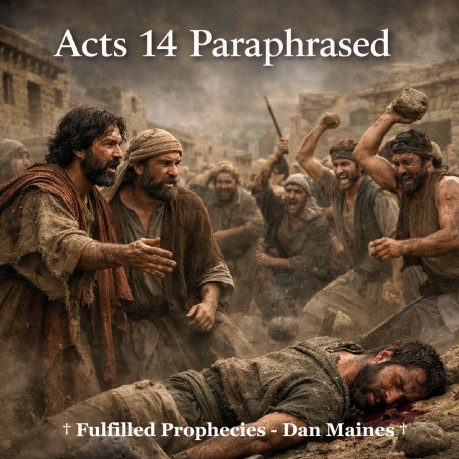
But Jews came from Antioch and
Iconium, and having won over the crowds, they stoned Paul and dragged
him out of the city, supposing him to be dead.
†
The same crowd that wanted to worship now turns against him.
†
Public opinion is unstable when not grounded in truth.
†
Persecution follows faithful preaching.
But while the disciples stood
around him, he got up and entered the city. The next day he went away
with Barnabas to Derbe.
† God's purpose
preserved Paul.
† He didn't quit, he
continued the mission.
† This shows endurance
in suffering.
After they had preached the
gospel to that city and had made many disciples, they returned to
Lystra and to Iconium and to Antioch,
† They
returned to strengthen believers, not just make converts.
†
Discipleship requires ongoing teaching.
† The
mission includes building up the church.
strengthening the souls of the
disciples, encouraging them to continue in the faith, and saying,
through many tribulations we must enter the kingdom of God.
†
The kingdom wasn't future, they were entering it then.
†
Tribulation was part of that transition period.
†
This aligns with Acts 1:3 and Colossians 1:13.
When they had appointed elders
for them in every church, having prayed with fasting, they entrusted
them to the Lord in whom they had believed.
†
Structure and leadership were established early.
†
Elders were appointed in every church.
† This
shows order in the body of Christ.
They passed through Pisidia and
came into Pamphylia.
† The mission continued
across regions.
† The gospel spread
geographically.
† This fulfills the expansion
pattern of Acts.
When they had spoken the word in
Perga, they went down to Attalia.
† The word
remained central in every place.
† Preaching
was always the priority.
† The message never
changed.
From there they sailed to
Antioch, from which they had been commended to the grace of God for
the work that they had accomplished.
† Their
mission had a defined purpose and completion.
†
God's grace was the foundation of their work.
†
This shows accountability and sending.
When they had arrived and
gathered the church together, they began to report all things that
God had done with them and how He had opened a door of faith to the
Gentiles.
† The focus is on what God had
done.
† The door of faith was opened to the
nations.
† This confirms the inclusion of the
Gentiles.
And they spent a long time with
the disciples.
† Fellowship and teaching
continued.
† Growth happens over time, not
instantly.
† The work didn't stop after the
journey.
†
Josephus, Antiquities of the Jews, describes the tensions between
Jews and Gentiles during this period.
†
Irenaeus, Against Heresies, confirms the early spread of the gospel
through apostolic preaching.
† Eusebius,
Ecclesiastical History, records the endurance of early believers
under persecution.
† Clement of Alexandria,
Stromata, speaks of turning from idols to the true God.
†
The gospel still divides truth from error, and we must stand firm in
it.
† We shouldn't seek glory for ourselves,
but point everything back to God.
†
Faithfulness means continuing even when there's opposition.
†
Discipleship matters, not just belief but growth and strengthening.
†
God has already opened the door of faith, and we walk in what's been
fulfilled.
Q: Why
did people react so differently to the same message?
A:
Because belief and unbelief come from the heart, John 3:19.
Q:
Were miracles the main focus?
A: No, they
confirmed the word, Hebrews 2:3-4.
Q: Why did
Paul refuse worship?
A: Because only God is
worthy, Revelation 22:8-9.
Q: What does
entering the kingdom through tribulation mean?
A:
It referred to that generation transitioning into the kingdom, Acts
1:3.
Q: Did the gospel include Gentiles from
the beginning?
A: Yes, God always intended it,
Isaiah 49:6.
© Fulfilled Prophecies - Dan
Maines.
† Acts 14
†
Josephus, Antiquities of the Jews
† Irenaeus,
Against Heresies
† Eusebius, Ecclesiastical
History
† Clement of Alexandria, Stromata
Links