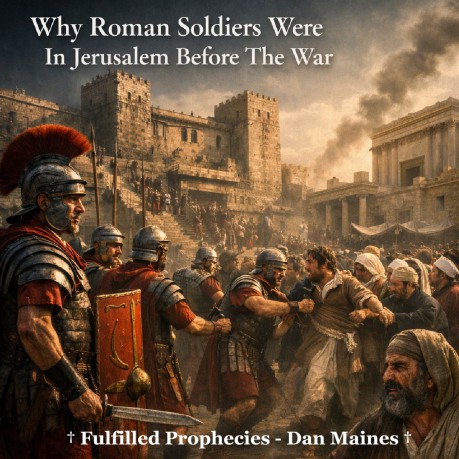
Why Roman Soldiers Were In
Jerusalem Before The War Introduction Luke 3:1 John 19:16 Matthew 27:27 Acts 21:31-32 Acts 21:34-35 Luke 13:1 Why Roman Soldiers Were Especially Visible During Passover † Passover brought enormous crowds to
Jerusalem. Jewish pilgrims traveled from across the Roman world to
celebrate the feast in the Temple. † Because Passover celebrated Israel's
deliverance from foreign oppression in Egypt, it carried strong
national emotion. † For this reason Roman troops increased their
visibility during Passover and other major feasts. † Roman troops were stationed at the Antonia
Fortress, a fortress built beside the Temple complex. † Josephus explains that the fortress
overlooked the Temple so Roman soldiers could monitor everything
happening in the courts during major gatherings. Roman Control Before The War † Rome first took control of Jerusalem in 63 BC
when the Roman general Pompey entered the city and brought Judea
under Roman authority. † In AD 6 Judea became a Roman province
governed directly by Roman prefects rather than local kings. † Roman prefects ruled from Caesarea but
maintained troops in Jerusalem because of the city's religious and
political importance. Historical References † Josephus records that Pompey captured
Jerusalem in 63 BC and placed Judea under Roman authority. How it applies to us today † Understanding the Roman presence in Jerusalem
helps us see the New Testament in its real historical setting. Q & A Appendix Q: When did Rome first take control of
Jerusalem? Q: Were Roman soldiers present in Jerusalem
during the life of Jesus? Q: Why were Roman soldiers especially visible
during Passover? Q: Where were Roman soldiers stationed in
Jerusalem? Q: Does the New Testament mention Roman soldiers
in Jerusalem before AD 66? † This is the fulfilled perspective we proclaim at
Fulfilled Prophecies † Source Index
By Dan Maines
† Many
people imagine Roman soldiers only appearing in Jerusalem after the
Jewish War began in AD 66. That idea isn't supported by either
scripture or history.
† Roman authority had
already ruled Judea for over one hundred years before that war began.
Because of that control, Roman soldiers were stationed in Jerusalem
long before the destruction of the city.
†
Understanding this historical setting helps us read the New Testament
correctly, because the gospels and Acts repeatedly mention Roman
officials and soldiers in Jerusalem decades before AD 66.
Now in the fifteenth year of the
reign of Tiberius Caesar, when Pontius Pilate was governor of Judea,
and Herod was tetrarch of Galilee, and his brother Philip tetrarch of
the region of Ituraea and Trachonitis, and Lysanias was tetrarch of
Abilene
† This verse places the ministry of
John the Baptist within the structure of Roman political authority.
Judea was already governed by a Roman prefect named Pontius Pilate.
†
Roman governors ruled the region on behalf of the emperor, and they
maintained order through Roman military forces stationed in the
province.
† Tacitus confirms that Judea was
governed by Roman officials during this period and that Roman
authority controlled the region.
So he then handed Him over to
them to be crucified.
† Jesus was executed
through the Roman method of crucifixion, which was a punishment
carried out by Roman soldiers.
† This shows
clearly that Roman military authority operated in Jerusalem during
the ministry of Jesus decades before the Jewish War.
†
Josephus explains that crucifixion was commonly used by Roman
authorities to punish rebellion and maintain control in conquered
territories.
Then the soldiers of the
governor took Jesus into the Praetorium and gathered the whole Roman
cohort around Him.
† A Roman cohort refers to
a unit of Roman soldiers stationed under the authority of the
governor.
† Their presence inside the
governor's headquarters in Jerusalem demonstrates that Roman troops
were permanently stationed in the city.
†
Roman governors required a military presence to enforce Roman law and
prevent uprisings among the population.
While they were seeking to
kill him, a report came up to the commander of the Roman cohort that
all Jerusalem was in confusion. At once he took along some soldiers
and centurions and ran down to them, and when they saw the commander
and the soldiers, they stopped beating Paul.
†
This passage describes Roman troops quickly responding to unrest in
Jerusalem.
† The soldiers came from the
fortress overlooking the Temple, showing that a Roman garrison was
stationed there at all times.
† This event
occurred around AD 57 to 58, almost a decade before the Jewish War
began.
But some in the crowd were
shouting one thing and some another, and when he could not find out
the facts because of the uproar, he ordered him to be brought into
the barracks. When he got to the stairs, he was carried by the
soldiers because of the violence of the mob.
†
The barracks mentioned here refer to the Roman garrison connected to
the Antonia Fortress beside the Temple.
†
Roman soldiers were stationed there so they could immediately
intervene if riots broke out in the Temple courts.
†
This confirms that a permanent Roman military presence existed
directly beside the Temple complex.
Now on that same occasion there
were some present who reported to Him about the Galileans whose blood
Pilate had mixed with their sacrifices.
†
This shows Roman authority intervening during Temple related activity
before the Jewish War.
† Pilate had already
carried out violent suppression connected to religious gatherings.
†
This demonstrates that Roman power was actively present in Jerusalem
during the time of Jesus.
† Josephus
records that the population of Jerusalem swelled dramatically during
these festivals as pilgrims arrived from many regions.
† Roman authorities feared
that this patriotic atmosphere could easily lead to rebellion against
Roman rule.
†
Soldiers watched the Temple area and the crowds closely in order to
prevent riots or revolts.
†
From this location soldiers could quickly enter the Temple courts if
trouble began among the crowds.
† Josephus records
that this event placed Judea under Roman dominance for the following
century.
†
This is why Roman governors such as Pontius Pilate appear in the
gospel accounts.
†
Josephus also explains that the Antonia Fortress overlooked the
Temple so Roman soldiers could monitor the crowds during festivals.
†
Tacitus confirms that Roman governors ruled Judea during the first
century and that Roman power controlled the province.
†
Eusebius explains that the early church grew within the Roman world
and that Roman rule formed the political background of the New
Testament era.
†
Jesus and the apostles preached the kingdom of God while living under
the authority of the Roman Empire.
† Even
though Rome was the most powerful empire of the time, the message of
Christ spread throughout its territory.
†
This reminds us that God's kingdom advances regardless of earthly
governments or political power.
A: Rome captured Jerusalem in 63 BC
when the Roman general Pompey entered the city and brought Judea
under Roman authority.
A: Yes. Roman
soldiers served under the governor Pontius Pilate and carried out the
crucifixion of Jesus.
A: Because Passover brought
massive crowds to Jerusalem and Roman authorities feared that the
festival could spark rebellion.
A: Roman troops were stationed at
the Antonia Fortress beside the Temple so they could quickly respond
to unrest.
A: Yes. Acts records
Roman soldiers intervening during riots and disturbances in the city
years before the Jewish War began.
© Fulfilled Prophecies - Dan
Maines.
† Luke 3
†
John 19
† Matthew 27
†
Acts 21
† Luke 13
†
Josephus, Antiquities of the Jews
† Josephus,
Wars of the Jews
† Tacitus, Annals
†
Eusebius, Ecclesiastical History
Links