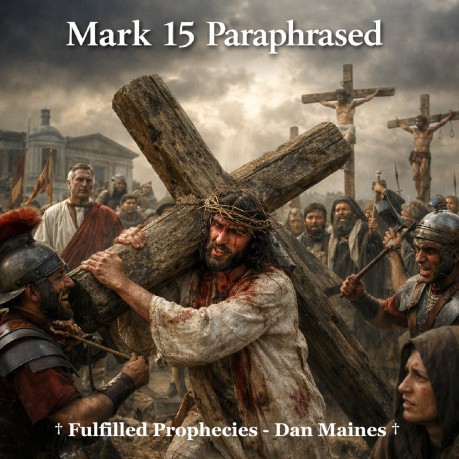
Mark 15 Paraphrased Introduction Mark 15:1 Mark 15:2 Mark 15:3 Mark 15:4 Mark 15:5 Mark 15:6 Mark 15:7 Mark 15:8 Mark 15:9 Mark 15:10 Mark 15:11 Mark 15:12 Mark 15:13 Mark 15:14 Mark 15:15 Mark 15:16 Mark 15:17 Mark 15:18 Mark 15:19 Mark 15:20 Mark 15:21 Mark 15:22 Mark 15:23 Mark 15:24 Mark 15:25 Mark 15:26 Mark 15:27 Mark 15:29 Mark 15:30 Mark 15:31 Mark 15:32 Mark 15:33 Mark 15:34 Mark 15:35 Mark 15:36 Mark 15:37 Mark 15:38 Mark 15:39 Mark 15:40 Mark 15:41 Mark 15:42 Mark 15:43 Mark 15:44 Mark 15:45 Mark 15:46 Mark 15:47 Historical References How It Applies To Us Today Q & A Appendix Q: Why did Pilate allow Jesus to be crucified if
he knew He was innocent? Q: Why was Barabbas released instead of Jesus? Q: Why did darkness fall during the
crucifixion? Q: What did the tearing of the temple veil
mean? Q: Why is the centurion's confession
important? † This is the fulfilled perspective we proclaim at
Fulfilled Prophecies † Source Index
By Dan Maines
† Mark 15
records the final trial, crucifixion, death, and burial of Jesus.
†
This chapter shows the Roman judgment, the mocking by soldiers, and
the execution that fulfilled the prophets.
†
The events here happened in real history under Roman authority, and
they set the stage for the resurrection that would follow.
Early in the morning the chief
priests, elders, scribes, and the whole council reached their
decision. They tied Jesus up, led Him away, and handed Him over to
Pilate.
† The religious leaders didn't have
authority to execute anyone under Roman rule, so they brought Jesus
to the Roman governor (John 18:31).
† Their
goal wasn't justice, it was to have Rome carry out the execution they
already decided on.
† Josephus describes how
Jewish leaders often brought capital cases before Roman governors
during this period.
Pilate asked Him, Are you the King
of the Jews? Jesus answered, It is as you say.
†
Pilate focused on political claims, because Rome only cared about
threats to Caesar.
† Jesus acknowledged the
title but didn't present Himself as a political rebel (John 18:36).
†
Roman historians like Tacitus confirm that Pilate governed Judea and
handled cases involving accusations of sedition.
The chief priests kept bringing
many accusations against Him.
† The leaders
tried to overwhelm the governor with charges hoping something would
stick.
† Luke records that they accused Him
of misleading the nation and opposing taxes to Caesar (Luke 23:2).
†
This shows how the charges were political, not theological.
Pilate questioned Him again,
saying, Aren't you going to answer? Look at how many things they are
accusing you of.
† Pilate was surprised by
Jesus' silence because defendants normally argued their case.
†
This silence fulfilled the prophecy of the suffering servant who
remained quiet before His accusers (Isaiah 53:7).
†
Roman legal practice expected self defense, which Jesus intentionally
refused.
But Jesus said nothing more, and
Pilate was amazed.
† Pilate recognized that
Jesus wasn't acting like a criminal.
† The
governor could see the charges were driven by jealousy (Matthew
27:18).
† Early Christian writers often
pointed to this moment as proof of Jesus' innocence.
Now at the feast the governor had
a custom of releasing one prisoner whom the people requested.
†
This practice was meant to keep peace during the crowded Passover
season.
† Roman authorities sometimes used
public gestures like this to prevent unrest.
†
Jerusalem would have been filled with pilgrims, making tension high.
A man named Barabbas was in prison
with rebels who had committed murder during an uprising.
†
Barabbas was likely involved in a violent revolt against Rome.
†
Ironically the real insurrectionist would be released while the
innocent one was condemned.
† Josephus
describes many such uprisings during this turbulent time.
The crowd came up and began asking
Pilate to do for them what he usually did.
†
The crowd expected the yearly release tradition.
†
The chief priests would soon influence their choice.
†
Public pressure often shaped Roman decisions in volatile regions.
Pilate answered them, saying, Do
you want me to release the King of the Jews for you?
†
Pilate attempted to free Jesus through the custom.
†
He likely thought the crowd would prefer Jesus over a violent
rebel.
† This was his attempt to avoid
executing a man he believed innocent.
He knew the chief priests had
handed Him over out of jealousy.
† Pilate saw
through their motives.
† Religious envy had
turned into a political accusation.
† Roman
officials often distrusted local religious leaders.
But the chief priests stirred up
the crowd so they would ask for Barabbas instead.
†
The leaders actively manipulated the crowd.
†
Public opinion shifted quickly under their influence.
†
This moment shows how mob pressure shaped the outcome.
Pilate responded again and said
to them, Then what do you want me to do with the one you call the
King of the Jews?
† Pilate placed the
decision back on the crowd.
† This shows his
hesitation to execute Jesus.
† Roman
governors often balanced justice with maintaining order.
They shouted again, Crucify
Him.
† The crowd demanded the Roman method of
execution.
† Crucifixion was reserved for
rebels and slaves.
† It was designed to be
both painful and humiliating.
Pilate said to them, Why? What
evil has He done? But they shouted even louder, Crucify Him.
†
Pilate openly admitted no crime had been proven.
†
The mob responded with louder demands instead of evidence.
†
This shows how political pressure overrode justice.
Wanting to satisfy the crowd,
Pilate released Barabbas to them. After having Jesus flogged, he
handed Him over to be crucified.
† Roman
flogging was brutal and often fatal on its own.
†
Pilate chose political peace over justice.
†
Tacitus later confirmed that Jesus was executed under Pontius Pilate.
The soldiers took Him inside the
palace courtyard and called together the whole battalion.
†
A Roman battalion could include hundreds of soldiers.
†
They gathered to mock the condemned prisoner.
†
Roman soldiers often ridiculed those they executed.
They dressed Him in purple and
twisted together a crown of thorns and put it on Him.
†
Purple symbolized royalty.
† The crown of
thorns mocked the idea that He was a king.
†
Their mockery unintentionally declared the truth about who He was.
They began greeting Him, Hail,
King of the Jews.
† The soldiers turned the
charge against Him into a cruel joke.
† Their
sarcasm echoed Roman loyalty chants to Caesar.
†
This fulfilled the suffering described in prophetic passages (Isaiah
50:6).
They kept striking His head with
a reed, spitting on Him, and kneeling down pretending to honor Him.
†
The abuse was both physical and humiliating.
†
Spitting was a sign of deep contempt in ancient culture.
†
The mock kneeling showed their complete disrespect.
After mocking Him, they took the
purple robe off Him, put His own clothes back on Him, and led Him out
to crucify Him.
† The crucifixion site would
be outside the city walls.
† Roman executions
were public warnings to others.
† The
condemned were often forced to carry the crossbeam.
They forced a man named Simon
from Cyrene, who was coming in from the countryside, the father of
Alexander and Rufus, to carry His cross.
†
Simon was likely a pilgrim visiting Jerusalem.
†
His sons later became known in the early church (Romans 16:13).
†
Roman soldiers could legally compel civilians to carry burdens.
They brought Him to the place
called Golgotha, which means Place of the Skull.
†
Golgotha was likely a hill outside Jerusalem.
†
The name may refer to its shape or to executions performed there.
†
Archaeological studies confirm crucifixions occurred outside city
walls.
They tried to give Him wine mixed
with myrrh, but He didn't take it.
† This
mixture acted as a mild pain duller.
† Jesus
refused it, choosing to face the suffering fully.
†
This fulfilled the pattern of voluntary sacrifice.
They crucified Him and divided
His clothes among themselves, casting lots to decide what each would
take.
† Roman soldiers kept the belongings of
the condemned.
† This fulfilled Psalm
22:18.
† Crucifixion involved nails or ropes
securing the victim to the cross.
It was the third hour when they
crucified Him.
† This places the crucifixion
around mid morning.
† Mark gives the timeline
of the execution process.
† Public executions
lasted for hours.
The inscription stating the
charge against Him read: The King of the Jews.
†
Roman practice included a written accusation above the victim.
†
This title unintentionally proclaimed the truth.
†
Pilate refused to change the wording despite objections (John
19:21-22).
They crucified two rebels with
Him, one on His right and one on His left.
†
This placed Jesus among criminals.
† The
scene fulfilled prophecy about being counted with transgressors
(Isaiah 53:12).
† Roman executions often
grouped criminals together.
Those passing by insulted Him,
shaking their heads and saying, You who would destroy the temple and
rebuild it in three days, save Yourself.
†
They misunderstood Jesus' earlier statement about the temple (John
2:19).
† The mocking crowds echoed
accusations from His trial.
† Public ridicule
was common during crucifixions.
Come down from the cross and save
Yourself.
† The crowd challenged His
authority and power.
† Ironically His refusal
to come down was exactly how salvation would come.
†
The temptation echoed earlier tests in the wilderness.
In the same way the chief priests
with the scribes mocked Him, saying among themselves, He saved
others, but He can't save Himself.
† The
leaders continued their mockery even at the cross.
†
Their words unintentionally confirmed His miracles.
†
Their blindness prevented them from seeing the purpose of the cross.
Let the Christ, the King of
Israel, come down now from the cross so we may see and believe. Those
who were crucified with Him were also insulting Him.
†
The demand for signs continued even at His death.
†
Faith based only on spectacle isn't true belief.
†
The criminals joined the mockery at first.
When the sixth hour came,
darkness fell over the whole land until the ninth hour.
†
The darkness symbolized divine judgment.
†
Ancient writers recorded unusual darkness around this time.
†
It marked the turning point of the crucifixion.
At the ninth hour Jesus cried out
with a loud voice, Eloi, Eloi, lama sabachthani, which means My God,
My God, why have You forsaken Me.
† Jesus
quoted Psalm 22.
† This connected His
suffering directly to prophetic scripture.
†
The cry expressed the weight of the moment.
Some of those standing nearby
heard it and said, Look, He's calling for Elijah.
†
The crowd misunderstood His words.
† Jewish
tradition expected Elijah to appear in times of crisis.
†
Their confusion added to the chaos of the scene.
Someone ran and filled a sponge
with sour wine, put it on a reed, and gave it to Him to drink,
saying, Let's see whether Elijah will come to take Him down.
†
Sour wine was a common drink for soldiers.
†
This act may have been curiosity rather than compassion.
†
The crowd still treated the moment like a spectacle.
Jesus let out a loud cry and
breathed His last.
† Jesus died willingly
after enduring the crucifixion.
† The loud
cry showed He still had strength at the moment of death.
†
His death completed the sacrifice.
The veil of the temple was torn
in two from top to bottom.
† The temple
curtain separated the Holy of Holies.
† The
tearing symbolized the end of the old covenant system.
†
God Himself tore it from top to bottom.
When the centurion standing there
saw how He died, he said, Truly this man was the Son of God.
†
A Roman officer recognized what many in Israel refused to see.
†
His confession stands as a powerful witness.
†
Roman soldiers were trained observers of death.
Some women were watching from a
distance, including Mary Magdalene, Mary the mother of James the
younger and Joses, and Salome.
† The women
remained when many disciples fled.
† They
would later become witnesses to the resurrection.
†
Their presence adds historical credibility to the account.
When He was in Galilee they used
to follow Him and serve Him, and many other women had come up with
Him to Jerusalem.
† These women supported
Jesus' ministry.
† Their loyalty continued
even at the crucifixion.
† Early Christian
communities remembered these witnesses.
When evening had already come,
because it was the preparation day, that is, the day before the
Sabbath,
† Jewish law required burial before
the Sabbath began.
† The timeline confirms
the approaching Sabbath sunset.
† Burial had
to happen quickly.
Joseph from Arimathea, a
respected member of the council who was also waiting for the kingdom
of God, courageously went to Pilate and asked for Jesus' body.
†
Joseph risked his reputation by publicly identifying with Jesus.
†
Not all council members supported the execution.
†
Roman permission was required to release a crucified body.
Pilate was surprised that He was
already dead, so he summoned the centurion and asked him if He had
been dead for some time.
† Crucifixion
victims sometimes lived for days.
† Pilate
verified the death before releasing the body.
†
The centurion confirmed it.
When he learned from the
centurion that He was dead, he granted the body to Joseph.
†
Roman law allowed relatives or supporters to bury the dead with
permission.
† This ensured Jesus received
proper burial.
† The confirmation also proves
the death was real.
Joseph bought a linen cloth, took
Him down, wrapped Him in the linen, and laid Him in a tomb cut out of
rock, then rolled a stone against the entrance.
†
Rock cut tombs were common for wealthy families.
†
The burial fulfilled prophecy about being with a rich man in death
(Isaiah 53:9).
† The stone sealed the
entrance.
Mary Magdalene and Mary the
mother of Joses saw where He was laid.
†
These women carefully observed the burial location.
†
Their testimony later confirmed the empty tomb.
†
Their witness became part of the earliest resurrection reports.
†
Tacitus, Annals 15.44 confirms Jesus was executed under Pontius
Pilate.
† Josephus, Antiquities of the Jews
mentions Jesus and the early Christian movement.
†
Eusebius recorded early Christian traditions about the crucifixion
events.
† Irenaeus affirmed the gospel
accounts in Against Heresies.
†
The cross shows the cost of redemption and the seriousness of sin.
†
Jesus' obedience demonstrates complete trust in God's plan.
†
The tearing of the veil shows the old covenant system had reached its
end.
† The historical witnesses remind us
that our faith is rooted in real events.
A: Pilate feared
unrest and chose to satisfy the crowd rather than enforce justice
(Matthew 27:24).
A:
The chief priests persuaded the crowd to demand Barabbas (Mark
15:11).
A: The darkness symbolized divine
judgment and the gravity of the moment (Amos 8:9).
A: It showed the old covenant temple
system had reached its end (Hebrews 9:8).
A: A Roman officer publicly
recognized Jesus' identity, confirming the impact of the event (Mark
15:39).
© Fulfilled Prophecies - Dan
Maines.
† Mark 15
†
Tacitus, Annals
† Josephus, Antiquities of
the Jews
† Irenaeus, Against Heresies
†
Eusebius, Ecclesiastical History
Links