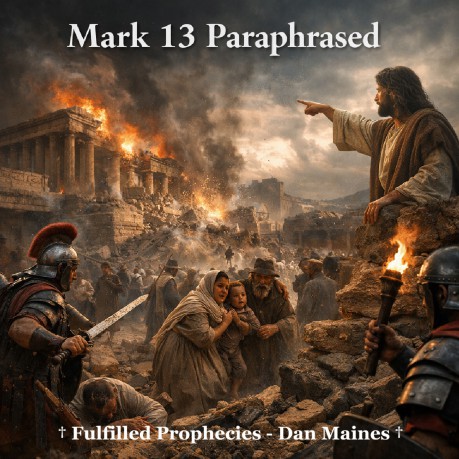
Mark 13 Paraphrased Introduction Mark 13:1 Mark 13:2 Mark 13:3 Mark 13:4 Mark 13:5 Mark 13:6 Mark 13:7 Mark 13:8 Mark 13:9 Mark 13:10 Mark 13:11 Mark 13:12 Mark 13:13 Mark 13:14 Mark 13:15 Mark 13:16 Mark 13:17 Mark 13:18 Mark 13:19 Mark 13:20 Mark 13:21 Mark 13:22 Mark 13:23 Mark 13:24 Mark 13:25 Mark 13:26 Mark 13:27 Mark 13:28 Mark 13:29 Mark 13:30 Mark 13:31 Mark 13:32 Mark 13:33 Mark 13:34 Mark 13:35 Mark 13:36 Mark 13:37 Historical References How it applies to us today Q & A Appendix Q What event fulfilled Jesus' prophecy about the
temple? Q What did Jesus mean by this generation? Q What was the abomination that causes
desolation? Q Why were believers told to flee the city? Q How do we know the gospel spread widely before
AD 70? † This is the fulfilled perspective we proclaim at
Fulfilled Prophecies † Source Index
By Dan Maines
† Mark 13
records Jesus explaining the coming destruction of the temple and the
judgment that would fall on that generation of Israel.
†
The disciples admired the massive stones of the temple, but Jesus
warned them that the entire structure would soon be torn down.
†
This chapter shows the events leading up to the destruction of
Jerusalem in AD 70, exactly as Jesus said would happen.
As Jesus was leaving the temple,
one of His disciples said to Him, Teacher, look at these enormous
stones and these impressive buildings.
† The
temple complex built by Herod was one of the most magnificent
structures in the ancient world.
† The
disciples were amazed by its size and beauty, not realizing it was
about to be destroyed (Luke 21:5-6).
†
Josephus wrote that some of the stones were massive and incredibly
impressive, showing why the disciples admired them.
Jesus answered him and said, Do
you see these great buildings? Not one stone will be left on another
that will not be torn down.
† Jesus foretold
the total destruction of the temple.
† This
prophecy was fulfilled when the Roman armies destroyed Jerusalem in
AD 70.
† Josephus records that the temple was
burned and dismantled until nothing remained standing.
As He sat on the Mount of Olives
across from the temple, Peter, James, John, and Andrew privately
asked Him about these things.
† The Mount of
Olives gave a clear view of the temple, making the prophecy even more
striking.
† These four disciples wanted to
understand when the destruction Jesus predicted would occur.
†
Matthew records the same discussion in Matthew 24 where they asked
about the sign of His coming and the end of the age.
They said, Tell us, when will
these things happen, and what will be the sign when all these things
are about to take place?
† The disciples were
asking about the timing of the temple's destruction.
†
Jesus answered by describing events that would happen before
Jerusalem fell.
† This question begins the
prophetic explanation that fills the rest of the chapter.
Jesus began to say to them, Watch
out that no one deceives you.
† Deception
would increase before the destruction of Jerusalem.
†
Many false teachers and false messiahs appeared in the years leading
up to AD 70.
† Josephus records several
impostors who led people astray during this time.
Many will come in My name saying,
I am he, and they will deceive many people.
†
Numerous individuals claimed to be deliverers or prophets.
†
These movements created unrest and confusion among the people.
†
Josephus wrote about false prophets promising deliverance during the
Roman siege.
When you hear about wars and
reports of wars, don't be alarmed, these things must happen, but the
end is not yet.
† The region experienced
political turmoil during the first century.
†
Jesus warned that these events alone would not immediately mean the
end of Jerusalem.
† Historical records show
repeated conflicts within the Roman Empire during this time.
Nation will rise against nation,
and kingdom against kingdom, there will be earthquakes in various
places, and there will be famines, these things are the beginning of
birth pains.
† These signs describe
increasing trouble leading up to the final judgment on Jerusalem.
†
Acts records famines during this period (Acts 11:28).
†
Earthquakes are also documented in historical records during the
first century.
But watch yourselves, they will
hand you over to councils, you will be beaten in synagogues, and you
will stand before governors and kings because of Me as a testimony to
them.
† The early Christians faced
persecution from both Jewish authorities and Roman officials.
†
The book of Acts shows believers brought before councils and
rulers.
† These trials gave believers
opportunities to testify about Christ.
The gospel must first be preached
to all the nations.
† The message of Christ
spread rapidly throughout the Roman world.
†
Paul declared the gospel had already gone out into all the world of
that time (Colossians 1:23).
† This fulfilled
Jesus' statement before Jerusalem fell.
When they arrest you and hand you
over, don't worry beforehand about what you will say, but say
whatever is given to you at that time, because it will not be you
speaking but the Holy Spirit.
† God would
guide believers during persecution.
† The
book of Acts records many moments where believers spoke boldly when
questioned by authorities.
† This promise
gave courage to early Christians facing trials.
Brother will betray brother to
death, and a father his child, children will rise against parents and
have them put to death.
† The coming turmoil
would divide families.
† Loyalty to Christ
would cause conflict among relatives.
†
Historical accounts describe intense divisions within Jewish society
during the revolt.
You will be hated by everyone
because of My name, but the one who endures to the end will be
saved.
† Faithful endurance was necessary
during this time of persecution.
† The end
refers to the end of the old covenant age and the destruction of
Jerusalem.
† Those who remained faithful
would escape the coming judgment.
When you see the abomination that
causes desolation standing where it should not be, let the reader
understand, then those who are in Judea must flee to the mountains.
†
This refers to the Roman armies surrounding Jerusalem.
†
Luke explains the same sign clearly, Jerusalem surrounded by armies
(Luke 21:20).
† Early Christians fled the
city before the destruction according to early church history.
The person on the housetop must
not go down or enter the house to take anything out.
†
The warning stresses urgency.
† When the sign
appeared, believers were to leave immediately.
†
Delay could mean being trapped in the siege.
The person in the field must not
return to get his cloak.
† Jesus emphasized
how quickly they must flee.
† The coming
destruction would arrive suddenly.
† Those
who listened to Christ's warning escaped the city.
How terrible it will be for
pregnant women and those nursing babies in those days.
†
The siege of Jerusalem caused terrible suffering.
†
Josephus records starvation and extreme hardship during the siege.
†
The warning highlights the severity of the coming judgment.
Pray that it will not happen in
winter.
† Winter conditions would make escape
more difficult.
† Harsh travel conditions
could slow those fleeing.
† This again shows
the practical nature of Jesus' warning.
Those days will bring distress
greater than anything from the beginning of creation until now, and
never again will be anything like it.
† The
destruction of Jerusalem was catastrophic for the Jewish nation.
†
Josephus described the siege as one of the worst disasters in Jewish
history.
† The old covenant system ended when
the temple was destroyed.
If the Lord had not shortened
those days, no one would survive, but for the sake of the chosen
people He shortened them.
† God's providence
limited the length of the siege.
† The
suffering would have been even worse if it continued longer.
†
This shows God's mercy even in judgment.
If anyone says to you, Look, here
is the Christ, or look, there He is, don't believe it.
†
False messiahs continued appearing during this time.
†
Jesus warned believers not to follow these claims.
†
Josephus records that many were deceived by such figures.
False christs and false prophets
will arise and perform signs and wonders to deceive, if possible,
even the chosen people.
† Deception would
intensify during the final years before Jerusalem fell.
†
Miraculous claims were often used to gain followers.
†
Jesus warned His disciples to remain vigilant.
But you must stay alert, I have
told you everything ahead of time.
† Jesus
prepared His disciples so they wouldn't be caught off guard.
†
The prophecy allowed believers to recognize the signs.
†
This preparation helped Christians escape the coming destruction.
In those days after that
distress, the sun will be darkened and the moon will not give its
light.
† This language reflects prophetic
judgment imagery used throughout the Old Testament (Isaiah 13:10).
†
It symbolically describes the collapse of a nation.
†
Here it represents the fall of Israel's covenant system.
The stars will fall from heaven
and the powers in the heavens will be shaken.
†
Prophets often used cosmic imagery to describe political and
covenantal upheaval.
† The fall of rulers and
authorities is symbolized in this language.
†
This reflects the end of the old covenant order centered on
Jerusalem.
Then they will see the Son of Man
coming in clouds with great power and glory.
†
This language comes from Daniel 7:13.
† It
describes Christ receiving authority and executing judgment.
†
The destruction of Jerusalem demonstrated His authority as the risen
King.
Then He will send out the angels
and gather His chosen people from the four winds, from the ends of
the earth to the ends of heaven.
† The gospel
call gathered believers from every nation.
†
Messengers spread the message across the Roman world.
†
The church became the gathered people of God.
Learn the lesson from the fig
tree, when its branch becomes tender and puts out leaves, you know
summer is near.
† Jesus used a simple
seasonal example.
† Just as signs in nature
show changing seasons, signs would show the approaching judgment.
†
The disciples were meant to recognize the approaching events.
So when you see these things
happening, know that it is near, right at the door.
†
The disciples themselves would see the signs.
†
The events Jesus described would occur within their lifetime.
†
The judgment was approaching rapidly.
I tell you the truth, this
generation will not pass away until all these things take place.
†
Jesus clearly placed the fulfillment within the lifetime of that
generation.
† Jerusalem fell about forty
years later in AD 70.
† This statement
anchors the entire prophecy in the first century.
Heaven and earth will pass away,
but My words will never pass away.
† The old
covenant world centered on Jerusalem would pass away.
†
Christ's authority and teaching remain forever.
†
His prophecy proved true when the temple was destroyed.
But about that day or hour no one
knows, not even the angels in heaven nor the Son, but only the
Father.
† The exact timing of the final
moment was unknown to the disciples.
† They
knew the signs but not the precise day.
†
This required constant watchfulness.
Be on guard and stay alert,
because you don't know when the time will come.
†
Jesus urged constant readiness.
† Believers
had to remain alert during the years leading up to the siege.
†
Watchfulness protected them from being caught in the destruction.
It is like a man going on a
journey who leaves his house and gives authority to his servants,
each with his work, and commands the doorkeeper to stay alert.
†
Jesus compared His followers to servants entrusted with
responsibility.
† They were to remain
faithful until the appointed time.
† This
parable emphasizes readiness and responsibility.
Therefore stay alert, because you
don't know when the master of the house will come, in the evening, at
midnight, when the rooster crows, or in the morning.
†
The illustration stresses uncertainty of the exact moment.
†
Faithful servants remain ready at all times.
†
Early believers maintained vigilance because of this warning.
If he comes suddenly, don't let
him find you sleeping.
† Spiritual
carelessness could lead to disaster.
† Jesus
urged active faithfulness.
† The destruction
of Jerusalem came quickly when the Romans attacked.
What I say to you, I say to
everyone, stay alert.
† The warning applied
to all disciples.
† Faithfulness and
watchfulness were essential during the transition of the ages.
†
This final statement summarizes the entire message of the chapter.
†
Josephus described the Roman siege of Jerusalem and the destruction
of the temple in AD 70 in The Jewish War.
†
Eusebius recorded that Christians fled Jerusalem to Pella before the
siege, preserving the church.
† Irenaeus
wrote about the fulfillment of Christ's warnings concerning
Jerusalem's destruction.
†
Jesus' prophecy proves that His words are completely trustworthy.
†
It reminds us that God keeps His promises and His warnings.
†
We should live faithfully and remain alert in our walk with Christ.
A The Roman destruction of Jerusalem
and the temple in AD 70 fulfilled His words (Luke 21:20-24).
A
He meant the generation living at that time who would witness the
events (Matthew 24:34).
A It referred to the Roman armies
surrounding Jerusalem (Luke 21:20).
A
To escape the coming destruction that would fall on Jerusalem
(Matthew 24:16).
A Paul wrote that the gospel had been
proclaimed throughout the world of that time (Colossians 1:23).
© Fulfilled Prophecies - Dan
Maines.
† Mark 13
†
Josephus, The Jewish War
† Irenaeus, Against
Heresies
† Eusebius, Ecclesiastical History
Links