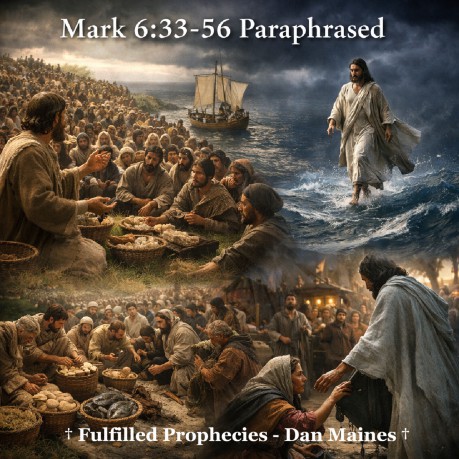
Mark 6:33-56
Paraphrased Mark 6:1-32 Paraphrased https://fulfilledprophecies.com/topics/1129.html
Mark 6:33-56 Paraphrased https://fulfilledprophecies.com/topics/1130.html
By Dan Maines
Introduction
†
This passage records the crowds pursuing Jesus, the feeding of the
five thousand, His authority over the sea, and the healings that
followed when He reached the other side.
†
These events happened in the generation leading up to the destruction
of Jerusalem, when the Messiah was revealing the kingdom and
gathering His people (Matthew 16:27-28).
†
Early Christian writers consistently pointed to the miracles of
Christ as historical proof that the promised Messiah had truly
appeared in Israel.
Mark 6:33
Many people
saw them leaving and recognized them, and people from all the towns
ran there on foot and arrived ahead of them.
†
The crowds were watching Jesus closely because His works had already
spread throughout the region (John 6:2).
†
This growing attention shows how rapidly His ministry expanded across
Galilee before the final generation of the old covenant system ended
(Luke 19:41-44).
† Eusebius later wrote that
the reputation of Christ spread quickly through Judea because the
people witnessed undeniable signs.
Mark 6:34
When
Jesus stepped ashore He saw a large crowd and felt compassion for
them because they were like sheep without a shepherd, so He began
teaching them many things.
† Jesus recognized
the spiritual failure of Israel's leaders who had not cared for the
people (Ezekiel 34:5).
† The nation had
priests and rulers but lacked faithful shepherds who would guide them
in truth (Jeremiah 23:1-2).
† Irenaeus
explained that Christ came as the true Shepherd promised to gather
the scattered sheep of Israel.
Mark 6:35
When
it was already late His disciples came to Him and said this place is
remote and the hour is already very late.
†
The disciples focused on the practical difficulty of feeding such a
massive crowd.
† Their concern revealed how
impossible the situation appeared from a human perspective.
†
Yet God had repeatedly provided for His people in wilderness places
before (Exodus 16:4).
Mark 6:36
Send the
people away so they can go into the surrounding countryside and
villages and buy something to eat.
† The
disciples assumed the only solution was to dismiss the crowd.
†
They had not yet realized that Jesus intended to provide the answer
Himself.
† This moment tested their
understanding of His power.
Mark 6:37
But
He answered and said you give them something to eat. They replied
should we go and spend two hundred denarii on bread and give it to
them to eat.
† Jesus challenged their
thinking by telling them to feed the crowd.
†
Two hundred denarii represented an enormous expense, making the
situation appear impossible.
† The disciples
were forced to confront their dependence on Christ.
Mark
6:38
He asked how many loaves do you have. Go and see.
When they checked they said five loaves and two fish.
†
The available food was extremely small compared to the size of the
crowd.
† This small supply set the stage for
a miracle demonstrating divine authority.
†
God often works through what appears insufficient in human eyes.
Mark
6:39
Then He instructed them to have all the people sit
down in groups on the green grass.
† Jesus
organized the crowd before the miracle took place.
†
The mention of green grass indicates the spring season around
Passover (John 6:4).
† Order and preparation
were established before the provision came.
Mark 6:40
So
they sat down in groups of hundreds and fifties.
†
The organized seating made distribution possible.
†
This arrangement resembles how Israel was organized in the wilderness
under Moses (Exodus 18:21).
† The structure
ensured everyone could receive food.
Mark 6:41
Taking
the five loaves and two fish He looked toward heaven and gave thanks,
then He broke the loaves and kept giving them to the disciples to set
before the people, and He divided the fish among them all.
†
Jesus acknowledged the Father before providing the food.
†
The disciples became the ones distributing the miracle to the
crowd.
† This moment foreshadowed their
future role in serving and teaching others.
Mark
6:42
They all ate and were satisfied.
†
The miracle provided real physical nourishment.
†
No one in the crowd went hungry.
† This
demonstrated the authority of Christ over creation.
Mark
6:43
They picked up twelve baskets full of broken
pieces and also of the fish.
† The leftovers
exceeded the original supply.
† The twelve
baskets likely symbolized the twelve tribes of Israel.
†
God's provision didn't merely meet the need, it overflowed beyond
it.
Mark 6:44
Five thousand men ate the
loaves.
† The total number present would have
been much larger when women and children were included.
†
This miracle became widely known throughout the region.
†
It confirmed the growing recognition of Jesus as the promised
Messiah.
Mark 6:45
Immediately Jesus made
His disciples get into the boat and go ahead of Him to the other side
toward Bethsaida while He sent the crowd away.
†
Jesus separated the disciples from the crowd immediately after the
miracle.
† The people were beginning to see
Him as a political leader (John 6:15).
† His
mission was the kingdom of God, not a national revolt.
Mark
6:46
After saying goodbye to them He went up on the
mountain to pray.
† Jesus often withdrew to
pray even after major miracles.
† This shows
His continual dependence on the Father.
†
Prayer remained central to His ministry.
Mark 6:47
When
evening came the boat was in the middle of the sea and He was alone
on land.
† The disciples were now struggling
on the lake without Him present.
† Darkness
and distance set the stage for another powerful demonstration.
†
The moment prepared them to witness something extraordinary.
Mark
6:48
Seeing them struggling to row because the wind was
against them, around the fourth watch of the night He came to them
walking on the sea and He intended to pass by them.
†
The fourth watch was between three and six in the morning.
†
The disciples had been fighting the wind for hours.
†
Walking on the water revealed Christ's authority over the forces of
nature.
Mark 6:49
When they saw Him
walking on the sea they thought it was a ghost and cried out.
†
The sight was so unexpected that fear overwhelmed them.
†
They couldn't immediately understand what they were seeing.
†
Their reaction shows how extraordinary the event truly was.
Mark
6:50
They all saw Him and were terrified, but
immediately He spoke with them and said take courage, it is I, do not
be afraid.
† Jesus calmed their fear with His
voice.
† The phrase it is I reflects divine
authority and identity (Exodus 3:14).
† His
presence replaced fear with reassurance.
Mark 6:51
Then
He climbed into the boat with them and the wind stopped, and they
were completely amazed.
† The storm ended the
moment Jesus entered the boat.
† Creation
itself responded to His authority.
† The
disciples were overwhelmed by what they witnessed.
Mark
6:52
They had not understood about the loaves because
their hearts were hardened.
† Even after the
feeding miracle they still struggled to grasp its meaning.
†
Spiritual understanding often develops slowly.
†
Later events would help them recognize who Jesus truly was.
Mark
6:53
When they crossed over they came to land at
Gennesaret and anchored the boat.
† The
journey across the lake ended along the western shore of Galilee.
†
News of Jesus had already spread widely throughout this area.
†
The people were already waiting.
Mark 6:54
As
soon as they got out of the boat the people recognized Him.
†
His reputation had spread throughout the region.
†
Many had already heard of the miracles.
†
Recognition triggered immediate activity among the crowd.
Mark
6:55
They ran through that whole region and began
carrying the sick on mats to wherever they heard He was.
†
People rushed to bring the sick because they believed He could heal
them.
† This demonstrates the widespread
faith in His power.
† Entire communities
responded to His presence.
Mark 6:56
Wherever
He entered villages or cities or countryside they laid the sick in
marketplaces and begged Him that they might just touch the edge of
His cloak, and all who touched it were healed.
†
Even touching His garment brought healing (Mark 5:27-29).
†
These miracles fulfilled the prophetic expectation of restoration
through the Messiah (Isaiah 35:5-6).
† The
works confirmed that the kingdom of God had arrived among
them.
Historical References
†
Josephus recorded that large crowds gathered around teachers and
prophets in Judea during the first century.
†
Eusebius described how the fame of Jesus spread rapidly throughout
the region because of the miracles people witnessed.
†
Irenaeus wrote that the works of Christ confirmed His identity as the
promised Son of God and Shepherd of Israel.
How it
applies to us today
† These events
remind us that Christ's power isn't limited by human resources.
†
The same Lord who fed thousands still provides for His people
today.
† His authority over nature, sickness,
and human need continues to define His reign.
Q & A
Appendix
Q Why did the crowds run
ahead of Jesus.
A They had already witnessed
miracles and wanted to hear His teaching and see His works (John
6:2).
Q Why did Jesus say the people were like
sheep without a shepherd.
A Israel's leaders
had failed to guide the people faithfully (Ezekiel 34:5).
Q
Why did Jesus feed the crowd instead of sending them away.
A
The miracle revealed God's provision and confirmed the authority of
Christ (Exodus 16:4).
Q Why were the disciples
afraid when Jesus walked on the water.
A They
didn't yet understand the full power and identity of Jesus.
Q
What did the healings prove about Jesus.
A They
confirmed that He was the promised Messiah who would restore and heal
God's people (Isaiah 35:5-6).
† This is the fulfilled
perspective we proclaim at Fulfilled Prophecies †
©
Fulfilled Prophecies - Dan Maines.
Source Index
†
Mark 6
† Josephus, Antiquities of the Jews
†
Irenaeus, Against Heresies
† Eusebius,
Ecclesiastical History
Links