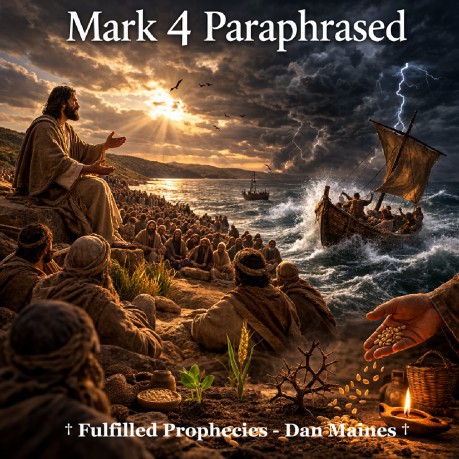
Mark 4
Paraphrased
By Dan Maines
Introduction
†
Mark 4 records several parables Jesus taught beside the Sea of
Galilee.
† These parables explained how the
message of the kingdom would spread, be resisted, and finally produce
fruit among those who receive it.
† The
teaching fits the time leading up to the judgment that came on
Jerusalem in that generation (Matthew 23:36; Matthew 24:34).
†
Early Christian writers noted that Jesus used parables both to reveal
truth to disciples and to conceal it from hardened Israel. Clement of
Alexandria explained that the Lord spoke this way so the faithful
would understand while the careless would miss the meaning.
†
This chapter ends with Christ demonstrating authority over creation,
showing that the same One who teaches the kingdom also rules the
world.
Mark 4:1
Jesus began teaching again
beside the sea. A huge crowd gathered around Him, so He stepped into
a boat and sat on the water while the crowd stood on the shore facing
Him.
† Teaching from a boat allowed Jesus to
speak to the large crowd gathered along the shoreline.
†
The setting reflects how widely His message was spreading across
Galilee (Mark 1:32-39).
† Eusebius noted that
large gatherings often followed Christ because His works and teaching
spread rapidly through the region.
Mark 4:2
He
taught them many things using parables, and in His teaching He said
to them:
† A parable is a comparison drawn
from everyday life to explain spiritual truth.
†
Jesus used stories familiar to farmers and villagers so the message
would connect with daily life.
† Irenaeus
wrote that Christ used parables to instruct the faithful while
exposing the blindness of those who rejected Him.
Mark
4:3
Listen carefully. A farmer went out to sow seed in
his field.
† The sower represents the one
spreading the message of God's kingdom.
† The
seed represents the word being proclaimed to Israel and the
nations.
† The command to listen shows the
importance of understanding the message being given.
Mark
4:4
As he scattered the seed, some fell along the path,
and birds came and ate it.
† The hardened
path represents people whose hearts are closed to the message.
†
Because the seed never enters the soil, the message never takes
root.
† Early writers saw this as describing
those who hear truth but quickly abandon it.
Mark
4:5
Other seed fell on rocky ground where the soil was
shallow. It sprouted quickly because the soil was thin.
†
This represents people who receive the message quickly but lack
depth.
† Initial excitement isn't the same as
true understanding.
† Tertullian wrote that
shallow faith disappears when persecution arrives.
Mark
4:6
But when the sun rose, the young plants were
scorched, and because they had no root they withered away.
†
The scorching sun represents trials and opposition.
†
Without deep roots in truth, faith collapses under pressure.
†
This describes many in Israel who followed Jesus briefly but
abandoned Him during conflict.
Mark 4:7
Other
seed fell among thorns. The thorns grew up and choked the plants, and
they produced no crop.
† Thorns represent
distractions, worries, and attachments that choke spiritual growth.
†
Even when truth is received, competing priorities can prevent
fruit.
† Clement of Alexandria warned
believers that worldly desires can suffocate faith.
Mark
4:8
But other seed fell on good soil and produced
grain. It grew and increased, yielding thirty, sixty, and even a
hundred times what was planted.
† Good soil
represents those who receive the word and allow it to grow.
†
Fruitfulness shows that true faith results in visible
transformation.
† The multiplied harvest
illustrates the expanding spread of the gospel in the first
century.
Mark 4:9
Then He said, Whoever
has ears to hear, let him listen.
† Jesus
repeatedly used this phrase to call for spiritual understanding.
†
Hearing with the ears isn't enough, the heart must receive the
truth.
† Many in Israel heard His teaching
but refused to believe it.
Mark 4:10
When
He was alone, those around Him with the twelve asked Him about the
parables.
† The disciples wanted deeper
understanding of His teaching.
† True
disciples seek explanation rather than dismissing what they don't
understand.
† This shows the difference
between the curious crowd and committed followers.
Mark
4:11
He told them, The mystery of the kingdom of God
has been given to you, but to those outside everything is explained
in parables.
† The mystery refers to truths
that were hidden but now revealed through Christ.
†
Those who followed Him were given insight into the kingdom.
†
Outsiders heard the stories but missed the meaning because of
unbelief.
Mark 4:12
So that they may see
and yet not perceive, and hear and yet not understand, otherwise they
might turn and be forgiven.
† This statement
echoes Isaiah's prophecy about Israel's hardened heart (Isaiah
6:9-10).
† Jesus wasn't preventing
repentance, He was exposing the blindness already present.
†
Many religious leaders refused the message even when truth stood
before them.
Mark 4:13
Then He said to
them, Don't you understand this parable? How will you understand any
of the parables?
† This parable serves as a
key for understanding the rest.
† The spread
of the word and the different responses to it explain the mission of
the kingdom.
† Understanding this teaching
helps interpret the others that follow.
Mark 4:14
The
farmer sows the word.
† The seed is the
message about God's kingdom being announced through Christ and His
apostles.
† The success of the harvest
depends on the condition of the soil, not the quality of the seed.
†
This explains why some responded while others rejected the
gospel.
Mark 4:15
Some people are like
seed along the path where the word is sown. When they hear it, Satan
immediately comes and takes away the word that was planted in them.
†
Spiritual opposition tries to prevent the message from taking root.
†
Hard hearts allow truth to be quickly removed.
†
This describes many leaders who opposed Jesus' message from the
beginning.
Mark 4:16
Others are like seed
sown on rocky ground. They hear the word and immediately receive it
with joy.
† Emotional response alone doesn't
equal lasting faith.
† Many people initially
followed Jesus because of miracles and excitement.
†
But shallow faith doesn't endure trials.
Mark 4:17
But
they have no root within themselves. They last only a short time.
When trouble or persecution comes because of the word, they quickly
fall away.
† The early church faced
persecution that exposed shallow belief.
†
Real faith survives hardship because it is rooted in truth.
†
This warning applied to those who abandoned the gospel during
pressure.
Mark 4:18
Others are like seed
sown among thorns. These are the people who hear the word.
†
Hearing alone isn't enough.
† Many listened
to Jesus yet continued living as before.
†
Without commitment the message never produces fruit.
Mark
4:19
But the worries of the world, the deception of
riches, and desires for other things enter in and choke the word,
making it unfruitful.
† Worldly concerns can
overpower spiritual priorities.
† Wealth and
ambition often distract people from truth.
†
This warning still applies in every generation.
Mark
4:20
But the seed sown on good soil represents those
who hear the word, accept it, and produce a harvest, thirty, sixty,
or a hundred times what was planted.
† True
faith results in transformation and fruitfulness.
†
The gospel spread rapidly in the first century through faithful
believers.
† The harvest shows the power of
God's word when it is received.
Mark 4:21
He
said to them, A lamp isn't brought in to be put under a basket or
under a bed. It's placed on a stand so it gives light.
†
The message of the kingdom was meant to be revealed, not hidden.
†
Christ's teaching would spread publicly through the apostles.
†
Truth shines brightest when it is openly proclaimed.
Mark
4:22
Nothing is hidden except to be revealed, and
nothing secret except to come to light.
†
God's purposes eventually become visible.
†
The kingdom that seemed small during Jesus' ministry would soon
spread widely.
† This was fulfilled as the
gospel moved throughout the Roman world.
Mark 4:23
If
anyone has ears to hear, let him listen.
†
Again Jesus calls for careful attention.
†
Understanding requires humility and willingness to receive truth.
†
Those who ignored this warning missed the message completely.
Mark
4:24
He also said to them, Pay attention to what you
hear. The measure you use will be measured to you, and more will be
given besides.
† Those who receive truth
sincerely will gain more understanding.
† But
those who ignore it will lose even what little they have.
†
This principle appears throughout Jesus' teaching.
Mark
4:25
For whoever has will be given more, and whoever
does not have, even what he has will be taken away.
†
Spiritual growth multiplies when truth is embraced.
†
Neglecting truth leads to spiritual loss.
†
This explains why disciples grew in understanding while others became
hardened.
Mark 4:26
He also said, The
kingdom of God is like a man who scatters seed on the ground.
†
This parable continues the theme of the growing harvest.
†
The kingdom doesn't appear suddenly in visible power.
†
Instead it begins quietly and grows over time.
Mark
4:27
He sleeps and rises night and day, and the seed
sprouts and grows, though he doesn't know how.
†
Growth happens through God's power rather than human control.
†
The farmer can't force the crop to grow.
† In
the same way the kingdom expands by God's work.
Mark
4:28
The earth produces the crop by itself, first the
blade, then the head, then the full grain in the head.
†
The process of growth unfolds step by step.
†
The kingdom began with Christ, then expanded through the apostles.
†
Eventually it reached maturity before the judgment on Jerusalem.
Mark
4:29
But when the grain is ready, he immediately sends
in the sickle, because the harvest has come.
†
Harvest imagery often refers to judgment (Joel 3:13; Matthew
13:39).
† In the first century the harvest
culminated in the end of the old covenant age.
†
The destruction of Jerusalem marked that transition.
Mark
4:30
He said, How can we describe the kingdom of God,
or what parable can we use to explain it?
†
Jesus invited the audience to consider the surprising nature of the
kingdom.
† It didn't begin with political
power or military strength.
† Instead it
started small but grew dramatically.
Mark 4:31
It
is like a mustard seed, which when planted in the ground is smaller
than all the seeds on earth.
† The mustard
seed was known for its tiny size.
† This
illustrates the humble beginnings of the kingdom.
†
Jesus' small group of followers would eventually influence the
world.
Mark 4:32
Yet when it is planted it
grows and becomes larger than all garden plants, producing large
branches so birds of the air can nest in its shade.
†
The kingdom would grow far beyond its small beginning.
†
Nations would find refuge within its reach.
†
Early writers saw this fulfilled in the rapid spread of
Christianity.
Mark 4:33
With many similar
parables He spoke the word to them as much as they were able to
understand.
† Jesus adjusted His teaching to
what listeners could handle.
† Parables
allowed deeper truth to unfold gradually.
†
Disciples gained fuller understanding over time.
Mark
4:34
He didn't speak to them without a parable, but
privately He explained everything to His disciples.
†
The inner circle received fuller explanation.
†
This prepared them to teach others later.
†
The apostles carried these teachings to the early church.
Mark
4:35
That evening He said to them, Let's go over to the
other side of the sea.
† The narrative shifts
from teaching to a powerful demonstration of authority.
†
Crossing the sea set the stage for the miracle that followed.
†
The disciples were about to witness Christ's power over nature.
Mark
4:36
After leaving the crowd, they took Him along in
the boat just as He was, and other boats followed with them.
†
Multiple boats were traveling across the lake together.
†
This suggests several witnesses to what happened next.
†
Such details strengthen the historical reliability of the
account.
Mark 4:37
A violent windstorm
arose, and waves began crashing into the boat so that it was nearly
swamped.
† Sudden storms were common on the
Sea of Galilee.
† The experienced fishermen
among the disciples knew the danger.
† This
moment revealed their fear despite being with Jesus.
Mark
4:38
But He was in the stern sleeping on a cushion.
They woke Him and said to Him, Teacher, don't you care that we're
about to die?
† Jesus' calm sleep shows His
complete trust in the Father.
† The disciples
panicked even though the Son of God was with them.
†
Their question reveals their struggle to understand His
authority.
Mark 4:39
He got up, rebuked
the wind, and said to the sea, Be still. The wind stopped, and the
sea became completely calm.
† Jesus commands
the storm the same way God controls the seas in the Old Testament
(Psalm 107:29).
† This miracle demonstrates
divine authority.
† The sudden calm shows the
power of His word.
Mark 4:40
Then He said
to them, Why are you afraid? Do you still have no faith?
†
Jesus challenged their fear because they had already witnessed many
miracles.
† Faith grows through trusting
God's power even during danger.
† The
question exposed their incomplete understanding.
Mark
4:41
They were filled with great fear and said to one
another, Who then is this, that even the wind and the sea obey Him?
†
The disciples realized they were in the presence of someone greater
than a prophet.
† Control over creation
belongs to God alone.
† This moment pointed
clearly to the divine identity of Christ.
Historical
References
† Josephus recorded how
storms on the Sea of Galilee could become violent and sudden,
confirming the realism of the account.
†
Clement of Alexandria taught that Christ's parables revealed truth to
believers while concealing it from hardened hearts.
†
Irenaeus explained that the parables showed the gradual spread of the
kingdom through the preaching of the apostles.
†
Eusebius described how the gospel message spread rapidly throughout
the Roman Empire following the apostolic mission.
How It
Applies To Us Today
† The condition
of the soil reminds us that our hearts determine whether God's word
grows in us.
† Faith must go deeper than
emotion so it can survive trials and opposition.
†
The kingdom still grows quietly through the faithful spread of the
message of Christ.
† When storms come in
life, we remember the One who calmed the sea is still Lord over all
things.
† True disciples listen carefully,
receive truth deeply, and produce fruit in their lives.
Q
& A Appendix
Q Why did Jesus teach
using parables?
A Parables revealed truth to
those willing to listen while exposing the hardened hearts of those
who rejected Him (Isaiah 6:9-10).
Q What does
the seed represent in the parable of the sower?
A
The seed represents the word of God being proclaimed to the people
(Luke 8:11).
Q Why do some people fall away
after hearing the message?
A Shallow faith
collapses when persecution or trials arise because it lacks deep
roots (Luke 8:13).
Q What does the mustard seed
teach about the kingdom?
A It shows that the
kingdom begins small but grows into something far greater than
expected (Daniel 2:35).
Q What does Jesus
calming the storm reveal about Him?
A His
authority over nature shows that He possesses the power of God
Himself (Psalm 107:29).
† This is the fulfilled
perspective we proclaim at Fulfilled Prophecies †
©
Fulfilled Prophecies - Dan Maines.
Source Index
†
Mark 4
† Josephus, Wars of the Jews
†
Irenaeus, Against Heresies
† Clement of
Alexandria, Stromata
† Eusebius,
Ecclesiastical History
Links