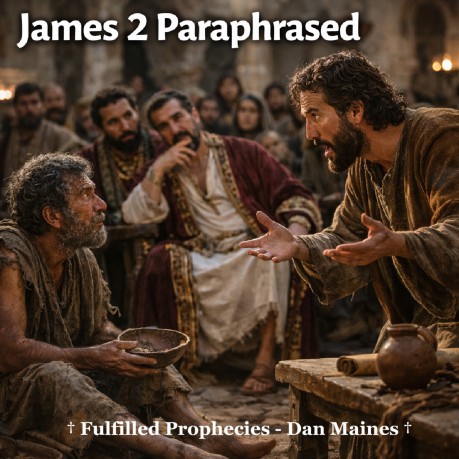
James 2 Paraphrased Introduction James 2:1 James 2:2 James 2:3 James 2:4 James 2:5 James 2:6 James 2:7 James 2:8 James 2:9 James 2:10 James 2:11 James 2:12 James 2:13 James 2:14 James 2:15 James 2:16 James 2:17 James 2:18 James 2:19 James 2:20 James 2:21 James 2:22 James 2:23 James 2:24 James 2:25 James 2:26 Historical References How It Applies To Us Today Q & A Appendix Q: Does James teach salvation by works? Q: Why does James warn about favoritism? Q: How does Abraham illustrate living faith? Q: Why does James mention demons believing? Q: What is the law of liberty? † This is the fulfilled perspective we proclaim at
Fulfilled Prophecies † Source Index
By Dan Maines
† James
continues addressing believers who were living during the final years
of the Old Covenant age, urging them to live out the faith they
claimed to have.
† The chapter focuses on two
major issues, favoritism and empty faith that produces no action.
†
James is not contradicting Paul. He is confronting people who claimed
belief but lived no differently from the world around them (Romans
3:28; Galatians 5:6).
My brothers, as you hold the faith
in our glorious Lord Jesus Christ, do not treat people with
favoritism.
† Faith in Christ removes social
barriers. Favoritism contradicts the kingdom Christ established (Acts
10:34).
† In the first century assemblies,
wealthy and poor believers gathered together. James warns that the
values of the old world system must not control the church (Galatians
3:28).
† The kingdom Christ brought was not
built on wealth, status, or position, but on faith and righteousness
(Luke 12:15).
If a man wearing a gold ring and
fine clothing enters your gathering, and a poor man in dirty clothing
also comes in,
† James describes a real
situation common in early assemblies where wealthy visitors were
treated differently.
† Synagogue style
gatherings often placed honorable seats toward the front. James
exposes how easily human pride infiltrates worship (Luke 14:7-11).
and you pay special attention to
the one wearing fine clothing and say, Sit here in a good place,
while you say to the poor man, Stand there, or sit by my footstool,
†
This shows the visible difference in treatment between rich and
poor.
† Christ repeatedly taught that earthly
status has no place in God's kingdom (Matthew 23:6-12).
†
The early believers were to reflect the justice and humility of
Christ rather than the social hierarchies of the Roman world.
have you not made distinctions
among yourselves and become judges with evil thoughts?
†
Favoritism reveals the motives of the heart. It shows judgment based
on outward appearance instead of righteousness (1 Samuel 16:7).
†
James calls this evil thinking because it contradicts the character
of God who shows no partiality (Romans 2:11).
Listen, my beloved brothers. Has
not God chosen the poor in the eyes of the world to be rich in faith
and heirs of the kingdom which He promised to those who love Him?
†
God often chose the humble and overlooked rather than the powerful (1
Corinthians 1:26-29).
† The poor were
frequently more receptive to the gospel because they were not relying
on wealth or power.
But you have dishonored the poor.
Is it not the rich who oppress you and drag you into court?
†
In the first century Roman world, wealthy landowners often exploited
the poor through legal systems.
† James
reminds believers that the rich persecutors were often the very
people being honored in the assemblies.
Do they not blaspheme the
honorable name by which you were called?
†
The name refers to Christ. Believers carried His name and identity
(Acts 11:26).
† Many wealthy persecutors
mocked the followers of Jesus, yet believers were still tempted to
seek their approval.
If you truly fulfill the royal law
according to the Scripture, You shall love your neighbor as yourself,
you are doing well.
† The royal law comes
from Leviticus and was affirmed by Jesus as central to God's will
(Matthew 22:37-40).
† Love for others is the
true evidence of living faith.
But if you show favoritism, you
commit sin and are convicted by the law as transgressors.
†
Favoritism breaks the command to love others equally.
†
Even a socially acceptable sin is still sin when measured by God's
standard.
Whoever keeps the whole law yet
stumbles in one point has become guilty of all.
†
The law functioned as a complete covenant system. Breaking one part
meant violating the covenant itself (Galatians 3:10).
†
This shows why righteousness cannot come through law keeping.
For He who said Do not commit
adultery also said Do not commit murder. If you do not commit
adultery but do commit murder, you have become a transgressor of the
law.
† The same lawgiver issued all
commandments. Breaking any command rejects the authority of the one
who gave it.
Speak and act as those who are to
be judged by the law of liberty.
† The law of
liberty refers to the gospel covenant under Christ (John 8:36).
†
Believers were no longer under the Mosaic law but under the freedom
found in Christ.
Judgment will be without mercy to
the one who has shown no mercy. Mercy triumphs over judgment.
†
Jesus taught the same principle during His ministry (Matthew 5:7).
†
The gospel reveals God's mercy, and believers must reflect that mercy
toward others.
What use is it, my brothers, if
someone says he has faith but has no works? Can that faith save
him?
† James is addressing empty claims of
belief that produce no transformation.
†
Genuine faith always produces action because faith trusts and obeys
God (Hebrews 11:6).
If a brother or sister is without
clothing and lacks daily food,
† James moves
from theory to a real life situation.
and one of you says to them Go in
peace, be warmed and filled, yet you do not give them what is
necessary for their body, what use is that?
†
Words without action are empty. Faith that does nothing for others is
not living faith.
Even so faith, if it has no
works, is dead by itself.
† Dead faith is
belief without obedience.
† James is exposing
the difference between real trust in God and mere intellectual
agreement.
But someone may say You have
faith and I have works. Show me your faith without works, and I will
show you my faith by my works.
† Works reveal
what a person truly believes.
You believe that God is one. You
do well. Even the demons believe that, and they tremble.
†
Mere belief in God's existence is not saving faith.
†
Demons acknowledge truth but remain in rebellion.
But are you willing to recognize,
foolish person, that faith without works is useless?
†
James again exposes the emptiness of inactive faith.
Was not Abraham our father
justified by works when he offered Isaac his son on the altar?
†
Abraham's obedience revealed the reality of his faith (Genesis 22).
†
His actions demonstrated trust in God's promise.
You see that faith was working
together with his works, and by works faith was completed.
†
Works do not replace faith. They demonstrate and mature it.
And the Scripture was fulfilled
which says Abraham believed God, and it was credited to him as
righteousness, and he was called the friend of God.
†
Abraham was declared righteous because he trusted God (Genesis 15:6).
You see that a person is
justified by works and not by faith alone.
†
James is not teaching salvation by works. He is saying that genuine
faith always produces visible obedience.
In the same way, was not Rahab
the prostitute also justified by works when she received the
messengers and sent them out another way?
†
Rahab's actions showed her faith in the God of Israel (Joshua 2).
For just as the body without the
spirit is dead, so also faith without works is dead.
†
Faith and action belong together. When action is missing, faith is
lifeless.
†
Irenaeus wrote that true believers demonstrate their faith through
obedience and love toward others.
† Clement
of Alexandria taught that faith produces a transformed life that
reflects Christ.
† Eusebius recorded that the
early church viewed the book of James as a call to practical
righteousness and living faith.
†
Real faith still produces action. Belief that never changes behavior
is not the faith taught by Christ.
† The
church must avoid favoritism, whether based on wealth, influence, or
status.
† Followers of Christ are called to
show mercy, generosity, and obedience because the gospel has changed
their hearts.
A:
No. James teaches that genuine faith produces works. Faith without
action is empty (James 2:17; Galatians 5:6).
A:
Because favoritism contradicts God's impartial character and violates
the command to love others (James 2:1-9; Romans 2:11).
A:
Abraham trusted God and acted on that trust when he offered Isaac
(James 2:21-23; Genesis 22).
A:
To show that intellectual belief alone does not equal saving faith
(James 2:19).
A:
The gospel covenant in Christ that frees believers from the
condemnation of the Mosaic law (James 2:12; John 8:36).
© Fulfilled Prophecies - Dan
Maines.
† James 2
†
Irenaeus, Against Heresies
† Clement of
Alexandria, Stromata
† Eusebius,
Ecclesiastical History
Links