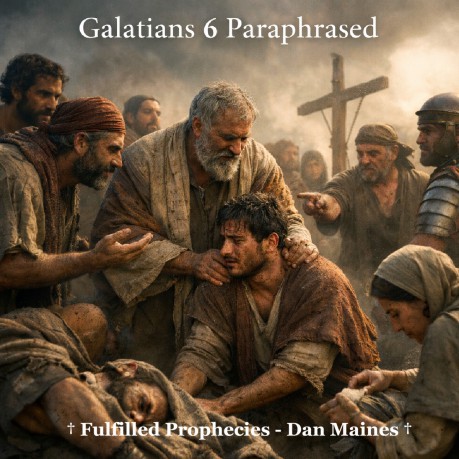
Galatians 6 Paraphrased Introduction Galatians 6:1 Galatians 6:2 Galatians 6:3 Galatians 6:4 Galatians 6:5 Galatians 6:6 Galatians 6:7 Galatians 6:8 Galatians 6:9 Galatians 6:10 Galatians 6:11 Galatians 6:12 Galatians 6:13 Galatians 6:14 Galatians 6:15 Galatians 6:16 Galatians 6:17 Galatians 6:18 Historical References How It Applies To Us Today Q & A Appendix Q: What is the law of Christ mentioned in
Galatians 6:2? Q: What does sowing and reaping mean in Galatians
6:7-8? Q: Why did Paul oppose circumcision for
Gentiles? Q: What does Paul mean by new creation in
Galatians 6:15? Q: What are the marks of Jesus Paul mentioned in
Galatians 6:17? † This is the fulfilled perspective we proclaim at
Fulfilled Prophecies † Source Index
By Dan Maines
† Paul
closes this letter by showing how believers are supposed to live
together under the freedom of Christ, correcting one another gently,
carrying burdens, and refusing the pride that came from the old law
system (Galatians 5:13-14).
† The chapter
also contrasts two ways of living, sowing to the flesh or sowing to
the Spirit, reminding believers that what a man plants in life is
exactly what he'll harvest later (2 Corinthians 9:6).
†
Early Christian teachers often used this passage to show that the
church was a community of restoration and accountability rather than
condemnation, something very different from the legal system that
dominated first century Judaism.
Brothers and sisters, if
someone is caught in wrongdoing, those who are walking in the Spirit
should gently help restore him, watching yourselves carefully so you
won't fall into the same temptation.
†
Restoration is the goal, not humiliation. Paul is calling believers
to repair the fallen brother rather than destroy him (Matthew
18:15).
† The warning to watch yourself shows
humility is required, because anyone can stumble if pride takes
control (1 Corinthians 10:12).
† Clement of
Alexandria taught that correction among believers must be done with
mercy and patience because the purpose is healing, not punishment.
Carry one another's burdens,
and in doing so you fulfill the law of Christ.
†
The law of Christ is the command to love others as Christ loved us
(John 13:34).
† Bearing burdens includes
emotional, spiritual, and practical support within the community of
believers (Romans 15:1).
† Tertullian wrote
that the early church was known for mutual care, where believers
shared burdens so no one stood alone.
If someone thinks he's
something when he's nothing, he's only deceiving himself.
†
Pride blinds a person to his real condition before God (Romans
12:3).
† The legalistic mindset of the
Judaizers created this false sense of superiority, which Paul
directly confronts here (Galatians 5:26).
†
Irenaeus noted that arrogance was the root of many early church
disputes because men forgot their dependence on God's grace.
Each person should carefully
examine his own work, and then he'll have reason to rejoice in
himself alone and not in comparison with someone else.
†
Paul is not promoting selfish pride but personal accountability
before God (2 Corinthians 13:5).
† Comparing
ourselves to others leads either to arrogance or discouragement,
neither of which produces spiritual maturity.
†
Early Christian teachers often emphasized self-examination as a
discipline that kept believers grounded in humility.
For each person will carry his
own load.
† While believers help carry
burdens, every person still answers to God for his own life (Romans
14:12).
† Paul distinguishes between shared
burdens and personal responsibility.
†
Eusebius observed that early church discipline balanced compassion
with personal accountability.
The one who is taught the word
must share all good things with the one who teaches him.
†
Paul affirms that those who teach the word should be supported by the
community (1 Corinthians 9:14).
† This
support is not payment for salvation but appreciation for labor in
teaching truth.
† Early Christian communities
regularly supported teachers and traveling ministers so the gospel
could spread.
Don't be deceived, God isn't
mocked, whatever a man sows, that he'll also reap.
†
This is a universal spiritual principle that applies to both
individuals and nations (Job 4:8).
† No one
can trick God or escape the consequences of the life they choose.
†
Barnabas wrote that the path a person walks reveals the harvest that
will eventually come.
The one who sows to his flesh
will harvest corruption from the flesh, but the one who sows to the
Spirit will harvest eternal life from the Spirit.
†
Living for sinful desires produces decay and destruction, while
living according to God's Spirit leads to life (Romans 8:13).
†
Eternal life here describes the life of the Spirit that believers
already participate in through Christ.
†
Early Christian teachers often contrasted the flesh and Spirit as two
different directions a life can take.
Let's not grow tired of doing
good, because at the right time we'll harvest if we don't give up.
†
Faithfulness often requires patience because spiritual harvest
doesn't appear instantly (James 5:7).
†
Perseverance was essential for first century believers facing
persecution.
† Ignatius encouraged believers
to continue doing good even when suffering because God sees every act
of faithfulness.
So then, while we have
opportunity, let's do good to everyone, especially to those who
belong to the family of faith.
† Christian
love extends outward to the world but has a special responsibility
toward fellow believers (1 Thessalonians 5:15).
†
The phrase while we have opportunity reminds believers that life
provides limited time to act in righteousness.
†
Early church communities were known for helping both believers and
outsiders during times of famine and hardship.
See with what large letters
I'm writing to you with my own hand.
† Paul
likely took the pen from his scribe here to personally emphasize the
seriousness of his message.
† Large letters
may indicate emphasis or possibly Paul's poor eyesight.
†
Early manuscripts often show authors adding closing lines personally
to authenticate their letters.
Those who want to look
impressive in the flesh are trying to force you to be circumcised,
only so they won't be persecuted for the cross of Christ.
†
The Judaizers wanted social approval and safety from Jewish
persecution.
† Circumcision had become a
badge of identity rather than a matter of true faith.
†
Irenaeus wrote that many false teachers tried to preserve acceptance
with both Judaism and Christianity at the same time.
Even those who are
circumcised don't keep the law themselves, but they want you to be
circumcised so they can boast about your flesh.
†
Paul exposes the hypocrisy of legalism, demanding obedience while
failing to keep the law personally.
† Their
goal was reputation and influence rather than truth.
†
Early church leaders repeatedly warned against teachers who sought
followers for their own glory.
But as for me, may I never
boast except in the cross of our Lord Jesus Christ, through whom the
world has been crucified to me, and I to the world.
†
Paul rejects all human pride and focuses entirely on Christ's
sacrifice.
† The cross ended the old system
of boasting in fleshly identity.
† The early
church viewed the cross as both the end of the old covenant order and
the beginning of the new life in Christ.
Neither circumcision nor
uncircumcision means anything, what matters is a new creation.
†
Identity in Christ replaces identity through physical covenant
markers.
† The new creation describes the
transformation brought by the gospel (2 Corinthians 5:17).
†
Early Christian writers used this language to describe the spiritual
rebirth of believers in the new covenant.
Peace and mercy be upon all
who follow this rule, and upon the Israel of God.
†
The rule Paul refers to is the principle of new creation rather than
law observance.
† The Israel of God refers to
the people of God defined by faith in Christ rather than ethnic
descent (Romans 2:28-29).
† Early church
writers frequently interpreted this phrase as referring to the
unified body of believers in Christ.
From now on let no one cause
me trouble, because I carry on my body the marks of Jesus.
†
Paul's scars from persecution were evidence of his loyalty to
Christ.
† These marks stood in contrast to
the outward mark of circumcision promoted by the Judaizers.
†
Early Christian tradition records that Paul endured repeated beatings
and imprisonment for the gospel.
The grace of our Lord Jesus
Christ be with your spirit, brothers and sisters. Amen.
†
Paul ends the letter the same way he began, emphasizing grace instead
of law (Galatians 1:3).
† Grace is the
foundation of the believer's relationship with God.
†
Early church teachers consistently closed letters with blessings of
grace to remind believers that salvation always begins and ends with
God's mercy.
†
Josephus described the intense conflict between Jewish legalists and
the early Christian movement during the first century.
†
Irenaeus wrote that the apostles opposed legalism because it
attempted to reintroduce the bondage Christ had already removed.
†
Clement of Alexandria explained that the gospel replaced external
religious markers with inner transformation through Christ.
†
Eusebius recorded that many early believers suffered persecution for
rejecting the requirement of circumcision and law observance.
†
Believers are still called to restore those who stumble rather than
condemn them.
† The church is meant to be a
community where burdens are shared and people support one another.
†
Pride and religious performance still tempt people today just like
they did in the first century.
† The true
mark of God's people is not outward religious identity but the new
creation produced by Christ.
A: The law of Christ is the
command to love one another as Christ loved us (John 13:34).
A: It means our choices produce
spiritual consequences, living for the flesh produces corruption,
while living for the Spirit produces life (Romans 8:13).
A: Because salvation comes through
Christ alone, not through the works of the law (Galatians 2:16).
A: The transformation believers
receive through Christ that replaces the old covenant identity (2
Corinthians 5:17).
A: The scars and suffering he
endured while preaching the gospel.
© Fulfilled Prophecies - Dan
Maines.
† Galatians
6
† Josephus, Antiquities of the Jews
†
Irenaeus, Against Heresies
† Eusebius,
Ecclesiastical History
† Clement of
Alexandria, Stromata
Links