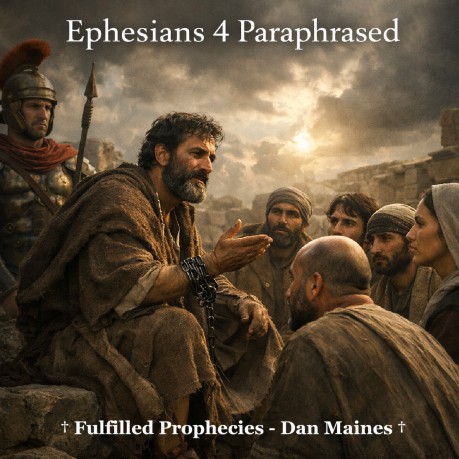
Ephesians 4
Paraphrased
By Dan Maines
Introduction
†
Paul moved from explaining what Christ accomplished to showing how
believers were supposed to live in light of that finished work. The
message wasn't about earning salvation, it was about living in unity
as the new covenant people of God (Romans 12:4-5).
†
The early church was learning how to live as one body made from Jews
and Gentiles together. Paul reminded them that humility, patience,
and unity were essential for that new covenant community (Colossians
3:12-14).
† Clement of Alexandria noted that
the unity of believers was evidence that Christ had already
established His kingdom among His people.
Ephesians
4:1
I, the Lord's prisoner, urge you to live in a way
that reflects the calling you received.
†
Paul was literally imprisoned because he preached Christ to the
nations, yet he still urged believers to live worthy of the new life
God had given them (Acts 28:30-31).
† The
calling Paul spoke of was the calling into the body of Christ, where
Jews and Gentiles became one people under the new covenant (Ephesians
2:14-16).
† Irenaeus later wrote that the
unity of the church proved that Christ had gathered the nations into
one family.
Ephesians 4:2
Be humble and
gentle, be patient with each other, and endure one another in love.
†
These qualities describe the character of Christ Himself, and
believers were called to reflect that same spirit toward one another
(Matthew 11:29).
† The unity of the church
wasn't maintained by power or authority, but through humility and
patience among believers (Philippians 2:3-4).
†
Clement of Rome emphasized that humility and peace among believers
were marks of the true church.
Ephesians 4:3
Work
hard to keep the unity the Spirit created through the bond of
peace.
† The Spirit had already united
believers into one body, their responsibility was to preserve that
unity, not create it (1 Corinthians 12:13).
†
The peace Paul mentioned reflects the reconciliation Christ
accomplished between God and humanity and between Jews and Gentiles
(Ephesians 2:17).
† Early church writings
often described the church as one body spread throughout the world,
united by the same Spirit.
Ephesians 4:4
There
is one body and one Spirit, just as you were called into one hope
when you were called.
† The body refers to
the church, the community of believers joined together through Christ
(1 Corinthians 12:12).
† The one hope refers
to the completed redemption Christ promised to bring in that
generation (Romans 8:23).
† Ignatius of
Antioch frequently wrote about the unity of the church as one body
under Christ.
Ephesians 4:5
There is one
Lord, one faith, one baptism.
† The one Lord
is Jesus Christ, the risen King who now reigns over His kingdom (Acts
2:36).
† The one faith refers to the message
of the gospel that the apostles preached everywhere (Jude 1:3).
†
Baptism symbolized entering the covenant community and identifying
with Christ's death and resurrection (Romans 6:3-4).
Ephesians
4:6
There is one God and Father of all, who is over
all, through all, and in all.
† This verse
emphasizes the universal authority of God as Father over the entire
covenant family (1 Corinthians 8:6).
† God's
presence working through believers showed that His Spirit now lived
among His people (1 Corinthians 3:16).
†
Early Christian writers often emphasized the unity of God as the
foundation for the unity of the church.
Ephesians
4:7
But grace was given to each one of us according to
the measure Christ chose to give.
† Every
believer received grace and a role within the body of Christ, not
just leaders or apostles (1 Peter 4:10).
†
The gifts given by Christ were meant to strengthen and build the
church as it grew toward maturity (1 Corinthians 12:7).
†
Irenaeus wrote that spiritual gifts were given for the building up of
the church.
Ephesians 4:8
Because of this
it says, When He ascended on high He led captivity captive and gave
gifts to people.
† Paul quoted Psalm 68:18 to
show that Christ's victory brought freedom and blessing to His
people.
† The phrase led captivity captive
reflects Christ's triumph over sin and death through His resurrection
(Colossians 2:15).
† Early Christian
interpreters saw this verse as describing Christ's victorious reign
after His resurrection.
Ephesians 4:9
Now
when it says He ascended, what does it mean except that He first
descended to the lower parts of the earth.
†
This refers to Christ coming into the world in humility before
returning to the Father in glory (Philippians 2:6-9).
†
His descent shows that the Son entered human history and experienced
death before His exaltation.
† Early church
teachers understood this as referring to Christ's incarnation and
death.
Ephesians 4:10
The One who
descended is the same One who ascended far above all the heavens so
He could fill everything.
† Christ's
ascension signified His authority over heaven and earth (Matthew
28:18).
† His reign continues through His
presence working in His people by the Spirit (Colossians 1:27).
†
Eusebius wrote that Christ's ascension marked the beginning of His
universal reign.
Ephesians 4:11
He gave
some as apostles, some as prophets, some as evangelists, some as
shepherds and teachers.
† These roles were
given to establish and strengthen the early church during its
foundational period (Ephesians 2:20).
†
Apostles and prophets helped lay the doctrinal foundation of the
gospel message.
† Evangelists and teachers
helped spread and explain that message throughout the growing
church.
Ephesians 4:12
Their purpose was
to equip the saints for ministry and to build up the body of
Christ.
† The leaders of the church weren't
meant to do all the work themselves, they were meant to prepare
believers to serve.
† The entire body of
believers participated in the growth and strengthening of the church
(1 Corinthians 12:27).
† Early Christian
communities operated as active bodies where every believer
contributed.
Ephesians 4:13
This continues
until we all reach unity in the faith and in the knowledge of the Son
of God, becoming mature and measuring up to the fullness of Christ.
†
The early church was moving toward spiritual maturity as Christ
completed His redemptive work.
† Unity in
faith meant agreement in the gospel message delivered by the
apostles.
† The fullness of Christ reflects
the completed covenant community revealed through the
gospel.
Ephesians 4:14
Then we will no
longer be like children, tossed around by waves and carried by every
wind of teaching and human trickery.
† Paul
warned against false teachings that attempted to distort the gospel
(Galatians 1:6-7).
† Spiritual maturity
protects believers from deception and instability.
†
Early church writings frequently warned against teachers who altered
apostolic doctrine.
Ephesians 4:15
Instead,
speaking the truth in love, we grow in every way into Him who is the
head, Christ.
† Truth and love must work
together in the life of the church.
† Christ
as the head means He is the authority and source of life for the body
(Colossians 1:18).
† The church grows when
believers build one another up in truth.
Ephesians
4:16
From Him the whole body is joined and held
together by every supporting part, each part working properly so the
body grows and builds itself up in love.
†
The church functions like a body where every member has a role and
purpose (1 Corinthians 12:18).
† Love is the
force that keeps the body unified and functioning properly.
†
Early Christian teachers often used the body analogy to describe the
church's unity.
Ephesians 4:17
So this is
what I say and insist on in the Lord, you must no longer live like
the Gentiles who walk in the emptiness of their thinking.
†
Paul contrasts the old life of ignorance with the new life in
Christ.
† The Gentile world was dominated by
idolatry and moral confusion (Romans 1:21).
†
The gospel called believers to a completely different way of
life.
Ephesians 4:18
Their understanding
is darkened, they are separated from the life of God because of their
ignorance and hardened hearts.
† Sin blinds
people spiritually and separates them from God's truth.
†
Hardened hearts prevent people from recognizing God's revelation.
†
Paul describes this same condition in Romans 1:28.
Ephesians
4:19
They have become insensitive, giving themselves
over to impurity and constantly chasing every kind of unclean
desire.
† When people reject God's truth they
often fall deeper into moral corruption.
†
The culture surrounding the early church was filled with idolatry and
immoral practices.
† The gospel offered a
complete transformation from that lifestyle.
Ephesians
4:20
But that isn't the way you learned Christ.
†
Following Christ meant leaving the old life behind.
†
The gospel didn't simply change beliefs, it changed how people
lived.
† The fulfilled perspective sees this
as covenant transition language, old things were passing and the new
life in Christ was being fully revealed.
Ephesians
4:21
If you truly heard Him and were taught in Him,
just as the truth is in Jesus.
† The message
of Jesus revealed the truth about God and salvation.
†
The apostles faithfully taught what they received from Christ.
†
Truth wasn't found in the old world of shadows, it was fully revealed
in Christ.
Ephesians 4:22
You were taught
to put away your old way of living, the old self that was being
corrupted by deceitful desires.
† The old
self refers to the life shaped by sin and rebellion.
†
Conversion involved a complete break from that former way of
living.
† Paul was calling them to leave
behind the corrupt patterns of the old world and walk in the reality
Christ had brought.
Ephesians 4:23
Instead
be renewed in the spirit of your mind.
†
Transformation begins with a renewed understanding shaped by God's
truth.
† Paul speaks of the same renewal in
Romans 12:2.
† The mind had to be reshaped by
the gospel, not by the fading patterns of the old age.
Ephesians
4:24
And put on the new self, created according to God
in righteousness and true holiness.
† The new
self reflects the restored image of God through Christ.
†
This new identity is rooted in the new covenant life.
†
What Adam lost in corruption, Christ restored in His people through
righteousness and holiness.
Ephesians 4:25
So
put away falsehood and speak truth with your neighbor, because we are
members of the same body.
† Honesty
strengthens unity within the church community.
†
Since believers belong to one body, deception harms everyone.
†
Truthfulness fits the new creation people, because the body of Christ
can't be built on lies.
Ephesians 4:26
Be
angry and yet don't sin, don't let the sun go down while you are
still angry.
† Anger itself isn't always
sinful, but it must never lead to sin.
†
Unresolved anger damages relationships within the body of Christ.
†
Paul was teaching covenant community discipline, because bitterness
spreads quickly when it isn't dealt with.
Ephesians
4:27
And don't give the devil an opportunity.
†
Allowing sin to remain unchecked opens the door to spiritual
destruction.
† Paul warned believers to
remain alert and disciplined.
† Division,
bitterness, and falsehood all give room for the enemy to work among
God's people.
Ephesians 4:28
The one who
steals must steal no longer, instead he should work honestly so he
can share with those who have need.
† The
gospel transforms not only beliefs but daily behavior.
†
Honest work allows believers to support others within the
community.
† Paul didn't just say stop doing
evil, he said replace it with righteousness that blesses
others.
Ephesians 4:29
Don't let any
harmful word come out of your mouth, but only what builds others up
and gives grace to those who hear.
† Words
have the power to strengthen or destroy relationships.
†
Speech among believers should always aim to encourage and edify.
†
Grace-filled speech reflects a grace-filled heart shaped by
Christ.
Ephesians 4:30
Don't grieve the
Holy Spirit of God who sealed you for the day of redemption.
†
The Spirit's presence marked believers as belonging to God.
†
Grieving the Spirit refers to resisting the work of God in one's
life.
† The day of redemption pointed to the
nearing fulfillment of what had been promised to that
generation.
Ephesians 4:31
Remove
bitterness, rage, anger, shouting, and slander along with every kind
of malice.
† These attitudes destroy unity
within the church.
† The new life in Christ
replaces hostility with compassion.
† These
sins belong to the old man and have no place in the one new body
Christ formed.
Ephesians 4:32
Be kind and
compassionate toward one another, forgiving each other just as God
also forgave you in Christ.
† Forgiveness
reflects the mercy God showed through Christ's sacrifice.
†
The unity of the church depends on believers extending grace to one
another.
† Early Christian writings
repeatedly emphasized forgiveness as the defining mark of Christ's
followers.
Historical References
†
Irenaeus explained that the unity of believers across nations
demonstrated the truth of the gospel.
†
Clement of Alexandria described Christian humility and love as
evidence that the teachings of Christ had transformed the world.
†
Eusebius recorded how the early church maintained unity despite
persecution and cultural differences.
How It Applies To
Us Today
† Believers today are still
called to live in humility, patience, and unity with one another.
†
The church functions best when every member contributes to the
strengthening of the whole body.
† Truth
spoken in love protects the church from division and deception.
†
Living the new life in Christ shows the world the transforming power
of the gospel.
Q & A Appendix
Q
Why did Paul emphasize unity so strongly in this chapter?
A
Because Jews and Gentiles were becoming one people in Christ, and
unity proved that the gospel had broken down the old barriers
(Ephesians 2:14-16).
Q What does the one body
represent?
A The church, the community of
believers joined together through Christ (1 Corinthians 12:12).
Q
Why were apostles and prophets given to the church?
A
They laid the foundation of the church by delivering the message of
Christ (Ephesians 2:20).
Q What does putting on
the new self mean?
A It means living according
to the new identity given through Christ rather than returning to the
old life of sin (Romans 6:6).
Q Why is
forgiveness so important among believers?
A
Because God forgave us through Christ, and that same grace must be
shown to others (Colossians 3:13).
† This is the
fulfilled perspective we proclaim at Fulfilled Prophecies †
©
Fulfilled Prophecies , Dan Maines.
Source Index
†
Ephesians 4
† Irenaeus, Against Heresies
†
Eusebius, Ecclesiastical History
† Clement of
Alexandria, Stromata
Links