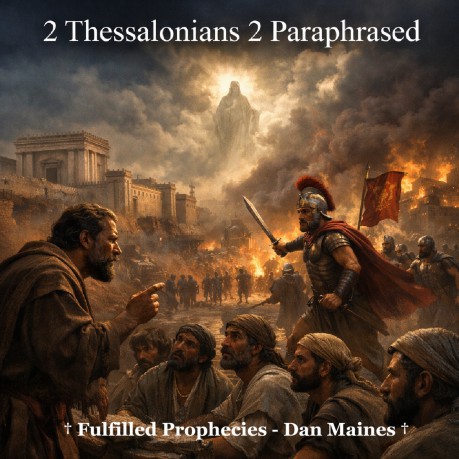
2 Thessalonians 2 Paraphrased Introduction † Paul wrote this section to calm believers who
were being shaken by false claims that the day of the Lord had
already arrived. 2 Thessalonians 2:1 † Paul begins by addressing the concern about
Christ's coming and the gathering of believers, which many in the
church feared had already happened (Matthew 24:30-31). 2 Thessalonians 2:2 † False teachers were claiming apostolic
authority to spread confusion among believers (Acts 20:29-30). 2 Thessalonians 2:3 † The rebellion refers to the widespread
apostasy within Israel before the destruction of Jerusalem (Matthew
23:37-38). 2 Thessalonians 2:4 † Roman emperors demanded worship and divine
titles, placing themselves above every god of the nations. 2 Thessalonians 2:5 † Paul had already explained these prophetic
developments to the church during his earlier visits (Acts 17:1-9). 2 Thessalonians 2:6 † Something was restraining the full rise of
this lawless power during that period. 2 Thessalonians 2:7 † Lawlessness was already growing within Israel
and the wider Roman world during the first century (Matthew 24:12). 2 Thessalonians 2:8 † Christ's victory over this lawless system
would come through judgment, not through a physical battle (Isaiah
11:4). 2 Thessalonians 2:9 † Deceptive signs and false prophets were
widespread during the years leading up to the Jewish war (Matthew
24:24). 2 Thessalonians 2:10 † Many within Israel rejected the message of
Christ and the apostles (John 5:40). 2 Thessalonians 2:11 † When people reject the truth repeatedly, God
allows them to follow the deception they prefer (Romans 1:24-25). 2 Thessalonians 2:12 † The judgment fell upon those who rejected the
gospel and supported the corrupt system opposing Christ. 2 Thessalonians 2:13 † Paul contrasts the faithful believers with
those who rejected the truth. 2 Thessalonians 2:14 † The gospel call brought believers into the
glory and kingdom of Christ (Colossians 1:13). 2 Thessalonians 2:15 † Paul encourages them to remain faithful to
apostolic teaching. 2 Thessalonians 2:16 † Paul closes this section with a prayer of
encouragement. 2 Thessalonians 2:17 † Despite persecution and confusion, believers
were called to continue living faithfully. Historical References † Josephus describes the false prophets and
chaos leading up to the Jewish War in Antiquities of the Jews and The
Jewish War. How It Applies To Us Today † This passage reminds us that God is always in
control of history even when events seem chaotic. Q & A Appendix Q: What rebellion was Paul referring to? Q: Who was the man of lawlessness? Q: What restrained the lawless one? Q: When was the lawless one destroyed? Q: What lesson does this passage teach believers
today? † This is the fulfilled perspective we proclaim at
Fulfilled Prophecies † Source Index † 2 Thessalonians 2
By Dan Maines
† Some people were spreading
letters and messages pretending to be from the apostles, causing fear
and confusion among the churches.
† Paul
reminds them that certain events had to happen first, and that God
was still in control of everything unfolding in their generation.
Now concerning the
coming of our Lord Jesus Christ and our being gathered together to
him, brothers, we ask you to think carefully about what you have
heard.
†
The gathering refers to the uniting of Christ's people as the old
covenant world was coming to its end (Hebrews 12:22-24).
†
The early church understood this gathering in connection with the
judgment coming upon Jerusalem.
Don't be quickly shaken
in your thinking or alarmed by some spirit, message, or letter
claiming to come from us saying the day of the Lord has already
arrived.
†
Paul warns them not to panic because rumors and forged teachings were
already circulating among the churches.
† The
day of the Lord was still approaching and had not yet fully unfolded.
Don't let anyone deceive
you in any way, because that day won't come until the rebellion
happens first and the man of lawlessness is revealed, the son of
destruction.
† The man of lawlessness
represents a lawless leader connected with the corrupt leadership
opposing Christ and the church (Daniel 11:36).
†
Many early Christians associated this lawless figure with the Roman
ruler Nero and the persecution he unleashed against believers.
He opposes and lifts
himself above every so called god or object of worship, so that he
takes his seat in the temple of God presenting himself as if he were
God.
†
Nero in particular accepted divine honors and required loyalty
expressed through emperor worship.
† The
temple language reflects the power structure tied to Jerusalem and
its corrupt leadership cooperating with Roman authority.
Don't you remember that
while I was still with you I kept telling you these things?
†
His teachings about the coming judgment and rebellion were not new to
them.
† The Thessalonians were expected to
recall what the apostles had already taught.
And now you know what is
holding him back so that he will be revealed at the proper time.
† Many
early interpreters believed the Roman governing structure itself was
restraining chaos until the right moment.
†
God was controlling the timing of these events so they unfolded
exactly when prophecy required.
The mystery of
lawlessness is already at work, only the one who restrains it now
will continue to do so until he is taken out of the way.
†
The restraint refers to the political order that was temporarily
holding back open rebellion and persecution.
†
Once that restraint was removed, the full crisis would unfold leading
up to the war with Rome.
Then the lawless one
will be revealed, whom the Lord Jesus will overthrow with the breath
of his mouth and destroy by the appearance of his coming.
† The destruction happened through the
events that culminated in the fall of Jerusalem in AD 70.
†
Jesus had already warned that this generation would see these things
take place (Matthew 24:34).
The coming of that
lawless one happens by the working of Satan with all kinds of power
and false signs and deceptive wonders.
† Josephus records numerous false
prophets and miracle claims stirring the crowds during this period.
†
These movements misled many people into rebellion and destruction.
They use every kind of
deception of wickedness among those who are perishing because they
refused to love the truth so that they could be saved.
† Their
rejection of the truth left them vulnerable to deception and false
hope.
† This refusal ultimately led to the
catastrophic destruction of the nation.
For this reason God
sends them a powerful delusion so they will believe the lie.
†
Israel's leaders had already hardened themselves against Christ's
message.
† Their continued rejection resulted
in spiritual blindness before the coming judgment.
So that all will be
judged who didn't believe the truth but took pleasure in
unrighteousness.
†
This judgment unfolded historically in the destruction of Jerusalem
and its temple.
† It confirmed that Christ's
warnings about that generation were completely fulfilled.
But we should always
give thanks to God for you brothers loved by the Lord, because God
chose you from the beginning for salvation through the Spirit's work
in making you holy and through your belief in the truth.
† The Spirit
was actively working within the church to preserve and guide them.
†
Their faith placed them among the people of the new covenant kingdom.
It was for this that he
called you through our gospel so that you may share in the glory of
our Lord Jesus Christ.
†
This glory wasn't a distant future hope but a present participation
in Christ's reign.
† The church was already
experiencing the reality of that kingdom.
So then brothers stand
firm and hold tightly to the teachings that you were taught whether
through what we said or through the letters we wrote to you.
† Both spoken teaching
and written letters carried the authority of Christ's message.
†
Stability in truth protected the church from deception.
Now may our Lord Jesus
Christ himself and God our Father who loved us and gave us eternal
encouragement and good hope by grace,
† Their hope was grounded in
God's grace and love rather than the chaos unfolding around them.
†
The believers were reminded that their future was secure in Christ.
encourage your hearts
and strengthen you in every good work and word.
†
Their strength came from God who was sustaining them through the
transition of the ages.
† The church was
being established as the enduring kingdom that would remain after the
old covenant world passed away.
† Irenaeus acknowledged that
early Christians connected prophetic warnings about lawless rulers
with the Roman persecutions.
† Eusebius
records the destruction of Jerusalem and the fulfillment of Christ's
warnings to that generation.
† Clement of
Alexandria wrote about the persecutions under Roman rulers and the
endurance of the early church.
†
Believers must remain grounded in the truth so they are not shaken by
false teachings.
† The kingdom Christ
established continues to grow and endure long after the old covenant
system ended.
† Just as the early church
stood firm during their trials, we are called to stand firm in faith
today.
A:
The widespread apostasy in Israel that rejected Christ and led to the
events surrounding the destruction of Jerusalem (Matthew 23:37-38).
A:
A lawless ruler connected with the persecuting Roman leadership,
commonly associated with Nero who violently opposed the church.
A:
The existing political order that temporarily held back the full
outbreak of rebellion and persecution until the proper time.
A:
Through the judgment events culminating in the destruction of
Jerusalem in AD 70, fulfilling Jesus' warnings to that generation
(Matthew 24:34).
A: That we must remain rooted in the
truth and not be shaken by deception or false teaching.
© Fulfilled Prophecies - Dan
Maines.
†
Josephus, Antiquities of the Jews
† Irenaeus,
Against Heresies
† Eusebius, Ecclesiastical
History
† Clement of Alexandria, Stromata
Links