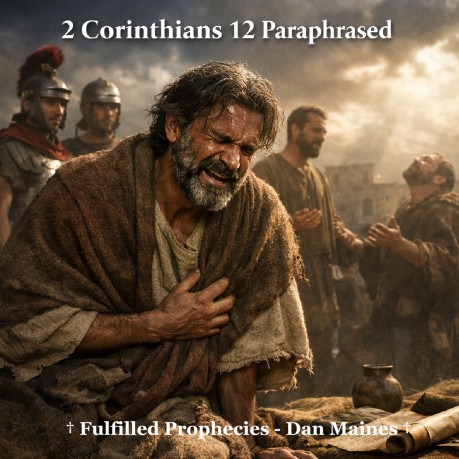
2 Corinthians 12 Paraphrased Introduction 2 Corinthians 12:1 2 Corinthians 12:2 2 Corinthians 12:3 2 Corinthians 12:4 2 Corinthians 12:5 2 Corinthians 12:6 2 Corinthians 12:7 2 Corinthians 12:8 2 Corinthians 12:9 2 Corinthians 12:10 2 Corinthians 12:11 2 Corinthians 12:12 2 Corinthians 12:13 2 Corinthians 12:14 2 Corinthians 12:15 2 Corinthians 12:16 2 Corinthians 12:17 2 Corinthians 12:18 2 Corinthians 12:19 2 Corinthians 12:20 2 Corinthians 12:21 Historical References How It Applies To Us Today Q & A Appendix Q: Why did Paul talk about visions and
revelations? Q: What was the thorn in the flesh? Q: Why didn't God remove Paul's suffering? Q: What does it mean that grace is sufficient? Q: Why did Paul refuse financial support from
Corinth? † This is the fulfilled perspective we proclaim at
Fulfilled Prophecies † Source Index
By Dan Maines
† Paul
continues defending his apostleship, but he does it in a way
completely opposite from worldly boasting.
†
Instead of bragging about power or status, he points to suffering,
weakness, and God's grace working through him.
†
This chapter shows that God's strength is revealed through human
weakness, a theme repeated throughout Paul's ministry (1 Corinthians
1:27-29).
I must go on boasting,
though it accomplishes nothing, but I'll speak about visions and
revelations the Lord gave.
† Paul reluctantly
continues his defense because false teachers were boasting about
spiritual experiences.
† His purpose isn't
self-glory but to show that God truly revealed things to him as an
apostle (Acts 9:15-16).
† The early church
understood Paul as a chosen messenger entrusted with revelation.
I know a man in Christ
who fourteen years ago was caught up to the third heaven. Whether it
happened in the body or outside the body I don't know, God knows.
†
Paul speaks about himself in the third person to avoid sounding
prideful.
† The third heaven was understood
in Jewish thought as the dwelling place of God (Genesis 28:17).
†
This experience shows the depth of revelation Paul received for the
church.
And I know that this man
was caught up into paradise. Whether in the body or apart from the
body I don't know, God knows.
† Paradise was
a term used for the place of God's presence and blessing (Luke
23:43).
† Paul's emphasis isn't on the
experience itself but on God's authority over it.
†
Early Christians often described paradise as the place where God's
presence was revealed.
He heard things that
cannot be spoken, words that a person isn't allowed to repeat.
†
Some revelations were too sacred to repeat publicly.
†
This shows Paul's restraint and humility compared to false teachers
who exaggerated spiritual experiences.
† God
sometimes reveals truths that remain beyond human explanation
(Deuteronomy 29:29).
I'll boast about such a
man, but I won't boast about myself except in my weaknesses.
†
Paul shifts the focus away from supernatural experiences and toward
weakness.
† This reverses worldly ideas of
strength and success.
† The gospel itself
centers on the weakness of the cross becoming the power of God (1
Corinthians 1:18).
Even if I did want to
boast, I wouldn't be foolish because I'd be speaking the truth, but I
hold back so no one will think more of me than what they see or hear
from me.
† Paul's concern is that believers
judge him by his life and message, not by extraordinary stories.
†
True ministry is measured by faithfulness, not spectacle (Galatians
1:10).
† This reveals Paul's humility despite
his authority as an apostle.
Because of the greatness
of these revelations, a thorn in the flesh was given to me, a
messenger of Satan to torment me so I wouldn't become arrogant.
†
The thorn kept Paul humble despite extraordinary revelation.
†
God allowed the affliction to prevent pride and to strengthen Paul's
dependence on Him.
† Suffering often plays a
role in shaping faithful servants of God (Romans 5:3-5).
Three times I pleaded
with the Lord to remove it from me.
† Paul
earnestly asked God for relief from this suffering.
†
His repeated prayer shows that faithful believers still struggle with
hardship.
† Even apostles experienced
unanswered requests when God's greater purpose was at work.
But He said to me, My
grace is enough for you, because My power is made perfect in
weakness. So I'll gladly boast about my weaknesses so Christ's power
may rest on me.
† God's grace becomes most
visible when human strength fails.
† The
weakness Paul endured became a stage for God's power.
†
This principle explains much of the suffering endured by early
Christians.
Therefore I'm content
with weaknesses, insults, hardships, persecutions, and difficulties
for Christ's sake, because when I'm weak then I'm strong.
†
Paul learned that suffering for Christ isn't defeat but participation
in God's work.
† Weakness becomes the place
where divine strength appears.
† This mindset
transformed how the early church viewed persecution.
I've become foolish in
boasting. You forced me into it. I should have been commended by you,
because I'm not inferior to those so called super apostles even
though I'm nothing.
† Paul refers
sarcastically to false teachers who claimed greater authority.
†
The Corinthians should have defended the apostle who founded their
church.
† Paul reminds them that genuine
authority comes from God's calling, not personal promotion.
The true signs of an
apostle were performed among you with great perseverance, signs,
wonders, and miracles.
† Apostolic authority
was confirmed by miracles and endurance.
†
These signs validated Paul's message and ministry.
†
The early church recognized such works as evidence of divine
authority.
How were you treated
worse than the other churches, except that I didn't burden you
financially? Forgive me for this wrong.
†
Paul ironically apologizes for not taking money from them.
†
His refusal to burden them financially was meant to protect the
gospel's credibility.
† False teachers often
exploited believers financially.
Now I'm ready to visit
you for the third time, and I won't be a burden to you because I'm
not seeking what belongs to you but you yourselves. Children
shouldn't store up for their parents, parents should store up for
their children.
† Paul's concern is the
spiritual well being of the believers, not financial gain.
†
His pastoral care reflects the heart of a spiritual father.
†
The relationship between Paul and the church was deeply personal.
I'll gladly spend and be
spent for your souls. If I love you more, will I be loved less?
†
Paul's devotion to the church is sacrificial.
†
Ministry often involves loving people who don't always return that
love.
† This reflects Christ's own
sacrificial love for His people (John 15:13).
But even if I wasn't a
burden to you, some say I was crafty and took advantage of you by
deception.
† False accusations were being
spread about Paul.
† Opponents tried to
discredit him to gain influence.
† This
tactic has appeared throughout church history.
Did I exploit you
through anyone I sent to you?
† Paul
challenges the accusations directly.
† His
associates also served with integrity.
† The
integrity of his ministry team confirmed his sincerity.
I urged Titus to visit
you and sent another brother with him. Did Titus exploit you? Didn't
we walk in the same spirit and follow the same steps?
†
Titus served the church faithfully without taking advantage of
anyone.
† Paul's coworkers followed the same
standards of honesty.
† The unity of their
conduct demonstrated genuine ministry.
Have you been thinking
all along that we've been defending ourselves to you? We're speaking
in Christ before God, and everything we do is for your
strengthening.
† Paul's goal wasn't self
defense but building up the church.
† His
words were spoken with accountability before God.
†
True spiritual leadership always seeks the good of the believers.
I'm afraid that when I
come I may not find you as I wish, and you may not find me as you
wish. I fear there may be strife, jealousy, anger, selfish ambition,
slander, gossip, arrogance, and disorder.
†
Paul was concerned about ongoing division within the church.
†
These sins destroy unity and weaken the body of Christ.
†
Church discipline sometimes became necessary to restore order.
I'm afraid that when I
come again my God may humble me before you and I'll mourn for many
who previously sinned and haven't repented of impurity, sexual
immorality, and reckless behavior they practiced.
†
Paul's sorrow would come from seeing believers refuse to repent.
†
Persistent sin harms the entire church community.
†
Repentance was necessary for restoration and spiritual health.
†
Irenaeus explained that Paul's suffering proved the authenticity of
his apostleship rather than diminishing it.
†
Clement of Alexandria wrote that Paul's humility demonstrated the
character required of Christian leaders.
†
Eusebius recorded that early Christians saw Paul's endurance in
weakness as evidence of divine strength at work.
†
God's strength still works through human weakness, not through human
pride.
† Believers shouldn't measure
faithfulness by worldly success or recognition.
†
Suffering and hardship often shape deeper faith and dependence on
God.
† True leadership in the church is
marked by humility, sacrifice, and care for others.
A: To show that God truly revealed
things to him as an apostle (Acts 9:15-16).
A:
Scripture doesn't identify it specifically, but it served to keep
Paul humble and dependent on God's grace (Galatians 4:13-15).
A:
Because God's power is displayed through weakness (1 Corinthians
1:27).
A:
God's sustaining favor provides strength even when circumstances
remain difficult (Hebrews 4:16).
A: To prevent accusations that he was
preaching for profit (1 Corinthians 9:12).
© Fulfilled Prophecies - Dan
Maines.
† 2
Corinthians 12
† Irenaeus, Against Heresies
†
Eusebius, Ecclesiastical History
† Clement of
Alexandria, Stromata
Links