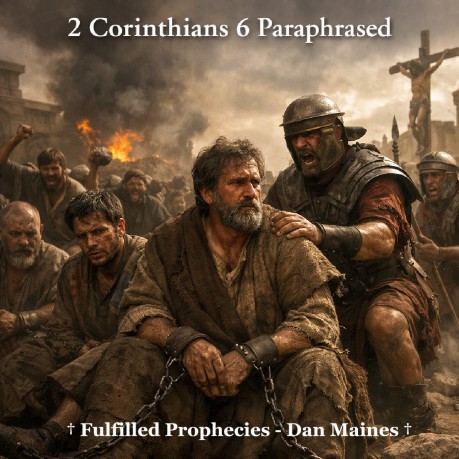
2 Corinthians 6 Paraphrased Introduction 2 Corinthians 6:1 2 Corinthians 6:2 2 Corinthians 6:3 2 Corinthians 6:4 2 Corinthians 6:5 2 Corinthians 6:6 2 Corinthians 6:7 2 Corinthians 6:8 2 Corinthians 6:9 2 Corinthians 6:10 2 Corinthians 6:11 2 Corinthians 6:12 2 Corinthians 6:13 2 Corinthians 6:14 2 Corinthians 6:15 2 Corinthians 6:16 2 Corinthians 6:17 2 Corinthians 6:18 Historical References How It Applies To Us Today Q & A Appendix Q What does it mean to receive God's grace in
vain? Q Why did Paul say now is the day of salvation? Q Why did the apostles suffer so much? Q What does it mean that believers are the temple
of God? Q Why did Paul warn about being unequally yoked
with unbelievers? † This is the fulfilled perspective we proclaim at
Fulfilled Prophecies † Source Index
By Dan Maines
† Paul
continues urging the Corinthians not to waste the grace that God has
given them. He reminds them that the time of salvation had arrived in
their generation, and that the ministry of the apostles came with
hardship, endurance, and faithful service.
†
This chapter shows the urgency of the gospel during the transition
period before the judgment of Jerusalem. The apostles were calling
people out of the old covenant world before its final collapse in AD
70.
† The message is clear, God had opened
the door of reconciliation, and people needed to respond while that
door stood open.
Working together with God,
we urge you not to receive His grace and then treat it as if it meant
nothing.
† Paul reminds believers that grace
is not something to ignore or take lightly. It demands a response of
faith and obedience (Romans 6:1-2).
† The
apostles saw themselves as laborers with God in the work of
reconciliation, calling people into the new covenant life (1
Corinthians 3:9).
† The warning shows that
people could hear the gospel yet fail to embrace it fully during that
critical generation.
For He says, At the time I
showed you favor I listened to you, and on the day of salvation I
helped you. Look, now is the time of favor. Now is the day of
salvation.
† Paul quotes Isaiah to show that
the promised time of salvation had arrived in his own generation
(Isaiah 49:8).
† The apostles consistently
taught that the fulfillment of God's promises was happening in their
lifetime (Hebrews 1:1-2).
† This urgency
shows that the prophetic timetable was active and moving toward its
climax in the first century.
We make sure that we place
no obstacle in anyone's path, so that no one can criticize the work
we are doing.
† Paul lived carefully so the
gospel would not be discredited by his conduct (1 Corinthians
9:12).
† The integrity of the messenger was
essential because the apostles represented Christ Himself.
†
Their conduct demonstrated that the new covenant ministry was
honorable and trustworthy.
Instead, in everything we
do we show that we are servants of God, enduring hardships, troubles,
and difficulties with patience.
† Apostolic
ministry was marked by suffering rather than comfort (Acts 14:22).
†
Their endurance confirmed that their mission came from God and not
from personal ambition.
† The early church
recognized suffering as part of faithful service in the kingdom.
We have been beaten,
imprisoned, and surrounded by riots. We have worked to exhaustion,
gone without sleep, and endured hunger.
†
Paul is describing the real cost of preaching Christ in the Roman
world (Acts 16:23).
† These hardships showed
the depth of dedication the apostles had to their mission.
†
Their suffering also fulfilled Jesus' warnings that His messengers
would face persecution (John 15:20).
Yet we continue in purity,
knowledge, patience, kindness, and in the power of the Holy Spirit,
showing genuine love.
† Paul contrasts
outward suffering with inward spiritual strength.
†
The Spirit empowered the apostles to demonstrate Christlike character
despite opposition (Galatians 5:22-23).
†
Genuine love was the mark of the true servants of Christ.
We speak the truth of God,
and the power of God works through us. We carry the weapons of
righteousness in both our right hand and our left.
†
The apostles relied on truth and righteousness rather than worldly
power (Ephesians 6:14).
† The imagery of
weapons shows spiritual warfare against deception and unbelief.
†
Their defense and offense were both grounded in God's righteousness.
We are treated with honor
by some and dishonor by others. Some praise us while others accuse us
of being deceivers, yet we remain faithful.
†
The apostles experienced both acceptance and rejection depending on
their audience.
† Truth often produces
divided reactions among people (Acts 17:32).
†
Despite criticism, the apostles continued their mission.
We are treated as if
nobody knows us, yet we are well known. People think we are dying,
yet we keep living. We are punished, yet we are not destroyed.
†
The world often overlooked the apostles, but God fully knew them (1
Corinthians 4:9-13).
† Their survival through
persecution showed God's sustaining power.
†
Their lives illustrated the paradox of suffering and victory in
Christ.
We appear sorrowful, yet
we are always rejoicing. We seem poor, yet we enrich many people. We
have nothing, yet we possess everything.
†
This describes the spiritual wealth believers possess even in
hardship (Matthew 5:12).
† The gospel brought
eternal riches to others through their preaching.
†
Their joy came from the kingdom of God rather than material
circumstances.
Corinthians, we have
spoken openly to you, and our hearts are wide open.
†
Paul emphasizes the sincerity of his relationship with the Corinthian
believers.
† His openness reflected genuine
pastoral care.
† The apostles did not hide
their intentions or manipulate their audience.
You are not restricted by
us, but you are restricted by your own feelings.
†
Paul explains that any distance between them was not caused by the
apostles.
† The Corinthians themselves had
allowed their affections to become divided.
†
Spiritual growth requires openness toward those who teach truth.
Now in return, I speak as
to children, open your hearts to us also.
†
Paul urges them to respond with the same love he had shown them.
†
Mutual affection strengthened unity within the church.
†
Spiritual family relationships were central to the early Christian
communities.
Do not bind yourselves
together with unbelievers in ways that place you under their
influence. For what partnership can righteousness have with
lawlessness? What fellowship can light have with darkness?
†
Paul warns believers not to compromise their faith by forming
spiritual alliances with unbelief.
† The
contrast between light and darkness reflects the difference between
the old covenant world and the new covenant life in Christ (John
8:12).
† The call is for spiritual separation
from corrupt influences.
What harmony can exist
between Christ and Belial? What share does a believer have with an
unbeliever?
† Paul uses strong contrasts to
show the incompatibility between Christ and evil.
†
Belial was a Jewish term representing wickedness or rebellion against
God.
† The believer's identity is rooted in
Christ, not in the systems of the world.
What agreement can there
be between the temple of God and idols? For we are the temple of the
living God, just as God said, I will live among them and walk among
them. I will be their God, and they will be My people.
†
Paul declares that believers themselves are now God's temple (1
Corinthians 3:16).
† This reflects the shift
from the physical temple in Jerusalem to the living spiritual temple
of God's people.
† The promise echoes
covenant language from Leviticus and Ezekiel about God's dwelling
with His people.
Therefore come out from
among them and separate yourselves, says the Lord. Do not touch what
is unclean, and I will welcome you.
† This
call echoes the prophetic warnings for Israel to separate from
corruption (Isaiah 52:11).
† In the first
century context, believers were leaving the old covenant system that
was approaching judgment.
† The church was
being formed as a distinct holy people.
And I will be a Father to
you, and you will be My sons and daughters, says the Lord Almighty.
†
God promises a restored family relationship with His people.
†
Through Christ, believers receive the full status of children of God
(Romans 8:15).
† This fulfilled the covenant
promise that God would dwell with and adopt His people.
†
Josephus described the turmoil of Judea leading up to AD 70,
confirming the intense pressures believers faced during this
generation.
† Irenaeus wrote that the
apostles endured extreme suffering while faithfully spreading the
gospel throughout the Roman world.
† Eusebius
recorded the persecution and hardships experienced by the early
church, showing the accuracy of Paul's descriptions of apostolic
trials.
†
We are reminded that God's grace is not something to ignore. It calls
us to live faithfully.
† Believers today
still represent God's temple, meaning our lives reflect His
presence.
† We are called to separate from
corruption and live as God's people in the world.
†
The faithfulness of the apostles encourages us to endure hardship
with the same dedication.
† Christ still
invites people to respond to the grace that has already been
revealed.
A It means hearing the gospel but failing
to respond with faithful obedience (Hebrews 2:1-3).
A
Because the fulfillment of the promised salvation had arrived during
the apostolic generation (Isaiah 49:8; Hebrews 1:1-2).
A
Their suffering confirmed the authenticity of their mission and
fulfilled Jesus' warnings about persecution (John 15:20).
A God's presence now dwells within His
people rather than in a physical building (1 Corinthians 3:16).
A Because spiritual
compromise can weaken faith and lead believers away from
righteousness (Ephesians 5:11).
© Fulfilled Prophecies - Dan
Maines.
† 2
Corinthians 6
† Josephus, The Jewish War
†
Irenaeus, Against Heresies
† Eusebius,
Ecclesiastical History
Links