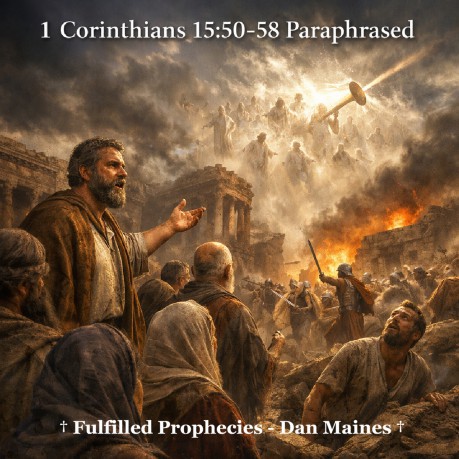
1 Corinthians 15:50-58
Paraphrased Introduction 1 Corinthians 15:50 1 Corinthians 15:51 1 Corinthians 15:52 1 Corinthians 15:53 1 Corinthians 15:54 1 Corinthians 15:55 1 Corinthians 15:56 1 Corinthians 15:57 1 Corinthians 15:58 Historical References How It Applies To Us Today Q & A Appendix Q What gave death its power according to Paul? Q What prophecy was fulfilled when death was
swallowed up in victory? Q How did Christ give believers victory over
death? Q Why did Paul urge believers to stand firm in
their work? † This is the fulfilled perspective we proclaim at
Fulfilled Prophecies † Source Index 1 Corinthians 15:1-19 Paraphrased https://fulfilledprophecies.com/topics/1062.html
1 Corinthians 15:20-49 Paraphrased https://fulfilledprophecies.com/topics/1063.html 1 Corinthians 15:50-58 Paraphrased https://fulfilledprophecies.com/topics/1064.html
By Dan Maines
† Paul
closes this chapter by explaining that the old mortal condition tied
to the corruptible world could not inherit the eternal kingdom Christ
was establishing.
† The change he describes
was not about corpses leaving graves centuries later, it was about
the transformation from the old covenant age of death into the new
covenant life in Christ.
† The fulfillment of
this promise was tied to the end of the age Jesus spoke about, when
the power of death connected to the law was removed (Matthew 24:34;
Hebrews 9:26).
Now I'm telling you
this, brothers, flesh and blood cannot inherit the kingdom of God,
and what is perishable cannot inherit what is imperishable.
†
Paul is explaining that the old mortal order connected to the Adamic
world could not enter the eternal kingdom Christ was bringing.
†
This doesn't mean believers stop existing physically, it means the
mortal covenant system tied to corruption couldn't inherit the
eternal life Christ established (Romans 8:10-11).
†
The old covenant world centered in Jerusalem was passing away, and a
new spiritual order was being revealed (Hebrews 12:27-28).
Listen, I'm revealing a
mystery to you, we won't all fall asleep, but we will all be
changed.
† The mystery Paul speaks of was the
transformation of living believers during that generation.
†
Some believers would still be alive when the change took place, which
shows this event belonged to their lifetime.
†
Jesus said the same thing when he told his disciples some standing
there wouldn't taste death until they saw the Son of Man coming in
his kingdom (Matthew 16:27-28).
In a moment, in the
blink of an eye, at the last trumpet, the trumpet will sound, the
dead will be raised imperishable, and we will be changed.
†
The last trumpet points to the closing of the old covenant age and
the full establishment of Christ's kingdom.
†
The resurrection here refers to the dead in Christ being raised into
the new covenant life, while the living believers were transformed
into that same life.
† This aligns with the
gathering of the elect Jesus described when the trumpet sounded
during the judgment on Jerusalem (Matthew 24:31).
This perishable must put
on the imperishable, and this mortal must put on immortality.
†
Paul is describing the transition from a covenant system tied to
death into the eternal life revealed through Christ.
†
The change wasn't about exchanging physical bodies but about
receiving the life of the Spirit that cannot die (2 Corinthians
5:1-4).
† Through Christ the people of God
entered a state where death no longer ruled over them.
When the perishable puts
on the imperishable and the mortal puts on immortality, then the
saying will come true, Death is swallowed up in victory.
†
Paul connects this moment to the fulfillment of the prophetic promise
that death would be defeated.
† This victory
came through Christ's finished work and the removal of the law that
empowered death.
† Isaiah foresaw this when
he said God would swallow up death forever (Isaiah 25:8).
Where, O death, is your
victory, where, O death, is your sting.
†
Paul is declaring that death had lost its authority over God's
people.
† Once the covenant of condemnation
ended, death no longer had the same power it once held.
†
This is the triumphant announcement that the enemy of death had been
defeated through Christ.
The sting of death is
sin, and the power of sin is the law.
† Paul
identifies the real source of death's power, the law that exposed and
condemned sin.
† As long as the old covenant
law stood, death continued to reign over the people.
†
When Christ fulfilled and removed that system, the power of death was
broken (Romans 7:9-11).
But thanks be to God,
who gives us the victory through our Lord Jesus Christ.
†
The victory Paul celebrates is the triumph Christ achieved through
his death and resurrection.
† Through him
believers entered the life that cannot be overcome by death.
†
This victory was fully revealed when the old covenant world finally
ended.
So then, my beloved
brothers, stand firm, don't be moved, always continue in the work of
the Lord, knowing your labor in the Lord isn't in vain.
†
Because Christ had already secured the victory, believers could
remain confident in their mission.
† Their
work in spreading the gospel was part of God's plan to bring the
kingdom to completion.
† Paul reminds them
that everything they endured had purpose because the promised
transformation was near (Hebrews 10:37).
†
Josephus records the destruction of Jerusalem and the end of the
temple system in AD 70, marking the close of the old covenant
order.
† Eusebius wrote that the early
Christians understood the fall of Jerusalem as the fulfillment of
Christ's prophetic warnings.
† Irenaeus
taught that Christ's victory over death came through his resurrection
and the establishment of the new covenant kingdom.
†
Clement of Alexandria explained that believers now live in the life
of Christ that cannot be overcome by death.
†
We live in the completed kingdom Christ established, not in a waiting
period for another age.
† Death no longer has
authority over the people of God because the covenant that empowered
it has passed away.
† Our calling is to
remain faithful in the work of the Lord, knowing the victory has
already been secured.
† The message of
Christ's completed triumph gives believers confidence, purpose, and
hope.
Q Did
Paul expect this transformation in his own lifetime?
A
Yes, Paul used language showing it would happen in that generation,
saying we will be changed (1 Corinthians 15:51).
A
Paul said the sting of death is sin and the power of sin is the law
(1 Corinthians 15:56).
A Paul was referring
to the prophecy in Isaiah 25:8.
A Through his death and resurrection he
removed the condemnation of the law and brought eternal life (Romans
8:1-2).
A Because the coming transformation
and victory of Christ meant their labor in the Lord wasn't in vain (1
Corinthians 15:58).
© Fulfilled Prophecies - Dan
Maines.
† 1
Corinthians 15
† Josephus, Wars of the Jews
†
Irenaeus, Against Heresies
† Eusebius,
Ecclesiastical History
† Clement of
Alexandria, Stromata
Links