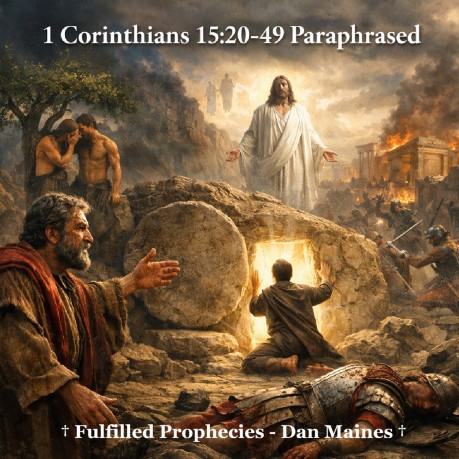
1 Corinthians 15:20-49
Paraphrased 1 Corinthians 15:1-19 Paraphrased https://fulfilledprophecies.com/topics/1062.html
1 Corinthians 15:20-49 Paraphrased https://fulfilledprophecies.com/topics/1063.html 1 Corinthians 15:50-58 Paraphrased https://fulfilledprophecies.com/topics/1064.html
By Dan Maines
Introduction
†
Paul now continues explaining the resurrection and its meaning for
humanity.
† He connects Adam and Christ,
showing how death entered through one man and life came through
another.
† This section explains the
transformation from the natural body to the spiritual body.
†
It reveals the order of resurrection and the victory of Christ over
death.
1 Corinthians 15:20
But now Christ
has been raised from the dead, the first harvest from among those who
have died.
† Christ's resurrection was the
beginning of the greater resurrection harvest that followed
(Leviticus 23:10-11).
† Paul calls Him the
first harvest because others would soon follow in the same
resurrection life.
† The firstfruits always
guaranteed the coming harvest in Israel's covenant system.
1
Corinthians 15:21
Since death came through a man,
resurrection from the dead also came through a man.
†
Adam introduced death into the human story through sin (Romans
5:12).
† Christ reversed that curse by
bringing resurrection life to His people.
†
The solution came through the same channel the problem began, through
a man.
1 Corinthians 15:22
Just as in Adam
everyone dies, in Christ everyone will be made alive.
†
Humanity inherited mortality and corruption through Adam (Romans
5:18-19).
† Those united to Christ receive
life and restoration.
† Paul is contrasting
two covenant heads, Adam and Christ.
1 Corinthians
15:23
But each in their proper order, Christ the first
harvest, after that those who belong to Christ at His coming.
†
Resurrection unfolds in a divine order.
†
Christ rose first as the firstfruits of the resurrection harvest.
†
Those who belonged to Him were raised at His coming in judgment upon
the old covenant world (Matthew 16:27-28).
1 Corinthians
15:24
Then comes the end, when He hands the kingdom
over to God the Father after destroying every rule, authority, and
power.
† The end refers to the end of the old
covenant age (Hebrews 8:13).
† Christ removed
the ruling powers tied to that covenant system.
†
The destruction of Jerusalem marked the full transition of covenant
authority.
1 Corinthians 15:25
For He must
reign until He has placed all His enemies under His feet.
†
Christ began reigning after His resurrection and ascension (Psalm
110:1).
† His reign continued until the
enemies of His kingdom were subdued.
† The
judgment of the old covenant system was part of this victory.
1
Corinthians 15:26
The last enemy that will be destroyed
is death.
† Death represented the covenant
curse inherited from Adam.
† Christ's
resurrection and kingdom work removed its authority over His people
(Hebrews 2:14-15).
† The resurrection
fulfilled the promise that death would not have the final word.
1
Corinthians 15:27
For God has placed everything under
His feet. But when it says everything is placed under Him, it is
clear that this does not include the One who placed everything under
Him.
† Paul clarifies that the Father remains
supreme over the kingdom order.
† Christ
rules as the appointed King under the Father's authority.
†
This reflects the fulfillment of Psalm 8:6 in Christ's reign.
1
Corinthians 15:28
When everything has been placed under
Him, then the Son Himself will also be subject to the One who placed
everything under Him, so that God may be all in all.
†
The completed kingdom results in God's full presence among His
people.
† Christ's mission brings all things
into harmony under the Father.
† The phrase
God may be all in all describes the finished covenant restoration.
1
Corinthians 15:29
Otherwise what will those do who are
baptized for the dead, if the dead are not raised at all? Why then
are they baptized for them?
† Paul references
a known practice among some believers in Corinth.
†
His argument is that belief in resurrection was assumed even by those
practicing it.
† Without resurrection hope
such actions would be meaningless.
1 Corinthians
15:30
And why are we also in danger every hour?
†
The apostles constantly faced persecution for preaching the
resurrection.
† Their suffering proves how
central the resurrection message was.
†
Without resurrection hope these sacrifices would be pointless.
1
Corinthians 15:31
I affirm, brothers and sisters, by
the pride I have in you in Christ Jesus our Lord, that I die every
day.
† Paul describes the daily risks he
faced in his ministry (2 Corinthians 11:23-27).
†
His life was continually threatened because of the gospel.
†
His commitment shows the seriousness of the resurrection message.
1
Corinthians 15:32
If from a human perspective I fought
with beasts in Ephesus, what benefit did it give me if the dead are
not raised? If the dead are not raised, let us eat and drink, for
tomorrow we die.
† Paul argues that suffering
for the gospel only makes sense if resurrection is real.
†
Without resurrection the logical conclusion would be despair and
indulgence (Isaiah 22:13).
† The gospel gives
life purpose beyond death.
1 Corinthians 15:33
Do
not be deceived, bad company corrupts good morals.
†
False teaching about resurrection was spreading among some
believers.
† Paul warns that association with
error damages faith and conduct.
† Sound
doctrine protects both belief and behavior.
1
Corinthians 15:34
Wake up to righteousness and stop
sinning, because some have no knowledge of God. I say this to your
shame.
† Denial of resurrection showed
spiritual ignorance among some teachers.
†
Paul calls the church to wake up and return to righteous thinking.
†
Knowledge of God must shape both belief and conduct.
1
Corinthians 15:35
But someone will ask, how are the
dead raised, and with what kind of body do they come?
†
Paul anticipates the skeptical question about resurrection bodies.
†
This leads into his explanation using examples from creation.
†
The resurrection body is transformed, not identical to the natural
body.
1 Corinthians 15:36
You foolish
person, what you sow does not come to life unless it dies.
†
Paul uses the example of planting seeds.
†
The seed must be buried before new life grows.
†
This illustrates the transformation involved in resurrection.
1
Corinthians 15:37
And what you sow is not the body that
will be, but a bare seed, perhaps wheat or something else.
†
The seed planted in the ground looks nothing like the plant that
emerges.
† Resurrection follows the same
principle of transformation.
† God determines
the final form of the new life.
1 Corinthians 15:38
But
God gives it a body just as He wished, and to each of the seeds a
body of its own.
† God governs the form and
nature of every living body.
† The
resurrection body is therefore God's design.
†
This emphasizes divine power in resurrection.
1
Corinthians 15:39
All flesh is not the same flesh, but
there is one kind for humans, another for animals, another for birds,
and another for fish.
† Paul points to the
diversity already present in creation.
†
Different forms of life have different types of bodies.
†
This proves God can create a different resurrection body.
1
Corinthians 15:40
There are also heavenly bodies and
earthly bodies, but the glory of the heavenly is one, and the glory
of the earthly is another.
† Paul contrasts
earthly existence with heavenly existence.
†
Resurrection belongs to the heavenly order.
†
The new body reflects a different kind of glory.
1
Corinthians 15:41
There is one glory of the sun,
another glory of the moon, and another glory of the stars, because
star differs from star in glory.
† Even
within the heavens there are different levels of glory.
†
This illustrates the variety of glory within God's creation.
†
Resurrection bodies therefore reflect a greater glory than earthly
ones.
1 Corinthians 15:42
So also is the
resurrection of the dead. It is sown perishable, it is raised
imperishable.
† The earthly body decays and
returns to dust.
† The resurrection body is
not subject to corruption.
† This reflects
the victory Christ secured through resurrection.
1
Corinthians 15:43
It is sown in dishonor, it is raised
in glory, it is sown in weakness, it is raised in power.
†
Human bodies experience weakness, sickness, and decay.
†
Resurrection replaces dishonor with glory.
†
The transformation reflects God's restoring power.
1
Corinthians 15:44
It is sown a natural body, it is
raised a spiritual body. If there is a natural body, there is also a
spiritual body.
† The natural body belongs to
the order of Adam.
† The spiritual body
belongs to the order of Christ.
† This
describes the transition from the old creation to the new.
1
Corinthians 15:45
So also it is written, the first man
Adam became a living person, the last Adam became a life giving
spirit.
† Adam received life from God
(Genesis 2:7).
† Christ became the giver of
life to humanity.
† The last Adam introduces
the new creation order.
1 Corinthians 15:46
However
the spiritual is not first, but the natural, then the spiritual.
†
Humanity first experienced the natural life inherited from Adam.
†
The spiritual life came later through Christ.
†
Redemption follows creation in God's order.
1
Corinthians 15:47
The first man is from the earth,
earthy, the second man is from heaven.
† Adam
was formed from the dust of the earth.
†
Christ came from heaven representing the new humanity.
†
These two men represent two different orders of life.
1
Corinthians 15:48
As is the earthy, so also are those
who are earthy, and as is the heavenly, so also are those who are
heavenly.
† Those who remain in Adam share
his earthly nature.
† Those who belong to
Christ share His heavenly life.
† Paul
contrasts two identities for humanity.
1 Corinthians
15:49
Just as we have borne the image of the earthy, we
will also bear the image of the heavenly.
†
Humanity once carried Adam's image of mortality and corruption.
†
Through Christ believers receive the image of the heavenly man.
†
This fulfills the promise of transformation through resurrection
life.
Historical References
†
Irenaeus wrote that Christ reversed Adam's fall and restored life to
humanity in Against Heresies.
† Justin Martyr
taught that the resurrection confirmed Christ's authority over death
in First Apology.
† Eusebius recorded that
the apostles preached resurrection as the central proof of the gospel
in Ecclesiastical History.
† Clement of
Alexandria explained that Christ brought humanity into a higher
spiritual life in Stromata.
How It Applies To Us Today
†
The resurrection shows that Christ has already defeated death.
†
Believers now live under the reign of the risen King.
†
Our identity is no longer defined by Adam but by Christ.
†
The kingdom life calls us to walk according to the Spirit.
†
This gives believers confidence that God's victory is already
established.
Q & A Appendix
Q
What does the first harvest mean in this passage?
A
It means Christ's resurrection began the greater resurrection harvest
that followed (1 Corinthians 15:20).
Q Why does
Paul compare Adam and Christ?
A Adam introduced
death into humanity while Christ brought resurrection life (1
Corinthians 15:21-22).
Q What is the spiritual
body Paul describes?
A It is the transformed
resurrection body belonging to the new life in Christ (1 Corinthians
15:44).
Q What does bearing the image of the
heavenly mean?
A It means sharing in Christ's
life rather than Adam's mortality (1 Corinthians 15:49).
Q
Why was resurrection so central to Paul's message?
A
Because without resurrection the gospel and the apostles' sacrifices
would be meaningless (1 Corinthians 15:30-32).
† This
is the fulfilled perspective we proclaim at Fulfilled Prophecies †
©
Fulfilled Prophecies - Dan Maines.
Source Index
†
1 Corinthians 15
† Irenaeus, Against
Heresies
† Justin Martyr, First Apology
†
Eusebius, Ecclesiastical History
† Clement of
Alexandria, Stromata
Links