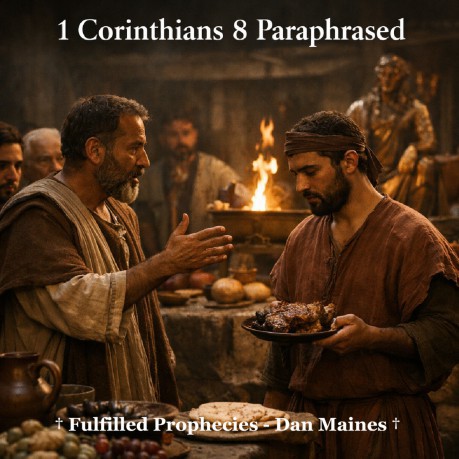
1 Corinthians 8 Paraphrased Introduction 1 Corinthians 8:1 1 Corinthians 8:2 1 Corinthians 8:3 1 Corinthians 8:4 1 Corinthians 8:5 1 Corinthians 8:6 1 Corinthians 8:7 1 Corinthians 8:8 1 Corinthians 8:9 1 Corinthians 8:10 1 Corinthians 8:11 1 Corinthians 8:12 1 Corinthians 8:13 Historical References How it applies to us today Q & A Appendix Q: Why did Paul address food sacrificed to
idols? Q: Was the food itself sinful? Q: Why did Paul still warn believers about eating
it? Q: What principle does Paul emphasize above
knowledge? Q: What example did Paul give to demonstrate
love? † This is the fulfilled perspective we proclaim at
Fulfilled Prophecies † Source Index
By Dan Maines
† This
chapter addresses a real issue the early believers faced, food that
had been sacrificed to idols.
† Paul explains
that knowledge alone is not enough, love must guide how believers
treat one another (1 Corinthians 13:1-2).
†
The discussion also shows the difference between intellectual
understanding and spiritual maturity in the body of Christ.
Now about food sacrificed
to idols, we know that all of us have knowledge. But knowledge by
itself can make a person arrogant, while love builds others up.
†
Paul starts by acknowledging that believers understood idols had no
real power, but knowledge without love can produce pride (1
Corinthians 13:4).
† The problem in Corinth
wasn't the food itself, it was how believers treated weaker brethren
who struggled with the issue (Romans 14:15).
†
Clement of Alexandria wrote that true knowledge must always be
governed by love so that believers don't harm the conscience of
others.
If someone thinks he
understands everything, he hasn't yet come to know as he ought to
know.
† Paul reminds them that spiritual
knowledge requires humility, not arrogance (1 Corinthians 13:12).
†
The person who claims complete understanding shows that he hasn't yet
grasped the full depth of God's wisdom.
†
Irenaeus warned that pride in knowledge was one of the earliest
dangers facing the church.
But if anyone loves God,
that person is known by Him.
† Love is the
true evidence of a relationship with God, not merely having correct
information (1 John 4:7-8).
† Being known by
God reflects covenant relationship rather than intellectual
achievement.
† Eusebius recorded that the
earliest Christians measured maturity by love for God and neighbor.
So concerning eating food
sacrificed to idols, we know that an idol is nothing in the world,
and that there is no God except one.
† Paul
affirms strict monotheism, idols were powerless statues with no real
existence (Isaiah 44:9-20).
† This knowledge
was correct, but it didn't mean everyone could act on it without
harming others.
† Early Christian writers
consistently taught that idols were empty images without divine
power.
Even if there are things
called gods in heaven or on earth, and there are many so called gods
and many so called lords,
† Paul recognizes
the pagan world was filled with many deities and religious systems.
†
These were only called gods by men, not actual divine beings
(Jeremiah 10:11).
† Justin Martyr wrote that
pagan religions created countless gods, but none were the true
Creator.
Yet for us there is one
God, the Father, from whom all things exist and for whom we live, and
one Lord, Jesus Christ, through whom all things exist and through
whom we live.
† This statement echoes the
Shema of Israel, affirming one God while identifying Jesus as Lord
(Deuteronomy 6:4).
† Paul shows the unity of
the Father and Christ in creation and redemption (Colossians 1:16).
†
Early Christians repeatedly used this verse to defend monotheism and
the authority of Christ.
However, not everyone has
this knowledge. Some people are so used to idols that when they eat
such food they still think of it as sacrificed to an idol, and their
conscience becomes defiled because it is weak.
†
Some believers had recently left pagan worship, so eating idol food
triggered their old associations.
† Even
though the idol was nothing, their conscience still felt they were
participating in idolatry (Romans 14:23).
†
Tertullian explained that new converts often struggled with habits
formed during their former pagan life.
Food doesn't bring us
closer to God. We aren't worse if we don't eat it, and we aren't
better if we do.
† Paul makes it clear that
food has no spiritual power to change our standing with God (Mark
7:18-19).
† The kingdom of God isn't based on
dietary choices but on righteousness and peace (Romans 14:17).
†
The issue therefore wasn't the food itself, but how believers
affected one another.
But be careful that your
freedom doesn't become a stumbling block to those who are weak.
†
Christian liberty must always be guided by concern for others
(Galatians 5:13).
† A stumbling block means
causing another believer to fall into sin or violate his
conscience.
† Early church teachers
repeatedly warned that freedom without love could damage the unity of
the church.
If someone with a weak
conscience sees you who have knowledge eating in an idol's temple,
won't he be encouraged to eat what is sacrificed to idols?
†
The weaker believer might imitate the stronger believer even though
he still believes the act is wrong.
† In that
case the person sins because he acts against his conscience (Romans
14:23).
† This shows why love must guide how
believers exercise their freedom.
And because of your
knowledge the weak person is destroyed, the brother for whom Christ
died.
† Paul stresses the seriousness of
harming another believer's faith.
† Christ
died for that person, so their spiritual well being must matter to us
(Romans 14:15).
† The early church emphasized
protecting the spiritual growth of new believers.
When you sin against the
brothers in this way and wound their weak conscience, you sin against
Christ.
† Harming a fellow believer is
treated as sin against Christ Himself (Matthew 25:40).
†
The church is Christ's body, so what affects one member affects the
whole body (1 Corinthians 12:26).
† This
teaching reinforced the seriousness of Christian responsibility
toward others.
Therefore if food causes
my brother to stumble, I will never eat meat again so that I won't
cause my brother to fall.
† Paul concludes by
giving his own example, he would give up personal freedom rather than
harm another believer.
† Love is willing to
sacrifice rights for the good of others (Philippians 2:3-4).
†
This principle shaped early Christian community life and unity.
†
Clement of Alexandria wrote that true Christian knowledge must always
serve love and the building up of the church.
†
Irenaeus warned that pride in knowledge often leads believers away
from humility and unity.
† Eusebius recorded
that the earliest Christians avoided practices that could damage the
conscience of new believers.
† Tertullian
described how converts from paganism struggled with former religious
practices and needed patience from the church.
†
Knowledge alone isn't the goal of the Christian life, love for others
must guide how we use what we know.
† Freedom
in Christ should never be used in ways that harm another believer's
conscience.
† Mature believers must protect
and strengthen those who are still growing in their faith.
†
Unity in the church comes when believers place love above personal
rights.
† The lesson of this chapter reminds
us that Christ died for every believer, so we must treat each other
with care and respect.
A: Because many believers in Corinth
lived among pagan temples where such food was common, creating
confusion for new converts.
A:
No. Paul explained that idols were nothing and food didn't affect a
believer's standing with God.
A: Because it could cause weaker believers
to violate their conscience and fall into sin.
A: Love that builds others up and
protects their faith.
A: He said he would completely give up
eating meat if it caused a brother to stumble.
© Fulfilled Prophecies - Dan
Maines.
† 1
Corinthians 8
† Clement of Alexandria,
Stromata
† Irenaeus, Against Heresies
†
Eusebius, Ecclesiastical History
†
Tertullian, On Idolatry
Links