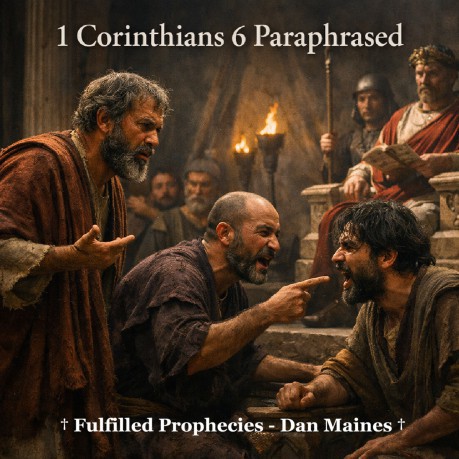
1 Corinthians 6 Paraphrased Introduction 1 Corinthians 6:1 1 Corinthians 6:2 1 Corinthians 6:3 1 Corinthians 6:4 1 Corinthians 6:5 1 Corinthians 6:6 1 Corinthians 6:7 1 Corinthians 6:8 1 Corinthians 6:9 1 Corinthians 6:10 1 Corinthians 6:11 1 Corinthians 6:12 1 Corinthians 6:13 1 Corinthians 6:14 1 Corinthians 6:15 1 Corinthians 6:16 1 Corinthians 6:17 1 Corinthians 6:18 1 Corinthians 6:19 1 Corinthians 6:20 Historical References How it applies to us today Q&A Appendix † This is the fulfilled perspective we proclaim at
Fulfilled Prophecies † Source Index
By Dan Maines
† Paul
confronts a serious problem among the believers in Corinth. Instead
of resolving disputes among themselves with wisdom and maturity, they
were taking each other before pagan courts. This showed a failure to
understand the authority and identity believers had in Christ.
†
The chapter also addresses moral purity, reminding believers that
their bodies belong to the Lord and are not meant for immorality.
Paul connects personal conduct directly to the reality that believers
are the temple of God.
† Early Christians
understood this passage as instruction for living faithfully during
the transition period before the judgment that came upon Jerusalem in
AD 70 (Hebrews 8:13).
When one of you has a
dispute with another believer, how can you dare to take the matter
before unbelieving judges instead of bringing it before God's
people?
† Paul rebukes believers who were
allowing pagan courts to judge matters that should have been settled
within the church community (Matthew 18:15-17).
†
The church was meant to function as a body guided by the wisdom of
Christ, not dependent on worldly authorities to resolve spiritual
matters.
† Clement of Alexandria noted that
Christians were expected to demonstrate higher moral judgment than
the surrounding culture.
Do you not realize that
God's people will judge the world? If the world is to be judged by
you, are you not capable of settling small disputes?
†
Paul reminds them of their future authority in Christ. Believers were
called to share in the judgment of the old covenant world that was
passing away (Matthew 19:28).
† If they would
participate in judging the world, surely they could resolve everyday
conflicts among themselves.
† Irenaeus wrote
that the saints would share in Christ's authority because they belong
to His kingdom.
Do you not know that we
will judge angels? How much more matters that belong to this life?
†
The statement highlights the elevated role believers have in God's
plan.
† Angels here likely refers to fallen
spiritual authorities connected to the old covenant system that was
being judged (2 Peter 2:4).
† Eusebius
explained that the authority of the saints was evidence of the new
covenant order replacing the old.
So if you have disputes
about everyday matters, why do you appoint those with no standing in
the church to judge them?
† Paul exposes the
inconsistency. Those outside the faith were being asked to settle
matters among people who supposedly possessed the wisdom of God.
†
The church was meant to model justice and righteousness before the
world (John 13:35).
I say this to your shame.
Is there not one wise person among you who can decide between
believers?
† Paul appeals to the maturity
that should exist within the church.
† The
body of Christ should always contain people capable of wise
discernment (James 1:5).
Instead, one believer goes
to court against another believer, and this happens in front of
unbelievers.
† Their behavior damaged the
witness of the church.
† Public legal battles
between believers displayed division rather than unity (John 17:21).
The very fact that you
have lawsuits with one another means you have already been defeated.
Why not rather accept being wronged? Why not allow yourselves to be
cheated?
† Paul calls them to a higher
standard, choosing humility instead of demanding personal rights.
†
Jesus taught the same principle when He told His followers to turn
the other cheek (Matthew 5:39).
Instead, you yourselves do
wrong and cheat, and you do this to fellow believers.
†
The problem was not just lawsuits but the sinful behavior behind
them.
† Paul exposes the hypocrisy of harming
the very people who were part of the same spiritual family (Romans
12:10).
Do you not know that those
who practice wrongdoing will not inherit God's kingdom? Do not
deceive yourselves. Those who live in sexual immorality, worship
idols, commit adultery, practice homosexuality,
†
Paul lists behaviors that characterized the old corrupt world
system.
† The kingdom of God required a
transformed life (Galatians 5:19-21).
† Early
Christian writers consistently warned believers not to return to the
moral corruption of pagan society.
thieves, greedy people,
drunkards, slanderers, and swindlers will not inherit God's
kingdom.
† These behaviors reveal hearts that
remain unchanged.
† The new covenant
community was expected to live differently from the surrounding
culture (Ephesians 4:22-24).
And this is what some of
you once were. But you were washed, you were set apart, you were made
right with God in the name of the Lord Jesus Christ and by the Spirit
of our God.
† Paul reminds them that their
identity had changed. They were no longer defined by their past
sins.
† Conversion meant cleansing and
restoration into God's covenant people (Titus 3:5).
You say everything is
permitted for me, but not everything is beneficial. Everything may be
permitted, but I will not allow anything to control me.
†
Christian freedom was never meant to become an excuse for sinful
behavior.
† True freedom means living under
the authority of Christ rather than under the control of desires
(Romans 6:12).
Food is meant for the
stomach and the stomach for food, but God will destroy both of them.
The body is not meant for sexual immorality but for the Lord, and the
Lord for the body.
† Some Corinthians treated
sexual behavior like appetite, something morally neutral.
†
Paul rejects that idea and teaches that the body has a sacred purpose
connected to the Lord.
God raised the Lord from
the dead, and He will also raise us by His power.
†
The resurrection power of God confirmed the future hope of believers
(1 Corinthians 15:44).
† This resurrection
life was tied to the transformation of the covenant people.
Do you not realize that
your bodies are members of Christ? Shall I then take what belongs to
Christ and join it to a prostitute? Absolutely not.
†
Paul stresses the spiritual union believers have with Christ.
†
Sexual immorality contradicts that sacred relationship.
Do you not know that the
one who joins himself to a prostitute becomes one body with her? For
it says the two will become one flesh.
† Paul
quotes the creation principle of unity in Genesis 2:24.
†
Sexual relationships were designed to reflect covenant union.
But the one who joins
himself to the Lord becomes one spirit with Him.
†
This describes the deep spiritual connection believers have with
Christ.
† That union shapes how believers
live and conduct themselves.
Run away from sexual
immorality. Every other sin a person commits is outside the body, but
the sexually immoral person sins against his own body.
†
Paul urges believers to flee immorality rather than flirt with it (2
Timothy 2:22).
† Sexual sin damages both the
body and the spiritual life.
Do you not know that your
body is a temple of the Holy Spirit who is in you, whom you received
from God? You do not belong to yourselves.
†
The imagery of the temple reflects the new covenant reality where
God's presence dwells among His people (Ephesians 2:19-22).
†
Believers collectively form the dwelling place of God.
You were bought with a
price. Therefore honor God with your body.
†
The price refers to Christ's sacrifice which redeemed believers from
the old covenant world (Acts 20:28).
†
Because they belong to Christ, their lives should reflect His
holiness.
†
Josephus described the moral corruption and internal conflict among
Jews and factions leading up to the destruction of Jerusalem in AD
70, which mirrors the warnings Paul gives about judgment and
conduct.
† Irenaeus wrote that believers must
live in holiness because they belong to Christ's kingdom and share in
His authority.
† Clement of Alexandria taught
that Christian conduct must reflect the holiness of the God who
dwells within His people.
† Eusebius recorded
how the early church understood these teachings as preparation for
the great transition that occurred in the first century.
†
Believers today should resolve conflicts with wisdom, humility, and
love rather than hostility and division.
†
Our lives should reflect the reality that we belong to Christ and not
to the world.
† The church should demonstrate
moral integrity in a culture that often rejects God's standards.
†
Remembering that we are the temple of God should shape every decision
we make.
Q: Why did
Paul rebuke believers for going to court?
A:
Because the church was meant to resolve its own disputes with wisdom
and unity (Matthew 18:15-17).
Q: What does it
mean that believers will judge the world?
A: It
refers to the authority Christ gives His people in His kingdom
(Matthew 19:28).
Q: Why is sexual immorality
treated so seriously?
A: Because believers'
bodies belong to Christ and are the temple of the Holy Spirit (1
Corinthians 6:19).
Q: What does it mean that
believers were washed and sanctified?
A: It
means they were cleansed and set apart through Christ (Titus 3:5).
Q:
Why does Paul say believers were bought with a price?
A:
Because Christ's sacrifice redeemed them and made them His own (Acts
20:28).
© Fulfilled Prophecies - Dan
Maines.
† 1
Corinthians 6
† Josephus, Wars of the Jews
†
Irenaeus, Against Heresies
† Eusebius,
Ecclesiastical History
† Clement of
Alexandria, Stromata
Links