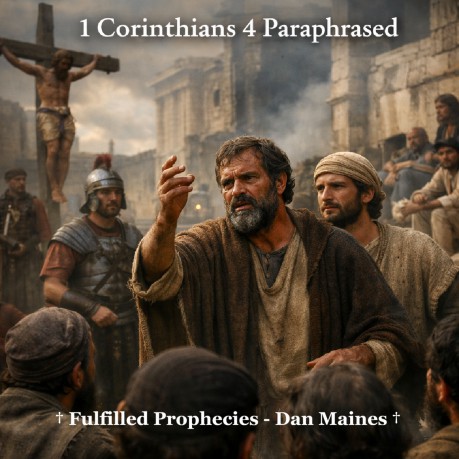
1 Corinthians 4 Paraphrased Introduction 1 Corinthians 4:1 1 Corinthians 4:2 1 Corinthians 4:3 1 Corinthians 4:4 1 Corinthians 4:5 1 Corinthians 4:6 1 Corinthians 4:7 1 Corinthians 4:8 1 Corinthians 4:9 1 Corinthians 4:10 1 Corinthians 4:11 1 Corinthians 4:12 1 Corinthians 4:13 1 Corinthians 4:14 1 Corinthians 4:15 1 Corinthians 4:16 1 Corinthians 4:17 1 Corinthians 4:18 1 Corinthians 4:19 1 Corinthians 4:20 1 Corinthians 4:21 Historical References How It Applies To Us Today Q & A Appendix † This is the fulfilled perspective we proclaim at
Fulfilled Prophecies † Source Index
By Dan Maines
† Paul
continues correcting the pride and division that had grown inside the
Corinthian church. Some believers were elevating certain teachers and
judging others as if they themselves were the final authority. Paul
reminds them that apostles were not celebrities but servants
entrusted with God's message. Their responsibility was faithfulness
to Christ, not the approval of human opinion (1 Corinthians 3:5-9).
†
This chapter exposes spiritual arrogance. The Corinthians believed
they had already reached maturity and authority, but Paul shows the
opposite. True apostles suffered, endured persecution, and served
humbly. Their example stands in sharp contrast to the pride of the
church (2 Corinthians 11:23-28).
† Early
Christian writers also recognized this humility in the apostles.
Clement of Alexandria wrote that the apostles lived lives of hardship
and sacrifice as faithful stewards of Christ's teaching, not rulers
seeking honor.
People should think of us
as servants of Christ and caretakers entrusted with the mysteries God
has revealed.
† Paul shifts the focus away
from personality worship. Apostles weren't leaders competing for
followers but servants entrusted with God's truth (Colossians
1:25-27).
† The word steward refers to a
servant managing a household on behalf of a master. The authority
belonged to Christ, not to the steward himself (Luke 12:42-43).
†
Ignatius of Antioch also described church leaders as servants
entrusted with Christ's teaching rather than masters over believers.
When someone is trusted
with a responsibility like this, the one thing required is that he
proves faithful.
† Faithfulness is the true
measure of ministry, not popularity, success, or public recognition
(Matthew 25:21).
† God's servants are judged
by their loyalty to Christ's message, not by the opinions of people
(Galatians 1:10).
† Tertullian wrote that the
apostles preserved the teachings of Christ faithfully and passed them
down without altering them.
As for me, it matters very
little if I'm judged by you or by any human court. I don't even judge
myself.
† Paul isn't dismissing
accountability, he's showing that human judgment is limited and often
misguided (Romans 14:4).
† Even
self-evaluation can be flawed because people often misunderstand
their own motives (Jeremiah 17:9).
† The
final authority belongs to God alone, who sees the heart.
I may not be aware of
anything wrong in myself, but that doesn't make me innocent. The one
who judges me is the Lord.
† A clear
conscience isn't the same as complete innocence because only God
knows the full truth of every action (Psalm 139:23-24).
†
Paul acknowledges that ultimate judgment belongs to Christ alone (2
Corinthians 5:10).
† This humbles both
teachers and believers because no one stands above God's evaluation.
So stop judging before the
proper time, wait until the Lord comes. He'll bring hidden things in
darkness to light and reveal the motives of every heart. Then each
person will receive praise from God.
† Human
judgment often focuses on appearances, but God reveals hidden motives
(1 Samuel 16:7).
† The coming of the Lord in
judgment exposed the true condition of Israel and vindicated the
faithful apostles (Matthew 16:27-28).
†
Eusebius recorded how early Christians believed the destruction of
Jerusalem revealed God's judgment against those who rejected Christ.
Brothers, I've used myself
and Apollos as examples so you can learn not to go beyond what's
written. Then none of you will become proud by favoring one teacher
over another.
† Paul deliberately uses
himself and Apollos to demonstrate humility and prevent the church
from forming factions (1 Corinthians 3:4-6).
†
The phrase not to go beyond what's written reminds believers to stay
grounded in Scripture rather than human pride (Isaiah 8:20).
†
Irenaeus warned that division in the church often comes when people
elevate personalities above truth.
What makes you different
from anyone else? What do you have that wasn't given to you? If
everything was given to you, why do you boast as if it wasn't?
†
Every spiritual gift, position, and blessing comes from God, not
personal greatness (James 1:17).
† Pride
forgets that everything we have is received, not earned (John
3:27).
† Augustine later echoed this same
truth, teaching that grace leaves no room for boasting.
You already think you're
full. You already think you're rich. You've begun reigning like kings
without us. I wish you really were reigning so we could reign with
you.
† Paul uses sarcasm to expose their
arrogance. They believed they had already arrived spiritually
(Revelation 3:17).
† The kingdom wasn't about
self-exaltation but about suffering with Christ (Romans 8:17).
†
True reign with Christ comes through faithfulness, not self-appointed
authority.
It seems to me God has
placed us apostles last, like men sentenced to death. We've become a
spectacle to the world, to angels, and to people.
†
Apostles experienced suffering and public humiliation as they carried
the gospel (Acts 5:40-41).
† The image of a
spectacle refers to condemned prisoners displayed in Roman arenas
(Hebrews 10:33).
† Tacitus and other
historians recorded how Christians were publicly displayed and
persecuted in Roman society.
We're fools for Christ's
sake, but you are wise in Christ. We're weak, but you are strong. You
are honored, but we are dishonored.
† Again
Paul uses irony to contrast the suffering apostles with the
self-satisfied Corinthians (2 Corinthians 12:10).
†
True Christian leadership often appears weak to the world (1
Corinthians 1:27).
† The apostles embraced
humility while others sought prestige.
Even now we go hungry and
thirsty. We're poorly clothed, beaten, and have no stable home.
†
Apostolic ministry involved constant hardship and sacrifice (2
Corinthians 11:27).
† Their suffering
reflected the same rejection Jesus endured (John 15:20).
†
Early Christian writings confirm that apostles lived lives of extreme
hardship while spreading the gospel.
We work hard with our own
hands. When we're insulted, we bless. When we're persecuted, we
endure it.
† Paul worked as a tentmaker to
support himself while preaching the gospel (Acts 18:3).
†
This attitude reflects Jesus' command to bless those who persecute
you (Matthew 5:44).
† Christian endurance
became a defining testimony to the watching world.
When we're slandered, we
answer kindly. We've become like the garbage of the world, the dirt
everyone wipes off their feet, even until now.
†
The apostles were treated as worthless by society despite carrying
the truth of Christ (Hebrews 11:36-38).
† The
phrase garbage of the world reflects how the world rejected those
proclaiming the gospel.
† Yet this rejection
fulfilled Jesus' warning that his followers would be hated.
I'm not writing these
things to shame you, but to warn you as my beloved children.
†
Paul's tone shifts from sarcasm to pastoral care. His goal is
correction, not humiliation (Hebrews 12:6).
†
Spiritual leaders correct believers out of love and responsibility
(Proverbs 27:6).
† Clement of Rome also
emphasized that correction within the church should always come from
love.
Even if you had countless
instructors in Christ, you don't have many fathers. I became your
father in Christ Jesus through the gospel.
†
Paul isn't claiming superiority but acknowledging his role as the one
who first brought them the gospel (Acts 18:1-11).
†
Spiritual fatherhood refers to nurturing believers in the faith.
†
Early Christian leaders used similar language to describe
discipleship relationships.
So I urge you to follow
my example.
† Paul calls them to imitate his
humility, sacrifice, and faithfulness (Philippians 3:17).
†
Christian leadership leads by example, not by dominance (1 Peter
5:3).
† The apostles modeled a life centered
on Christ.
That's why I've sent
Timothy to you. He's my beloved and faithful child in the Lord, and
he'll remind you of my ways in Christ, just as I teach everywhere in
every church.
† Timothy served as Paul's
trusted representative (Philippians 2:19-22).
†
The message taught in Corinth was the same message taught
everywhere.
† Unity in doctrine was essential
for the early church.
Some of you have become
arrogant, thinking I won't come to you.
†
Pride had led certain believers to challenge Paul's authority.
†
Arrogance often grows when people believe accountability is absent
(Proverbs 16:18).
† Paul confronts this
directly.
But I'll come to you soon
if the Lord wills, and I'll find out not just what these arrogant
people are saying but what power they actually have.
†
Words alone mean little without genuine spiritual fruit (Matthew
7:16).
† True authority comes from the power
of God's Spirit, not persuasive speech (1 Corinthians 2:4).
†
Paul's coming would reveal the difference between empty boasting and
real faith.
The kingdom of God isn't
just talk, it is power.
† The kingdom is
demonstrated through transformed lives and God's active work (Romans
14:17).
† The gospel produces real spiritual
change, not merely theological debate.
†
Early Christians emphasized that faith must be lived out, not only
spoken.
What do you want? Should
I come with discipline, or with love and a gentle spirit?
†
Paul leaves the choice to the Corinthians. Their response would
determine how he addressed them (Galatians 6:1).
†
Loving correction is sometimes necessary to restore believers.
†
Church discipline existed to protect truth and restore unity.
†
Clement of Alexandria taught that the apostles lived lives of
humility and suffering as faithful servants entrusted with the
message of Christ.
† Irenaeus wrote that the
apostles faithfully preserved and transmitted the teaching of Christ
without altering it.
† Eusebius recorded the
hardships and persecutions endured by early Christians and apostles
while spreading the gospel.
† Tacitus
described the public humiliation and persecution Christians faced
under Roman authority.
†
Spiritual pride still destroys churches today just as it did in
Corinth. Everything we have comes from God, so there's no room for
boasting.
† Faithfulness matters more than
recognition. God measures servants by loyalty to Christ, not
popularity.
† Christian leaders should
imitate the humility of the apostles rather than seeking influence or
status.
† The kingdom of God is demonstrated
through transformed lives and real spiritual power, not just words.
†
Believers must remember that judgment belongs to the Lord, and our
role is to remain faithful stewards of what he has entrusted to us.
Q Why
did Paul call himself a servant rather than a leader?
A
Because apostles were stewards entrusted with God's truth, not rulers
seeking personal authority (Colossians 1:25).
Q
Why does Paul say not to judge before the time?
A
Because only God can reveal the hidden motives of the heart and judge
rightly (1 Samuel 16:7).
Q Why did the apostles
suffer so much?
A Their suffering reflected the
rejection Jesus said his followers would experience (John 15:20).
Q
What does it mean that the kingdom of God is power?
A
The kingdom produces real transformation through God's Spirit rather
than empty speech (Romans 14:17).
Q Why did
Paul send Timothy to Corinth?
A Timothy was a
faithful helper who reminded the churches of Paul's teachings and
example (Philippians 2:19-22).
© Fulfilled Prophecies - Dan
Maines.
† 1
Corinthians 4
† Clement of Alexandria,
Stromata
† Irenaeus, Against Heresies
†
Eusebius, Ecclesiastical History
† Tacitus,
Annals
Links