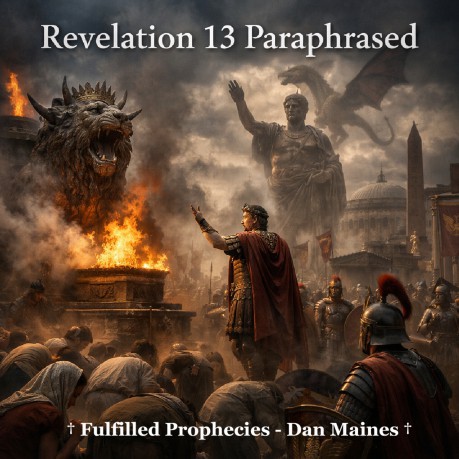
Revelation 13 Paraphrased Introduction † Revelation 13 describes the rise of a
persecuting ruler and the system of power that supported him during
the final years before Jerusalem's destruction in AD 70. John wasn't
writing about events thousands of years in the future, he was warning
the first century church about the Roman power that was already
rising against them (Revelation 1:1, 3). † The beast represents a ruling Caesar who
demanded worship and exercised authority through the Roman system.
Scripture repeatedly connects this power with blasphemy, persecution,
and domination of the nations (Daniel 7:23-25). † The mark connected to this system reflects
loyalty and participation in that imperial structure. In the first
century, economic life often required recognition of Caesar's
authority, which fits John's warning perfectly (Revelation 13:16-17). Revelation 13:1 I saw a beast rising up out of the sea. It had ten horns and seven
heads. Ten crowns sat on its horns, and blasphemous names were
written on its heads. † The sea in prophetic imagery often represents
the nations and political turmoil from which empires rise (Daniel
7:2-3). † The seven heads identify the line of Roman
Caesars connected to the persecuting power described throughout
Revelation (Revelation 17:9-10). † The blasphemous names reflect the divine
titles Roman emperors claimed, including being called lord and god. Revelation 13:2 The beast I saw looked like a leopard, its feet were like a bear,
and its mouth was like a lion. The dragon gave it power, authority,
and a throne. † These animal symbols echo the kingdoms
described in Daniel 7, showing Rome as the continuation and
culmination of earlier oppressive empires. † The dragon represents Satan working through
earthly authority to persecute God's people (Revelation 12:9). † Rome inherited the power structures of
previous empires and expanded them into a massive imperial system. Revelation 13:3 One of its heads looked like it had been fatally wounded, but the
wound was healed. The whole earth was amazed and followed the beast. † This reflects the chaos after Nero's death
and the restoration of imperial authority under the following rulers. † Roman propaganda and imperial loyalty revived
the empire's authority even after a period of turmoil. † The amazement of the nations shows how deeply
the Roman world admired and followed imperial power. Revelation 13:4 People worshiped the dragon because he gave authority to the
beast, and they worshiped the beast saying, Who is like the beast,
and who can fight against it? † Emperor worship was common throughout the
Roman Empire, especially in the eastern provinces. † This worship represented allegiance to
political power rather than submission to the true God. † The question Who is like the beast mirrors
phrases of divine praise, showing how imperial authority replaced
true worship. Revelation 13:5 The beast was given a mouth speaking arrogant and blasphemous
words, and it was allowed to act for forty two months. † The forty two months equals the same
prophetic time period as the great tribulation leading up to
Jerusalem's fall (Revelation 11:2, Revelation 12:6). † Roman rulers openly promoted themselves as
divine figures during this time. † This limited time period shows that the
persecution had a defined end. Revelation 13:6 It opened its mouth to speak blasphemies against God, against His
name, and against those who dwell in heaven. † The Roman imperial cult openly insulted the
God of Israel and persecuted those who refused emperor worship. † Christians were often accused of disloyalty
to the empire because they refused to acknowledge Caesar as lord. † These blasphemies were political and
religious attacks against the authority of Christ. Revelation 13:7 It was allowed to make war with the saints and to overcome them,
and authority was given to it over every tribe, people, language, and
nation. † Roman persecution targeted believers across
the empire, especially during Nero's reign. † The phrase overcome them refers to physical
persecution, not spiritual defeat (Revelation 12:11). † Rome's global authority fits the description
of ruling over many nations. Revelation 13:8 All who live on the earth will worship it, everyone whose name
hasn't been written in the book of life belonging to the Lamb who was
slain from the foundation of the world. † Faithful believers resisted the imperial cult
because their loyalty belonged to Christ. † The book of life represents those who belong
to the Lamb and refuse false worship. † This contrast highlights the difference
between those loyal to empire and those loyal to Christ. Revelation 13:9 If anyone has ears to hear, let him listen. † This phrase calls believers to pay attention
and understand the warning. † Jesus used this same expression when
emphasizing important truth (Matthew 11:15). † The message required discernment in the midst
of persecution. Revelation 13:10 If anyone is destined for captivity, he will go into captivity. If
anyone kills with the sword, he must be killed with the sword. This
calls for endurance and faith from the saints. † Persecution was part of the experience of the
early church. † The call to endurance reminds believers that
God remained sovereign over these events. † Faithfulness during suffering was a central
theme of Revelation. Revelation 13:11 Then I saw another beast rising out of the earth. It had two horns
like a lamb but it spoke like a dragon. † This second beast represents the supporting
system that promoted emperor worship. † The lamb like appearance shows a deceptive
religious authority. † It functioned as propaganda and religious
enforcement for imperial power. Revelation 13:12 It exercised all the authority of the first beast and made the
earth and those living in it worship the first beast whose fatal
wound was healed. † Local officials and priesthoods enforced
loyalty to the emperor throughout the empire. † Temples to Caesar were built in many Roman
cities. † This system directed worship and allegiance
back to the imperial throne. Revelation 13:13 It performed great signs, even making fire come down from heaven
to the earth in front of people. † Religious displays and political
demonstrations reinforced the authority of Rome. † False signs have often accompanied systems of
deception (Matthew 24:24). † These acts impressed the crowds and
strengthened imperial loyalty. Revelation 13:14 It deceived those who lived on the earth because of the signs it
was allowed to perform in front of the beast. It told those living on
the earth to make an image for the beast that had been wounded by the
sword and lived. † Statues and images of the emperor were set up
throughout the Roman world. † People were expected to show reverence to
these images. † Refusal often brought punishment or
exclusion. Revelation 13:15 It was allowed to give breath to the image of the beast so that
the image could speak and cause those who refused to worship the
image of the beast to be killed. † The image represents the enforced authority
of imperial worship. † Christians who refused to participate were
often executed. † This reflects the historical persecution
recorded in Roman history. Revelation 13:16 It required everyone, small and great, rich and poor, free and
slave, to receive a mark on their right hand or on their forehead. † The mark represents visible allegiance to the
imperial system. † Biblical imagery often uses hand and forehead
to represent actions and thoughts (Deuteronomy 6:8). † This symbolizes loyalty expressed both
inwardly and outwardly. Revelation 13:17 No one could buy or sell unless he had the mark, the name of the
beast, or the number of its name. † Participation in trade guilds and markets
often required acknowledgment of imperial authority. † Refusing emperor worship could result in
economic exclusion. † This pressure forced people to choose between
survival and faithfulness. Revelation 13:18 This calls for wisdom. Let the one who has understanding calculate
the number of the beast, for it's the number of a man, and its number
is 666. † The number 666 fits the Hebrew numerical
value of Nero Caesar. † This directly connects the prophecy with the
persecuting ruler of the first century. † The instruction to calculate the number shows
the original audience could identify the figure involved. Historical References † Tacitus recorded Nero's persecution of
Christians after the fire of Rome (Tacitus, Annals 15.44). † Suetonius described Nero's brutal treatment
of believers and his demand for loyalty. † Eusebius later documented how the early
church understood Nero as a major persecutor. How It Applies To Us Today † Revelation 13 reminds us that political power
often tries to replace loyalty to God. † Believers are called to remain faithful even
when pressure comes from powerful systems. † The message encourages endurance and trust in
Christ regardless of earthly authority. Q&A Appendix Q Who is the beast in Revelation 13? A The beast represents a Roman Caesar connected
to the persecuting imperial system, historically identified with
Nero, whose reign included severe persecution of Christians
(Revelation 13:18). Q What does the mark of the beast represent? A The mark represents allegiance and
participation in the Roman imperial system that required loyalty to
Caesar (Revelation 13:16-17). Q Why is the number 666 significant? A The number corresponds to the Hebrew numerical
value of Nero Caesar, identifying the persecuting ruler connected to
the prophecy (Revelation 13:18). Q How did the first century believers recognize
the beast? A John told them to calculate the number because
it was the number of a man. When the name Nero Caesar is written in
Hebrew letters, the numerical value equals 666, which allowed the
original audience to identify the persecuting ruler during their own
time (Revelation 13:18). Q Why did John say the saints needed endurance? A The believers were facing real persecution from
the Roman authorities. Revelation encouraged them to remain faithful
even if they were imprisoned or killed, knowing that their loyalty
belonged to Christ and not Caesar (Revelation 13:7, 10; Revelation
12:11). Q What does the image of the beast represent? A The image reflects the statues and
representations of the Roman emperor placed throughout the empire
where people were expected to show loyalty and reverence. Refusing to
honor these images often brought punishment or death (Revelation
13:14-15). † This is the fulfilled perspective we proclaim at
Fulfilled Prophecies † © Fulfilled Prophecies - Dan Maines. Source Index † Revelation 1:1, 3; Daniel 7:2-3, 23-25;
Revelation 11:2; Revelation 12:6, 9, 11; Matthew 11:15; Matthew
24:24; Deuteronomy 6:8; Revelation 13:18 † Tacitus, Annals 15.44; Suetonius, The Twelve
Caesars; Eusebius, Ecclesiastical History.
By Dan Maines
Links