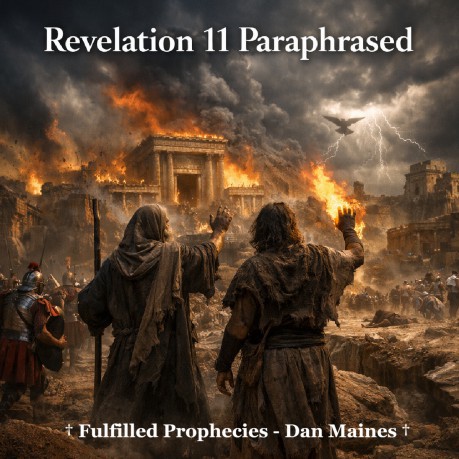
Revelation 11 Paraphrased Introduction † Revelation 11 continues the vision of judgment that was about
to fall on Jerusalem in the first century. The temple, the witnesses,
and the earthquake all point directly to events leading up to AD 70.
Jesus had already warned that the temple would be destroyed within
that generation (Matthew 23:36-38; Matthew 24:1-2). † The measuring of the temple shows that God was marking what
belonged to Him and what would soon be judged. The outer court being
given to the nations reflects the Roman armies surrounding and
trampling Jerusalem (Luke 21:20-24). † The two witnesses represent God's testimony against apostate
Israel. Their prophetic role echoes Moses and Elijah, symbols of the
Law and the Prophets testifying against the nation that rejected
Christ (Matthew 17:3-5). Revelation 11:1 Then I was given a measuring rod like a staff and told, Get up and
measure the temple of God, the altar, and those who worship there. † Measuring symbolizes ownership and preservation. God was
identifying His faithful people before judgment fell (Ezekiel 40:3-5;
Zechariah 2:1-5). † The temple mentioned here was still standing when this vision
was given, which supports the early date before AD 70 (Matthew
24:1-2). † The worshipers being measured shows God knew exactly who
remained faithful within Israel (2 Timothy 2:19). Revelation 11:2 But leave out the outer court of the temple and do not measure it,
because it has been given to the nations, and they will trample the
holy city for forty two months. † The outer court being given to the nations reflects Roman
control over Jerusalem during the war leading to AD 70 (Luke 21:24). † Forty two months equals three and a half years, which matches
the length of the Jewish War from AD 66 to AD 70. † The trampling of the city was exactly what Jesus predicted
when He warned Jerusalem about the coming destruction (Luke
19:41-44). Revelation 11:3 And I will grant authority to my two witnesses, and they will
prophesy for one thousand two hundred and sixty days, dressed in
sackcloth. † The 1,260 days equals the same three and a half year period
mentioned earlier, symbolizing the time of intense tribulation before
the fall of Jerusalem. † Sackcloth represents mourning and warning of judgment (Jonah
3:5-8). † The two witnesses symbolize God's prophetic testimony through
His people and His word confronting Israel's rebellion (Hebrews
1:1-2). Revelation 11:4 These are the two olive trees and the two lampstands that stand
before the Lord of the earth. † This imagery comes from Zechariah's vision where the olive
trees represent God's anointed witnesses supplying light (Zechariah
4:2-6). † Lampstands represent churches or witnesses who carry God's
message (Revelation 1:20). † Together they show that God's truth was being proclaimed
despite opposition. Revelation 11:5 If anyone wants to harm them, fire comes out of their mouth and
devours their enemies. If anyone tries to harm them, he must be
killed in this way. † The fire from their mouth represents the power of God's word
bringing judgment (Jeremiah 5:14). † Prophets often spoke of judgment in terms of consuming fire
because God's word exposes and condemns sin (Hebrews 4:12). † This shows that rejecting God's testimony brings destruction. Revelation 11:6 These witnesses have authority to shut the sky so that rain will
not fall during the days of their prophecy, and they have authority
over the waters to turn them into blood and to strike the earth with
every kind of plague as often as they want. † These signs mirror the miracles of Elijah and Moses, again
linking the witnesses to the Law and the Prophets (1 Kings 17:1;
Exodus 7:17). † The message is that Israel was rejecting the same authority
that God had already confirmed through His prophets. † Their power shows that the judgment coming on Jerusalem was
not random, it was divinely decreed. Revelation 11:7 When they finish their testimony, the beast that comes up from the
abyss will make war with them, overcome them, and kill them. † The beast represents the Roman emperor who wielded imperial
power against the church (Revelation 13:1-8). † Roman persecution did indeed attempt to silence the gospel
message during the first century. † Their death reflects how God's messengers were often rejected
and killed by those they warned (Matthew 23:34-36). Revelation 11:8 Their dead bodies will lie in the street of the great city which
spiritually is called Sodom and Egypt, where also their Lord was
crucified. † The great city where the Lord was crucified clearly identifies
Jerusalem. † Calling it Sodom and Egypt shows how corrupt the city had
become spiritually (Isaiah 1:10; Ezekiel 23:3). † Jerusalem had rejected its Messiah and persecuted His
followers. Revelation 11:9 For three and a half days people from every nation, tribe,
language, and people will look at their dead bodies and will not
allow them to be buried. † Leaving bodies unburied was considered the ultimate disgrace
in the ancient world. † The nations watching reflects the wide attention given to
events surrounding Jerusalem's fall. † The three and a half days symbolize a short but intense period
of apparent defeat. Revelation 11:10 Those who live on the earth will celebrate over them and send
gifts to one another because these two prophets tormented those who
lived on the earth. † The celebration shows how the world often rejoices when God's
truth is silenced. † The witnesses tormented people not physically but through
their message of conviction and warning. † This mirrors how the prophets were hated for exposing sin
(Amos 7:10-13). Revelation 11:11 But after the three and a half days the breath of life from God
entered them, and they stood on their feet, and great fear fell on
those who saw them. † The breath of life echoes Ezekiel's vision of resurrection,
symbolizing vindication (Ezekiel 37:5-10). † God vindicated His witnesses and proved their testimony true. † Their standing again represents the triumph of God's word. Revelation 11:12 Then they heard a loud voice from heaven saying to them, Come up
here. And they went up to heaven in a cloud while their enemies
watched them. † Ascending in a cloud symbolizes divine vindication and
acceptance by God. † Clouds in scripture often represent God's presence and
authority (Daniel 7:13). † This shows that the message of the witnesses was ultimately
confirmed by God. Revelation 11:13 At that hour a great earthquake occurred, and a tenth of the city
fell. Seven thousand people were killed in the earthquake, and the
rest were terrified and gave glory to the God of heaven. † Earthquakes in prophecy symbolize political and covenantal
upheaval. † The fall of part of the city foreshadows the complete
destruction that would soon follow. † Even in judgment, some recognized God's authority. Revelation 11:14 The second woe is past. Look, the third woe is coming quickly. † The warnings were unfolding exactly as foretold. † The phrase coming quickly confirms the imminent nature of
these events. † The final judgments were about to be completed. Revelation 11:15 Then the seventh angel sounded his trumpet, and loud voices in
heaven said, The kingdom of the world has become the kingdom of our
Lord and of His Christ, and He will reign forever and ever. † This announces Christ's victory and the full establishment of
His kingdom. † Jesus had already said that some standing with Him would see
His kingdom come in power (Mark 9:1). † The fall of Jerusalem marked the end of the old covenant
order. Revelation 11:16 The twenty four elders who sit on their thrones before God fell on
their faces and worshiped God. † The elders represent the redeemed people of God praising Him
for fulfilling His promises. † Their worship celebrates the completion of God's redemptive
plan. † Heaven recognizes what God has accomplished. Revelation 11:17 They said, We give thanks to You, Lord God Almighty, who is and
who was, because You have taken Your great power and begun to reign. † God's reign was not beginning for the first time but being
fully manifested through the judgment of the old system. † Christ had already been given authority after His resurrection
(Matthew 28:18). † The destruction of Jerusalem confirmed His kingship. Revelation 11:18 The nations were angry, and Your wrath came, and the time came for
the dead to be judged and for rewarding Your servants the prophets
and the saints and those who fear Your name, both small and great,
and for destroying those who destroy the earth. † This reflects the covenant judgment that Jesus predicted
against Jerusalem. † The reward for the saints shows God's faithfulness to His
people. † The destruction of those corrupting the land points to the
judgment on apostate Israel. Revelation 11:19 Then the temple of God in heaven was opened, and the ark of His
covenant appeared in His temple, and there were flashes of lightning,
sounds, thunder, an earthquake, and great hail. † The heavenly temple being opened shows the new covenant
reality where access to God is fully revealed. † The ark appearing symbolizes the fulfillment of God's covenant
promises. † The thunder and earthquake imagery shows the finality of the
covenant transition. Historical References † Josephus describes the destruction of Jerusalem in AD 70 and
the devastation that followed during the Roman siege. † Eusebius records that Christians fled Jerusalem before the
destruction, fulfilling Jesus' warning (Luke 21:20-21). † Tacitus also records the Roman campaign against Jerusalem
during this time period. How It Applies To Us Today † God's promises always come true even when people doubt them (2
Peter 3:9-10). † Jesus reigns now as King, and His kingdom cannot be shaken
(Hebrews 12:28). † The fall of Jerusalem reminds us that rejecting God's truth
always leads to judgment. Q & A Appendix Q: Who are the two witnesses in Revelation 11? A: They represent God's prophetic testimony
through His word and His people confronting Israel before the fall of
Jerusalem (Zechariah 4:2-6; Matthew 23:34-36). Q: What does the trampling of the holy city mean? A: It refers to the Roman armies surrounding and
destroying Jerusalem during the Jewish War (Luke 21:20-24). Q: Why is Jerusalem called Sodom and Egypt? A: Because spiritually it had become corrupt and
oppressive like those cities after rejecting its Messiah (Isaiah
1:10). Q: What does the measuring of the temple mean in
Revelation 11:1? Q: Why are the witnesses described with the power
of Moses and Elijah? Q: What does the seventh trumpet announce? † This is the fulfilled perspective we proclaim at
Fulfilled Prophecies † Source Index † Revelation 11:1-19; Matthew 24:1-2; Luke
21:20-24; Zechariah 4:2-6; Jeremiah 5:14; Daniel 7:13; Ezekiel
37:5-10; Matthew 23:34-36; Mark 9:1; Hebrews 12:28; Isaiah 1:10; Amos
7:10-13; Matthew 28:18; 2 Peter 3:9-10 † Josephus, Wars of the Jews; Eusebius,
Ecclesiastical History; Tacitus, Histories.
By Dan Maines
A: It shows God marking what
belonged to Him before judgment fell. Just as in Ezekiel's vision,
measuring symbolized preservation and ownership. The faithful were
known by God even as the temple system was about to be destroyed
(Ezekiel 40:3-5; 2 Timothy 2:19).
A: The signs connected to
drought, plagues, and judgment reflect the ministries of Elijah and
Moses. This shows that the Law and the Prophets stood as witnesses
against Israel for rejecting the Messiah (1 Kings 17:1; Exodus 7:17;
Matthew 17:3-5).
A:
The seventh trumpet declares that Christ's kingdom has fully replaced
the old covenant world that was centered in Jerusalem. With the
destruction of the temple in AD 70, the old system ended and Christ's
reign was openly confirmed (Revelation 11:15; Hebrews 12:26-28).
© Fulfilled Prophecies - Dan
Maines.
Links