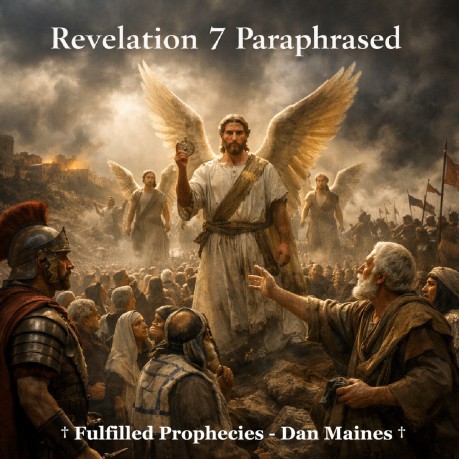
Revelation 7 Paraphrased Introduction † Revelation 7 pauses the judgment sequence to
show God's protection over His people before the final covenant
judgment falls on Jerusalem (Revelation 6:17; Matthew 24:21-22). Revelation 7:1 After this I saw four angels standing at the four corners of the
land, holding back the four winds so that no destructive wind would
blow on the land or sea or against any tree. † The four winds represent judgment forces
being restrained until God's people are sealed and protected
(Jeremiah 49:36; Daniel 7:2). Revelation 7:2 Then I saw another angel coming from the rising of the sun,
carrying the seal of the living God, and he called out with a loud
voice to the four angels who were allowed to harm the land and the
sea. † The seal represents God's mark of protection,
similar to the mark placed on the righteous in Ezekiel's vision
before judgment struck Jerusalem (Ezekiel 9:4). Revelation 7:3 Do not harm the land or the sea or the trees until we have sealed
the servants of our God on their foreheads. † The forehead seal symbolizes open
identification with God, in contrast to the mark of the beast which
represented allegiance to Caesar worship (Revelation 13:16-17). Revelation 7:4 And I heard the number of those who were sealed, one hundred forty
four thousand sealed from every tribe of the sons of Israel. † The number 144000 is symbolic of the complete
remnant of Israel who believed in Christ before Jerusalem fell
(Romans 11:5). Revelation 7:5 From the tribe of Judah twelve thousand were sealed, from the
tribe of Reuben twelve thousand, from the tribe of Gad twelve
thousand. † Judah appears first because Christ came from
this tribe as the Messiah (Hebrews 7:14). Revelation 7:6 From the tribe of Asher twelve thousand, from the tribe of
Naphtali twelve thousand, from the tribe of Manasseh twelve thousand. † The inclusion of these tribes shows the
symbolic restoration of Israel through the new covenant community
(James 1:1). Revelation 7:7 From the tribe of Simeon twelve thousand, from the tribe of Levi
twelve thousand, from the tribe of Issachar twelve thousand. † Levi appears even though priests
traditionally had no land inheritance, showing that priesthood now
belongs to the new covenant people (1 Peter 2:9). Revelation 7:8 From the tribe of Zebulun twelve thousand, from the tribe of
Joseph twelve thousand, from the tribe of Benjamin twelve thousand
were sealed. † The full tribal list emphasizes completeness
rather than literal tribal counting. Revelation 7:9 After these things I looked, and there was a great multitude which
no one could count, from every nation and tribe and people and
language, standing before the throne and before the Lamb, clothed in
white robes and holding palm branches in their hands. † This fulfills God's promise that all nations
would come to Him through the Messiah (Genesis 12:3). Revelation 7:10 And they were crying out with a loud voice saying Salvation
belongs to our God who sits on the throne and to the Lamb. † Salvation is attributed fully to God and
Christ, not to human effort (Ephesians 2:8-9). Revelation 7:11 All the angels were standing around the throne and around the
elders and the four living creatures, and they fell on their faces
before the throne and worshiped God. † The heavenly host joins in worship, showing
the cosmic significance of redemption (Hebrews 12:22-23). Revelation 7:12 Saying Amen blessing and glory and wisdom and thanksgiving and
honor and power and might belong to our God forever and ever Amen. † The sevenfold praise emphasizes the
completeness of God's glory. Revelation 7:13 Then one of the elders answered and said to me These who are
clothed in the white robes, who are they and where have they come
from. † The question draws attention to the identity
of the redeemed people. Revelation 7:14 I said to him My lord you know. And he said to me These are the
ones who come out of the great tribulation, and they have washed
their robes and made them white in the blood of the Lamb. † The great tribulation refers to the suffering
leading up to Jerusalem's destruction (Matthew 24:21). Revelation 7:15 For this reason they are before the throne of God, and they serve
Him day and night in His temple, and He who sits on the throne will
spread His presence over them. † The temple imagery reflects the new covenant
dwelling of God with His people (Ephesians 2:19-22). Revelation 7:16 They will no longer hunger and will no longer thirst, nor will the
sun beat down on them nor any scorching heat. † This echoes Isaiah's promise of restoration
for God's people (Isaiah 49:10). Revelation 7:17 For the Lamb in the center of the throne will shepherd them and
will guide them to springs of the water of life, and God will wipe
every tear from their eyes. † Christ is portrayed as both Lamb and
Shepherd, the one who sacrificed Himself and now leads His people
(John 10:11). Historical References † Eusebius records that believers fled
Jerusalem before the Roman siege after being warned through
revelation (Ecclesiastical History 3.5). How It Applies To Us Today † God's people are always known and protected
by Him even during times of trial (2 Timothy 2:19). Q & A Appendix Q: What is the great tribulation mentioned in
Revelation 7:14? Q: Who are the 144000? Q: What does the sealing mean? Q: Why are the servants sealed before the
judgment begins? Q: Why is the great multitude described as coming
from every nation? Q: Why are palm branches mentioned in Revelation
7:9? † This is the fulfilled perspective we proclaim at
Fulfilled Prophecies † Source Index † Revelation 7:1-17; Ezekiel 9:4-6; Jeremiah
49:36; Daniel 7:2; Genesis 19:22; 2 Timothy 2:19; Exodus 28:36-38;
Romans 11:5; Hebrews 7:14; Romans 1:16; James 1:1; Galatians 3:28-29;
1 Peter 2:9; Genesis 12:3; Revelation 3:5; John 12:13; Ephesians
2:8-9; John 1:29; Hebrews 12:22-23; Isaiah 6:1-3; Revelation 1:5;
Matthew 24:21; Ephesians 2:19-22; Isaiah 49:10; John 10:11; John
4:14; Matthew 28:19; Hebrews 12:28 † Eusebius, Ecclesiastical History 3.5;
Josephus, Wars of the Jews 6.3-6; Tertullian, Against Marcion 3.22
By Dan Maines
†
The sealing of the servants shows that God marked and preserved His
faithful remnant during the approaching destruction of the old
covenant world (Ezekiel 9:4-6).
† This
chapter also reveals the great multitude from the nations who entered
the kingdom through Christ before the fall of Jerusalem, showing the
fulfillment of God's promise to bless all nations through Abraham
(Genesis 22:18; Matthew 24:14).
† Similar
imagery appears when God delays judgment for the sake of His faithful
servants (Genesis 19:22).
† Eusebius records
that believers were warned and fled Jerusalem before its destruction,
showing God's protection over His people (Eusebius, Ecclesiastical
History 3.5).
†
God's servants are sealed to show they belong to Him and will be
preserved through the coming tribulation (2 Timothy 2:19).
†
Early Christians understood this as God's protection over the
faithful during the Jewish War (AD 66-70).
†
This imagery reflects the priestly mark of belonging to God (Exodus
28:36-38).
† Tertullian described believers
as marked by God through their faith and loyalty to Christ
(Tertullian, Against Marcion 3.22).
† It represents fullness and
completeness, twelve tribes multiplied by twelve apostles and
multiplied again to signify the full covenant community.
†
The early church understood this as the faithful remnant of Israel
who received the gospel in the first century.
†
The listing of tribes emphasizes the covenant roots of the gospel
beginning with Israel (Romans 1:16).
† This
sealing shows that the gospel reached faithful Jews before the
destruction of the temple.
† God's promises to Israel were
fulfilled in Christ through those who believed (Galatians 3:28-29).
†
The faithful remnant formed the foundation of the early church.
†
The kingdom of God was now composed of believers rather than tribal
inheritance.
† This demonstrates the
transformation of Israel under Christ's covenant.
† Joseph
appears instead of Ephraim, likely reflecting symbolic representation
rather than strict genealogy.
† This shows
that God preserved a faithful Jewish remnant before the old covenant
system ended.
†
The white robes symbolize righteousness given through Christ
(Revelation 3:5).
† Palm branches represent
victory and celebration, similar to the triumphal entry of Christ
(John 12:13).
†
The Lamb imagery recalls Christ's sacrificial death that redeemed His
people (John 1:29).
† This celebration shows
the completed redemption of believers from every nation.
†
This imagery reflects Isaiah's vision of heavenly worship (Isaiah
6:1-3).
† The church's victory is celebrated
in heaven.
† Worship in
heaven reflects the final victory of God's kingdom.
†
Early Christian writings often echoed similar doxologies in worship
gatherings.
† White robes
symbolize purification through Christ's sacrifice (Revelation 1:5).
†
This sets up the explanation of their faithful endurance.
†
Believers endured persecution but were spiritually cleansed by
Christ's sacrifice.
† This shows that the
tribulation was a first century event.
†
Believers now serve God continually as His priestly people.
†
God's presence replaces the old temple system.
† It
symbolizes spiritual satisfaction and protection under Christ's
kingdom.
† The suffering of the early church
was temporary.
† The water of life represents
eternal life through the gospel (John 4:14).
†
This promise shows the completed comfort and victory of God's people.
†
Josephus describes the immense suffering during the Jewish War which
matches the tribulation Jesus predicted (Josephus, Wars of the Jews
6.3-6).
† Tertullian described believers as
sealed by God through their faithfulness to Christ (Against Marcion
3.22).
†
The kingdom Christ established continues to gather people from every
nation just as Revelation describes (Matthew 28:19).
†
Our confidence rests in the finished work of Christ who has already
secured victory for His people (Hebrews 12:28).
A: It refers to the intense
suffering surrounding the destruction of Jerusalem in AD 70, which
Jesus predicted in Matthew 24:21.
A:
They represent the faithful remnant of Israel who believed in Christ
before the fall of Jerusalem (Romans 11:5).
A:
It shows God's ownership and protection over His people during the
coming judgment (Ezekiel 9:4; 2 Timothy 2:19).
A: The sealing shows that God
identifies and protects His people before covenant judgment falls.
This mirrors the mark placed on the faithful before Jerusalem was
judged in Ezekiel 9:4-6, and it shows that God knew and preserved His
people during the tribulation Jesus warned about in Matthew 24:21-22.
A: This fulfills God's
promise that the Messiah would bring salvation to all nations. The
gospel went out to the world before Jerusalem fell, just as Jesus
said it would in Matthew 24:14, and it fulfilled the promise given to
Abraham that all nations would be blessed through his seed in Genesis
22:18.
A: Palm branches were a symbol of victory
and celebration in Israel. When Jesus entered Jerusalem the people
waved palm branches in recognition of the coming King (John 12:13).
Here the redeemed celebrate the victory of the Lamb who brought
salvation through His sacrifice (Revelation 5:9-10).
© Fulfilled Prophecies - Dan
Maines.
Links