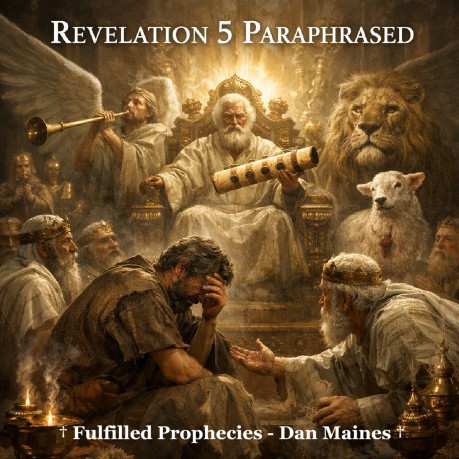
Revelation 5 Paraphrased Introduction † Revelation 5 continues the throne room scene that began in the
previous chapter. The focus now shifts to a sealed scroll in God's
hand and the search for someone worthy to open it. This scroll
represents God's decreed judgment and covenantal conclusion that
would soon unfold upon the old covenant world. Revelation 5:1 Revelation 5:1 † The scroll written on both sides shows a complete and final
decree. Nothing was left unfinished or unwritten. It represented the
full judgment that was about to unfold (Ezekiel 2:9-10). Revelation 5:2 Revelation 5:2 † The question was not who was strong enough but who was worthy.
Opening the scroll required authority given by God Himself. Revelation 5:3 Revelation 5:3 † This shows the complete inability of mankind and angels to
fulfill God's redemptive plan. The solution had to come from the
Messiah alone. Revelation 5:4 Revelation 5:4 † John's weeping reflects the seriousness of the moment. If no
one could open the scroll, God's plan for justice and redemption
would remain unrevealed. Revelation 5:5 Revelation 5:5 † The Lion of Judah is a direct reference to Genesis 49:9-10
where the Messiah was promised to come from Judah's royal line. Revelation 5:6 Revelation 5:6 † The Lamb that appeared slain represents Christ's sacrificial
death. Though He was killed, He now stands alive and victorious. Revelation 5:7 Revelation 5:7 † This moment shows Christ receiving full authority to carry out
God's covenant plan. Revelation 5:8 Revelation 5:8 † The worship of the Lamb confirms His divine authority and
kingship. Heaven recognizes Christ as worthy of honor and praise. Revelation 5:9 Revelation 5:9 † The new song celebrates the new covenant reality established
by Christ's sacrifice. Revelation 5:10 Revelation 5:10 † This fulfills God's promise that His people would be a kingdom
of priests (Exodus 19:6). Revelation 5:11 Revelation 5:11 † The massive number of angels emphasizes the glory and
authority of Christ's kingship. Revelation 5:12 Revelation 5:12 † The sevenfold praise reflects completeness and perfection.
Christ is worthy of every form of honor. Revelation 5:13 Revelation 5:13 † This universal praise shows the ultimate recognition of God's
sovereignty and Christ's kingship. Revelation 5:14 Revelation 5:14 † Amen confirms the truth and certainty of what was
proclaimed. Historical References † Justin Martyr wrote that Christ alone fulfilled the prophetic
promises and received authority from the Father to rule and judge. How It Applies To Us Today † Christ reigns now as the victorious Lamb who completed
redemption and fulfilled God's covenant plan. Q & A Appendix Q What does the scroll represent in Revelation
5? Q Why was only Christ worthy to open the
scroll? Q What does the Lamb that appeared slain
represent? Q What do the prayers of the saints represent? Q Why did John begin crying when no one could
open the scroll? Q Why is Jesus called both the Lion and the Lamb
in this chapter? Q What does the new song represent in heaven? † This is the fulfilled perspective we proclaim at
Fulfilled Prophecies † Source Index † Revelation 5:1-14; Ezekiel 2:9-10; Daniel
7:13-14; Genesis 49:9-10; Isaiah 11:1,10; Exodus 19:6; Luke 18:7;
John 1:29; Hebrews 9:12 † Justin Martyr, Dialogue with Trypho † Irenaeus, Against Heresies † Eusebius, Ecclesiastical History
By Dan Maines
† The sealed
scroll shows that God's plan was fixed and written beforehand.
Nothing about the coming judgment was accidental or random. It was
already determined and waiting for the appointed time to be revealed
(Isaiah 29:11; Daniel 12:4).
† Only the Messiah could open
this scroll. The scene reveals Christ as the rightful King and
Redeemer who alone had authority to bring the old covenant age to its
completion and reveal the new covenant kingdom.
Then I saw in the right hand
of the One seated on the throne a scroll written on both sides and
sealed shut with seven seals.
† The
seven seals show divine authority and finality. In the ancient world
sealed documents represented official decrees that only authorized
persons could open. This scroll belonged to God alone.
† The
fact that it was in God's right hand shows power and authority. The
plan of judgment and redemption was fully under His control (Isaiah
46:9-10).
Then I saw a powerful angel
loudly announcing, who is worthy to open the scroll and break its
seals?
†
This challenge revealed that no created being had the right to carry
out God's covenant judgment. Only the Messiah could do this work
(Isaiah 11:1-4).
† The loud proclamation emphasizes the
universal scope of the question. All heaven and earth were
effectively being asked if anyone qualified.
But no one in heaven or on
earth or under the earth was able to open the scroll or even look
inside it.
† It also highlights humanity's helpless
condition apart from Christ. No prophet, priest, or king in Israel
had the authority to bring the covenant story to completion.
†
The phrase heaven, earth, and under the earth simply means the entire
created order. No one anywhere could open the scroll.
I began to cry deeply because
no one was found worthy to open the scroll or look into it.
† The sorrow shows the longing for
the fulfillment of God's promises to Israel and the nations. The
prophets had spoken of this day for centuries (Habakkuk 2:3).
†
John's reaction shows how central the Messiah is to God's entire
redemptive plan.
Then one of the elders said
to me, stop crying. Look, the Lion from the tribe of Judah, the Root
of David, has overcome so he can open the scroll and its seven seals.
†
The Root of David refers to Christ as the fulfillment of the Davidic
covenant and the rightful King of Israel (Isaiah 11:1,10).
†
The phrase has overcome points to Christ's victory through His death
and resurrection. That victory made Him worthy to open the scroll.
Then I saw standing between
the throne and the four living creatures and the elders a Lamb that
looked as if it had been killed. It had seven horns and seven eyes
which are the seven spirits of God sent out into all the earth.
†
The seven horns symbolize complete power and authority. Horns in
scripture often represent kingship and strength (Daniel 7:24).
†
The seven eyes represent complete knowledge and the fullness of God's
Spirit working throughout the earth (Zechariah 4:10).
He came forward and took the
scroll from the right hand of the One sitting on the throne.
† It reflects Daniel's vision where the
Son of Man receives dominion and authority from God (Daniel
7:13-14).
† The action confirms that Christ alone was worthy
to execute the judgments written in the scroll.
When He took the scroll, the
four living creatures and the twenty four elders fell down before the
Lamb. Each one held a harp and golden bowls full of incense which
represent the prayers of God's people.
†
The prayers of the saints show that God's people had long cried out
for justice and redemption (Luke 18:7).
† These prayers were
about to be answered as the scroll was opened and God's covenant
judgments unfolded.
They sang a new song saying
you are worthy to take the scroll and open its seals because you were
killed and by your blood you purchased people for God from every
tribe and language and people and nation.
† Redemption through Christ extended
beyond Israel to the nations, fulfilling God's promise to Abraham
(Genesis 12:3).
† The emphasis on Christ's blood highlights
the foundation of the new covenant kingdom.
You have made them a kingdom
and priests to our God and they will reign upon the earth.
† Believers share in Christ's reign
as part of His spiritual kingdom (Ephesians 2:6).
† The reign
upon the earth shows the establishment of God's kingdom in the world
through the gospel.
Then I looked and heard the
voices of many angels around the throne along with the living
creatures and the elders. Their number was countless thousands and
thousands.
† Heaven itself celebrates the
Lamb's victory and authority to open the scroll.
† This scene
shows the cosmic significance of Christ's redemptive work.
They were loudly saying
worthy is the Lamb who was killed to receive power and wealth and
wisdom and strength and honor and glory and praise.
† His death did not
diminish His glory but established it.
† Heaven openly
acknowledges the Lamb as the rightful ruler.
Then I heard every creature
in heaven and on earth and under the earth and in the sea saying
blessing and honor and glory and authority belong to the One sitting
on the throne and to the Lamb forever and ever.
† The Lamb is worshiped
alongside the One on the throne, demonstrating Christ's divine
authority.
† The entire creation acknowledges God's reign.
The four living creatures
kept saying amen and the elders fell down and worshiped.
† The elders falling down shows complete
submission and reverence before God and the Lamb.
† Heaven
fully recognizes the Lamb as the one worthy to carry out God's
covenant plan.
†
Irenaeus taught that the Lamb who was slain fulfilled the redemption
foretold in the prophets and was given authority over all creation.
†
Eusebius connected the Lamb's victory with the historical judgment
that came upon Jerusalem in the first century.
† The opening of
the scroll reminds us that history is not random. God governs events
according to His purpose.
† Believers today live under the
authority of the Lamb who conquered through sacrifice and now reigns
as King.
A The scroll represents God's written decree
of covenant judgment and redemption that would soon unfold (Ezekiel
2:9-10; Daniel 12:4).
A Because He alone conquered through
His death and resurrection and fulfilled the messianic promises
(Genesis 49:9-10; Isaiah 11:1).
A It represents Jesus Christ whose
sacrificial death redeemed His people and established the new
covenant (John 1:29; Hebrews 9:12).
A
They represent the cries of God's people for justice and deliverance
which were about to be answered (Luke 18:7; Revelation 6:10).
A John's sorrow shows how
critical the moment was. If no one could open the scroll, God's
covenant plan of judgment and redemption would remain hidden and
unfinished. The prophets had long spoken of the day when God's
purposes would finally be revealed and fulfilled (Habakkuk 2:3;
Daniel 12:4).
A The Lion represents His
royal authority as the promised King from the tribe of Judah, while
the Lamb represents His sacrificial death that redeemed His people.
Together they show that Christ conquered not by force, but through
His sacrifice and resurrection (Genesis 49:9-10; John 1:29; Isaiah
53:7).
A
The new song celebrates the completion of redemption through Christ.
His sacrifice purchased people from every nation and established the
new covenant kingdom where believers serve as priests to God
(Revelation 5:9-10; 1 Peter 2:9).
© Fulfilled Prophecies - Dan
Maines.
Links