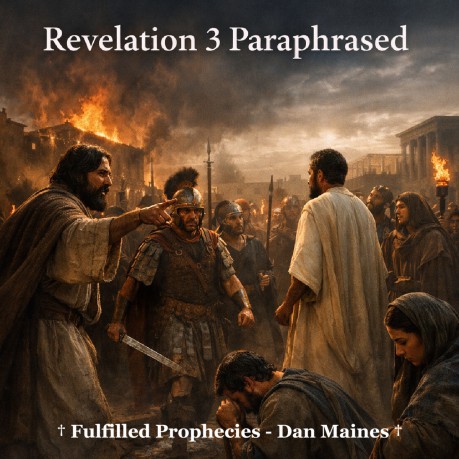
Revelation 3 Paraphrased Introduction † Revelation 3 continues the messages Jesus
sent to the remaining churches in Asia. These were real first century
congregations living under pressure during the years leading up to
the fall of Jerusalem and the persecution under Rome. Revelation 3:1 Write this to the messenger of the church in Sardis. The one who
holds the seven spirits of God and the seven stars says this. I know
the things you're doing. You have a reputation for being alive, but
in reality you're spiritually dead. † Sardis had a strong outward reputation, but
Christ saw their true condition. Religious activity doesn't equal
spiritual life (Matthew 23:27). Revelation 3:2 Wake up and strengthen what remains before it dies completely,
because I haven't found your works complete in the sight of my God. † The command to wake up shows they were
drifting spiritually. Churches can slowly decay if they stop pursuing
truth (Hebrews 2:1). Revelation 3:3 Remember what you received and heard. Hold on to it and turn back.
If you don't wake up, I'll come like a thief, and you won't know the
hour when I'll come against you. † The coming like a thief refers to unexpected
judgment, language used throughout the New Testament for the coming
judgment upon that generation (Matthew 24:42-44). Revelation 3:4 But you still have a few people in Sardis who haven't stained
their garments. They'll walk with me in white because they are
worthy. † Even in corrupt churches there are faithful
believers who remain pure in faith and conduct (1 Kings 19:18). Revelation 3:5 The one who overcomes will be clothed in white garments, and I
will never erase his name from the book of life. I will confess his
name before my Father and before His angels. † Overcoming means remaining faithful during
persecution and testing (1 John 5:4). Revelation 3:6 Anyone who has ears should listen to what the Spirit says to the
churches. † This repeated phrase shows that every church
was meant to learn from the warnings given to each congregation. Revelation 3:7 Write this to the messenger of the church in Philadelphia. The
holy and true one, who holds the key of David, who opens and no one
can shut, and shuts and no one can open, says this. † The key of David represents Christ's
authority over God's kingdom (Isaiah 22:22). Revelation 3:8 I know your works. See, I have set before you an open door that no
one can shut. You have little strength, yet you kept my word and
didn't deny my name. † The open door refers to opportunity for the
gospel and access into God's kingdom (1 Corinthians 16:9). Revelation 3:9 Look, I will cause those from the synagogue of Satan, who claim to
be Jews but are not and are lying, I will make them come and bow down
before your feet, and they'll know that I have loved you. † The synagogue of Satan refers to unbelieving
Jews who opposed the gospel and persecuted believers (John 8:44). Revelation 3:10 Because you kept my command to remain faithful, I will keep you
from the hour of testing that is about to come upon the whole
inhabited world, to test those who live on the earth. † The hour of testing refers to the coming
tribulation surrounding the Jewish war and the destruction of
Jerusalem (Matthew 24:21). Revelation 3:11 I'm coming quickly. Hold firmly to what you have so no one will
take your crown. † The phrase coming quickly again shows the
nearness of the events described in Revelation (Revelation 1:1). Revelation 3:12 The one who overcomes I'll make a pillar in the temple of my God,
and he'll never go out from it again. I'll write on him the name of
my God, the name of the city of my God, the new Jerusalem coming down
out of heaven from my God, and my new name. † Becoming a pillar represents permanent
belonging in God's kingdom (Galatians 2:9). Revelation 3:13 Anyone who has ears should listen to what the Spirit says to the
churches. † This final reminder again calls believers to
pay attention to Christ's message. Revelation 3:14 Write this to the messenger of the church in Laodicea. The Amen,
the faithful and true witness, the beginning of God's creation, says
this. † Jesus calls Himself the Amen, meaning He is
the confirmation and fulfillment of God's promises (2 Corinthians
1:20). Revelation 3:15 I know your works, you're neither cold nor hot. I wish you were
either cold or hot. † Laodicea was spiritually indifferent, neither
fully rejecting Christ nor fully devoted. Revelation 3:16 Because you're lukewarm and neither hot nor cold, I'm about to
spit you out of my mouth. † This strong image shows Christ's rejection of
empty religion. Revelation 3:17 Because you say I'm rich and have become wealthy and need nothing,
yet you don't realize you're miserable, pitiful, poor, blind, and
naked. † Laodicea was a wealthy city, which made the
church confident in material success. Revelation 3:18 I advise you to buy from me gold refined by fire so you'll become
rich, white garments so you'll be clothed and your shame won't be
exposed, and eye salve to anoint your eyes so you'll see. † Gold refined by fire represents genuine faith
tested through trials (1 Peter 1:7). Revelation 3:19 Those I love I rebuke and discipline. So be earnest and repent. † Christ's rebuke is evidence of His love, not
rejection (Hebrews 12:6). Revelation 3:20 Look, I stand at the door and knock. If anyone hears my voice and
opens the door, I'll come in to him and eat with him, and he with me. † This isn't a salvation invitation to
unbelievers but a call to a compromised church to restore fellowship
with Christ. Revelation 3:21 The one who overcomes I'll grant to sit with me on my throne, just
as I overcame and sat down with my Father on His throne. † Believers share in Christ's kingdom authority
through union with Him (Ephesians 2:6). Revelation 3:22 Anyone who has ears should listen to what the Spirit says to the
churches. † The final call again emphasizes the
importance of listening to Christ's message. Historical References † Irenaeus noted that the letters to the
churches revealed the real spiritual condition of early Christian
congregations during the apostolic era. How It Applies To Us Today † Christ still evaluates the spiritual
condition of His people today. Outward reputation doesn't replace
genuine faithfulness. Q & A Appendix Q: Was Revelation written about events thousands
of years later? Q: What does overcoming mean in Revelation? Q: Why were the churches warned about coming
judgment? Q: What did Jesus mean when He said He would come
like a thief in Revelation 3:3? Q: What is the book of life mentioned in
Revelation 3:5? Q: What is the new Jerusalem mentioned in
Revelation 3:12? † This is the fulfilled perspective we proclaim at
Fulfilled Prophecies † Source Index † Revelation 3; Matthew 24:34; Luke 21:20-21;
Hebrews 12:22-23; Acts 2:33; 1 Peter 1:7; 1 John 5:4 † Irenaeus, Against Heresies; Eusebius, Church
History; Tertullian, Apology
By Dan Maines
†
Each message reveals the spiritual condition of those churches,
showing faithfulness, compromise, warning, and promise. These
warnings were urgent because the time of judgment was near for that
generation (Revelation 1:1, 1:3).
† The Lord
was walking among His churches and evaluating them. These letters
show that Christ already ruled and judged His people long before
modern prophetic systems were invented.
† The seven
spirits represent the fullness of God's Spirit working through Christ
among the churches (Isaiah 11:2).
† Jesus
alone evaluates the real condition of His people, not their public
reputation (1 Samuel 16:7).
† Their works weren't
complete because outward religion had replaced genuine obedience
(James 2:17).
† This warning shows that
Christ disciplines His churches when they begin drifting from
faithfulness (Hebrews 12:6).
†
Sardis was warned to return to the original gospel message they had
received (Galatians 1:6-8).
† This wasn't
talking about thousands of years later, but about a judgment that
could come suddenly upon them.
†
White garments symbolize righteousness and faithfulness before God
(Revelation 19:8).
† Jesus always preserves a
faithful remnant among His people.
† The
book of life represents those who belong to God's kingdom
(Philippians 4:3).
† Jesus promised to
acknowledge faithful believers before the Father, fulfilling His
words from the Gospels (Matthew 10:32).
†
Spiritual hearing requires humility and obedience (Isaiah 6:9-10).
†
The Spirit was actively speaking through Christ's message to guide
the early church.
†
Jesus alone controls access to the kingdom, not earthly rulers or
religious leaders (John 10:9).
† This
authority shows that Christ had already been enthroned as the
Messianic king.
†
Though they had little strength politically or socially, they
remained faithful.
† Christ values
faithfulness over influence or power.
†
Their claim to be God's true people was false because they rejected
the Messiah.
† God promised that the truth of
Christ's followers would eventually be recognized.
† Faithful
believers were preserved because they obeyed Jesus' warnings to flee
(Luke 21:20-21).
† The phrase inhabited world
referred to the Roman world of that time (Luke 2:1).
†
Their crown represents reward for faithful endurance (James 1:12).
†
This warning emphasizes perseverance during persecution.
†
The new Jerusalem represents the covenant community of believers, not
a physical city descending in the future (Hebrews 12:22-23).
†
This promise shows the security of those who remain faithful to
Christ.
† The
Spirit speaks through the written word and through Christ's
authority.
† Every church generation must
listen carefully to these warnings.
† The faithful and true witness shows
that His evaluation is perfectly accurate.
†
The beginning of creation means the origin and ruler over creation,
not that He was created (Colossians 1:16).
†
Lukewarm faith represents compromise and complacency.
†
Christ calls His people to wholehearted devotion (Matthew 22:37).
† Lukewarm faith dishonors
the gospel because it shows no real transformation.
†
Jesus demands genuine commitment from His followers.
†
Spiritual poverty can exist even where material wealth is abundant
(Luke 12:15).
† Christ exposes the true
condition of self-satisfied religion.
† White
garments symbolize righteousness that comes through Christ.
†
Eye salve refers to spiritual understanding given through God's
truth.
† Repentance is
always the path back to restoration.
† God
corrects His people to bring them back into faithful obedience.
† Shared meals symbolized
covenant fellowship in the ancient world (Luke 22:20).
†
Jesus was calling the Laodicean church to renew their relationship
with Him.
†
Jesus had already been enthroned at the right hand of God (Acts
2:33).
† This promise shows the victory
believers share through Christ.
†
Every church throughout history must hear and apply these warnings.
†
Spiritual obedience begins with attentive hearing.
†
Eusebius recorded that persecution and internal compromise were
common challenges faced by first century churches.
†
Tertullian wrote that Christ continually examined and corrected His
churches to keep them faithful.
† Churches must guard
against spiritual complacency, compromise, and pride.
†
Faithfulness during trials remains the mark of true discipleship.
A: No. Revelation repeatedly
says the events were near and about to happen (Revelation 1:1, 1:3,
22:6).
A:
Overcoming means remaining faithful to Christ through persecution and
trials (1 John 5:4).
A: Because the crisis of the Jewish
war and the destruction of Jerusalem was approaching their generation
(Matthew 24:34).
A: It referred
to sudden judgment that would come unexpectedly upon that generation.
Jesus used the same language when speaking about the destruction that
was coming upon Jerusalem (Matthew 24:42-44; Luke 21:34-36).
A: The book of life represents
those who belong to God's kingdom and have received life through
Christ. Scripture describes faithful believers as being written in
this book (Philippians 4:3; Daniel 12:1).
A: The new Jerusalem
represents the covenant community of believers, the dwelling place of
God among His people. It is described as the heavenly city believers
had already come to through Christ (Hebrews 12:22-23; Revelation
21:2).
© Fulfilled Prophecies - Dan
Maines.
Links