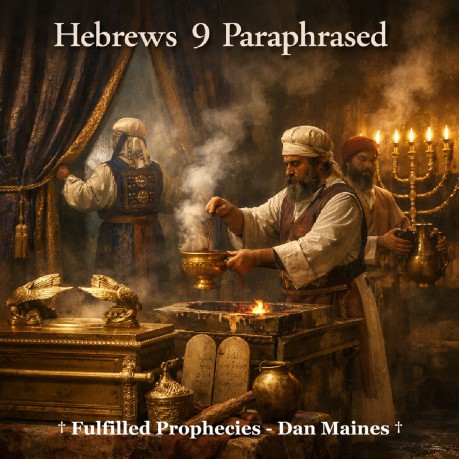
Hebrews 9 Paraphrased Introduction † The writer of Hebrews explains how the old
covenant system worked and why it was temporary. The tabernacle,
priests, and sacrifices all pointed forward to Christ. They were
shadows that prepared Israel for the greater reality that came
through Him. † Hebrews 9 shows that the old system couldn't
truly remove sin. It could only remind people of their guilt and
point ahead to the better sacrifice that was coming. † The fulfilled perspective recognizes that the
old covenant order was passing away in the first century and was
completely removed in AD 70, exactly as Jesus foretold (Matthew
24:1-2). The earthly sanctuary under the first covenant † The first covenant included regulations for
worship and a sacred tent built on earth where priests carried out
their duties (Exodus 25:8-9). † These arrangements weren't random. They were
designed by God to illustrate deeper spiritual realities that would
later be fulfilled in Christ (Colossians 2:16-17). † Early Christians understood the tabernacle as
symbolic. Barnabas wrote that these earthly patterns pointed to the
greater work of Christ that was about to be revealed. Hebrews 9:1 The first covenant had rules for worship and a sacred place set up
on earth where the priests served. † The tabernacle system was the center of
Israel's worship life (Exodus 25:8). † But it was always temporary and symbolic, not
the final solution for sin (Hebrews 8:5). † The physical sanctuary pointed forward to
something greater that Christ would accomplish. Hebrews 9:2 A tent was prepared with two sections. In the first room were the
lampstand, the table, and the bread set before God, and this room was
called the Holy Place. † These items symbolized God's presence and
provision for His people (Exodus 26:35). † The bread represented fellowship with God,
while the lampstand symbolized divine light. † These objects were teaching tools that
prepared Israel to understand the work of the Messiah. Hebrews 9:3 Behind the second curtain was another room called the Most Holy
Place. † This inner chamber represented the immediate
presence of God. † Only the high priest could enter it, and only
once each year on the Day of Atonement (Leviticus 16:2). † This restriction showed that full access to
God hadn't yet been opened. Hebrews 9:4 In that room were the golden altar for incense and the ark of the
covenant covered with gold. Inside the ark were the jar holding
manna, Aaron's staff that once budded, and the stone tablets of the
covenant. † Each item reminded Israel of God's covenant
history. † The manna recalled God's provision in the
wilderness (Exodus 16:33). † Aaron's staff reminded them of God's chosen
priesthood (Numbers 17:10). Hebrews 9:5 Above the ark were the cherubim representing God's glory,
overshadowing the place where atonement was made. But we won't go
into every detail about these things right now. † The mercy seat symbolized God's throne of
mercy where blood was sprinkled for forgiveness (Leviticus 16:14). † This ritual showed that sin required a
covering. † But it also pointed forward to Christ's final
atonement. Hebrews 9:6 When everything was arranged this way, the priests regularly
entered the outer room to perform their daily duties. † Daily priestly service was constant under the
old covenant. † This constant activity showed that the work
of dealing with sin was never finished. † The repetition itself proved that the system
was incomplete. Hebrews 9:7 But only the high priest entered the inner room, and he did it
once a year, bringing blood for himself and for the sins the people
had committed without realizing it. † The Day of Atonement was the most sacred day
in Israel's calendar (Leviticus 16:29-30). † Even the high priest needed sacrifice for his
own sins. † This showed that the old priesthood itself
was flawed. Hebrews 9:8 By this arrangement the Holy Spirit was showing that the way into
God's presence hadn't yet been opened while the first tent was still
standing. † The barrier inside the temple symbolized
limited access to God. † As long as that system remained active, the
fuller reality hadn't yet arrived. † Christ's work would soon open that access
completely. Hebrews 9:9 This arrangement was a picture for that time, showing that gifts
and sacrifices couldn't actually clear a person's conscience. † The old sacrifices dealt with outward ritual
purity. † But they couldn't remove inner guilt. † Only Christ's sacrifice could cleanse the
conscience. Hebrews 9:10 These rules dealt with food, drink, and ceremonial washings. They
were external regulations that applied only until the time when
everything would be set right. † These regulations were temporary. † They prepared the way for the new covenant. † Their purpose ended when Christ fulfilled
them. Hebrews 9:11 But when Christ came as the high priest of the good things that
were coming, He entered the greater and more perfect sanctuary that
wasn't made by human hands. † Christ's priesthood is superior to the
Levitical system. † His work isn't limited to an earthly
structure. † His ministry fulfills everything the
tabernacle symbolized. Hebrews 9:12 He didn't enter with the blood of goats and calves. He entered
once for all with His own blood and secured eternal redemption. † Animal sacrifices had to be repeated
constantly. † Christ's sacrifice happened once and
accomplished what the others couldn't. † His work provided true and lasting
redemption. Hebrews 9:13 If the blood of goats and bulls and the ashes of a young cow
sprinkled on people could make them ceremonially clean, † These rituals restored people to
participation in temple life. † They addressed ceremonial impurity, not the
root of sin. † They pointed forward to a better cleansing. Hebrews 9:14 how much more will the blood of Christ cleanse our conscience from
dead works so we can serve the living God. † Christ's sacrifice cleanses the inner person. † It removes guilt and restores true fellowship
with God. † This cleansing allows believers to serve God
freely. Hebrews 9:15 For this reason Christ is the mediator of a new covenant, so those
who are called may receive the promised eternal inheritance. † The new covenant fulfills the promises given
through the prophets (Jeremiah 31:31-34). † Christ's mediation brings lasting
forgiveness. † This inheritance belongs to those who trust
Him. Hebrews 9:16 Where a covenant is involved, the death of the one who made it
must be established. † Covenants often required sacrificial
confirmation. † Christ's death established the new covenant. † His sacrifice secured its promises. Hebrews 9:17 A covenant becomes effective after death, because it isn't in
force while the one who made it is still alive. † The writer uses legal imagery to explain the
necessity of Christ's death. † Without His sacrifice, the covenant promises
wouldn't be enacted. † His death marked the turning point between
the covenants. Hebrews 9:18 That's why even the first covenant wasn't put into effect without
blood. † Blood sacrifices marked covenant commitments
throughout Israel's history. † The shedding of blood symbolized the
seriousness of sin. † Christ's sacrifice fulfilled this pattern
perfectly. Hebrews 9:19 After Moses had declared every commandment to all the people, he
took the blood of calves and goats with water, scarlet wool, and
hyssop, and sprinkled both the scroll and the people. † This event took place when the law was first
given (Exodus 24:6-8). † The people were symbolically set apart by
blood. † This foreshadowed the greater cleansing that
would come through Christ. Hebrews 9:20 He said, This is the blood of the covenant that God commanded you
to keep. † Moses' words pointed forward to Christ's
statement at the Last Supper (Matthew 26:28). † The old covenant required obedience under
law. † The new covenant would be sealed by Christ's
sacrifice. Hebrews 9:21 In the same way he sprinkled blood on the tabernacle and on
everything used in the service. † This ritual symbolized purification. † The entire system was marked by sacrificial
blood. † Yet it still couldn't remove sin completely. Hebrews 9:22 According to the law almost everything was cleansed with blood,
and without the shedding of blood there is no forgiveness. † Blood represented life given in place of
another. † This principle prepared the world for the
ultimate sacrifice of Christ. † His death fulfilled what the sacrificial
system pointed toward. Hebrews 9:23 The earthly copies of heavenly realities had to be purified this
way, but the greater realities required better sacrifices. † The tabernacle was only a shadow of something
greater. † Christ's sacrifice belongs to the greater
reality. † His work surpasses everything that came
before. Hebrews 9:24 Christ didn't enter a sanctuary made by human hands. He entered
heaven itself and now appears in God's presence on our behalf. † Christ's priestly work isn't confined to
earthly structures. † His intercession secures our standing before
God. † The earthly temple was never the ultimate
destination. Hebrews 9:25 He didn't enter to offer Himself again and again like the high
priest who enters the sanctuary every year with blood that isn't his
own. † Repeated sacrifices marked the weakness of
the old system. † Christ's sacrifice required no repetition. † His work was complete and final. Hebrews 9:26 Otherwise He would have needed to suffer repeatedly since the
foundation of the world. But now He has appeared once at the end of
the ages to remove sin through His sacrifice. † The phrase end of the ages refers to the
closing period of the old covenant age. † Christ's sacrifice marked the turning point
in redemptive history. † The destruction of Jerusalem confirmed that
the old age had ended. Hebrews 9:27 Just as people are appointed to die once and after that comes
judgment, † This reflects the universal reality of human
mortality. † Judgment follows death as part of God's
justice. † Christ's sacrifice addresses that ultimate
reality. Hebrews 9:28 so Christ was offered once to bear the sins of many, and He will
appear a second time, not to deal with sin but to bring salvation to
those who eagerly wait for Him. † His sacrifice dealt with sin fully. † His coming in judgment upon Jerusalem marked
the completion of the covenant transition. † Those who trusted Him received the salvation
He promised. Historical References † Josephus described the destruction of the
temple in AD 70, confirming the end of the old sacrificial system. † Eusebius recorded that early Christians fled
Jerusalem before its destruction, understanding Jesus' warnings. † Clement of Alexandria taught that the old
sacrificial system was symbolic and fulfilled in Christ. How it applies to us today † Hebrews 9 reminds us that Christ's sacrifice
is complete and sufficient. † We don't need a temple, priests, or repeated
sacrifices because Jesus finished that work. † Our relationship with God now rests on the
finished work of Christ. Q And A Appendix Q Why were animal sacrifices repeated so often? Q What does it mean that Christ entered a greater
sanctuary? Q Why does Hebrews say Christ appeared at the end
of the ages? Q Why did God establish the tabernacle system if
it couldn't remove sin? Q What did the curtain in the temple represent? Q Why does Hebrews emphasize that Christ offered
Himself once? Q What does it mean that Christ is the mediator
of a new covenant? † This is the fulfilled perspective we proclaim at
Fulfilled Prophecies † Source Index † Hebrews 9:1-28 † Exodus 24:6-8; Exodus 25:8-9; Exodus 26:35;
Leviticus 16:2, 14, 29-30; Numbers 17:10; Matthew 24:1-2; Matthew
26:28; Colossians 2:16-17; Hebrews 8:5; Hebrews 10:1-4 † Josephus, Wars of the Jews; Clement of
Alexandria, Stromata; Eusebius, Ecclesiastical History.
By Dan Maines
A
Because they couldn't fully remove sin, they only pointed forward to
the final sacrifice Christ would provide (Hebrews 10:1-4).
A It means His priestly work isn't
tied to the earthly temple but to the greater reality His sacrifice
accomplished (Hebrews 9:24).
A Because His ministry took place
at the close of the old covenant age that ended with the destruction
of Jerusalem (Hebrews 9:26; Matthew 24:2).
A God gave the
tabernacle and sacrifices as teaching tools that pointed forward to
Christ. They showed that sin required death and that forgiveness
required a substitute. They prepared Israel to understand the greater
sacrifice that was coming through the Messiah (Hebrews 9:9-10;
Galatians 3:24).
A
The curtain showed that access to God's presence was restricted under
the old covenant. Only the high priest could enter the Most Holy
Place once each year. When Jesus died the curtain was torn, showing
that the barrier was removed through His sacrifice (Hebrews 9:7-8;
Matthew 27:51).
A Because the old sacrifices had
to be repeated constantly, proving they weren't sufficient. Christ's
sacrifice happened once and fully dealt with sin. There was no need
for repetition because His offering accomplished complete redemption
(Hebrews 9:12; Hebrews 9:25-26).
A A mediator establishes the
covenant relationship between God and His people. Through His death
Jesus secured the promises of the new covenant, including forgiveness
of sins and the inheritance of eternal life (Hebrews 9:15; Jeremiah
31:31-34).
© Fulfilled Prophecies - Dan
Maines.
Links