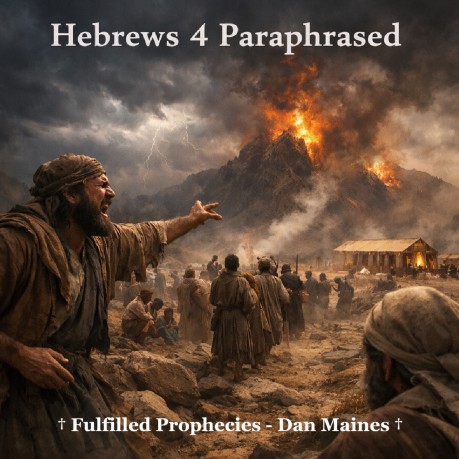
Hebrews 4 Paraphrased Introduction † The writer continues warning the early
believers not to repeat Israel's mistake in the wilderness. God
promised them rest, yet many never entered it because they refused to
believe. The message to the first century church was urgent, because
the old covenant age was about to end and the true rest of God was
being revealed through Christ. † The promise of rest was not merely about land
or physical peace. It pointed to the completed work of God through
the Messiah, where the burden of the law and the old covenant system
would finally come to an end (Matthew 11:28-30). † This chapter shows that the rest of God was
still open during the apostolic age, and the believers were urged to
enter it through faith before the passing away of the old covenant
world (Hebrews 8:13). Hebrews 4:1 Hebrews 4:1 † The promise still stood during the lifetime
of the apostles. That means the fulfillment had not yet fully arrived
but was very near (Hebrews 10:36-37). † Israel failed to enter God's rest in the
wilderness because they did not trust Him. The same danger existed
for those living during the transition from the old covenant to the
new (Psalm 95:7-11). † Faith, not ancestry or law-keeping, was the
requirement for entering God's rest (Romans 4:16). Hebrews 4:2 Hebrews 4:2 † Israel heard the promise but refused to
believe it. Hearing the truth alone is not enough if the heart
refuses to trust God (Numbers 14:22-23). † The gospel message was already being preached
during the apostolic age as the fulfillment of the promises made long
ago (Acts 13:32-33). † Faith is what connects a person to the
promise, otherwise the message passes by without producing life
(Romans 10:17). Hebrews 4:3 Hebrews 4:3 † God's rest began after creation when His work
was completed (Genesis 2:2). † Yet the promise of entering that rest
continued throughout Israel's history, showing that it pointed to
something greater than the Sabbath day alone (Psalm 95:11). † Believers were beginning to enter that rest
through Christ during the first century transition (Matthew 11:28). Hebrews 4:4 Hebrews 4:4 † The seventh day rest established the pattern
that pointed to a greater spiritual rest (Genesis 2:2-3). † The Sabbath law later reminded Israel of that
rest, but it was only a shadow of the greater fulfillment in Christ
(Colossians 2:16-17). † The writer uses creation itself to show that
God's rest existed long before the law of Moses. Hebrews 4:5 Hebrews 4:5 † This refers back to the warning given in
Psalm 95 where God spoke about Israel's rebellion. † The repetition shows that the promise of
entering God's rest was still open after the wilderness generation
failed (Psalm 95:7-11). † That meant the rest pointed to something
beyond the land of Canaan. Hebrews 4:6 Hebrews 4:6 † The door to God's rest was still open during
the apostolic age. † The failure of the wilderness generation did
not cancel God's promise. † Instead it pointed forward to a future
fulfillment through Christ (Acts 2:39). Hebrews 4:7 Hebrews 4:7 † David wrote Psalm 95 centuries after Joshua
brought Israel into Canaan. † That proves the promised rest had not yet
been fully realized in Joshua's time. † The invitation to enter God's rest remained
open until the fulfillment came through Christ. Hebrews 4:8 Hebrews 4:8 † Joshua brought Israel into the land but that
was not the final rest. † The true rest pointed to the completion of
God's redemptive work through Christ. † This shows that the old covenant system was
never the final goal. Hebrews 4:9 Hebrews 4:9 † The Sabbath pointed forward to a greater rest
beyond the weekly observance. † That rest was fulfilled in the completed work
of Christ (Matthew 11:28-30). † The believers living in the first century
were approaching the moment when that rest would fully arrive with
the end of the old covenant age (Hebrews 8:13). Hebrews 4:10 Hebrews 4:10 † Just as God finished creation and rested,
believers would rest from the works of the law. † The burden of the old covenant system was
coming to its end (Galatians 3:24-25). † Salvation was not achieved through works but
through the finished work of Christ (Ephesians 2:8-9). Hebrews 4:11 Hebrews 4:11 † The warning again points back to Israel's
failure in the wilderness. † The believers were urged to remain faithful
during the approaching judgment on Jerusalem (Hebrews 10:25). † Faithfulness was necessary during that
transitional period before the old covenant system passed away. Hebrews 4:12 Hebrews 4:12 † God's word exposes what is truly inside a
person. † It separates truth from deception and reveals
whether someone truly trusts God. † The prophetic word was actively judging the
unbelief of that generation (Jeremiah 23:29). Hebrews 4:13 Hebrews 4:13 † God sees the heart, not just outward
behavior. † The approaching judgment on Jerusalem would
reveal who truly belonged to Him. † No one could escape God's knowledge or His
justice (Ecclesiastes 12:14). Hebrews 4:14 Hebrews 4:14 † Jesus replaced the Levitical priesthood as
the true high priest. † His priesthood is greater than the temple
system that was about to pass away (Hebrews 7:23-28). † Believers were called to remain faithful to
Him. Hebrews 4:15 Hebrews 4:15 † Jesus fully experienced human life and
temptation. † Because of this He is able to sympathize with
those who struggle. † His sinless life made Him the perfect
mediator between God and man (1 Timothy 2:5). Hebrews 4:16 Hebrews 4:16 † Access to God was no longer limited to the
temple system. † Through Christ believers could approach God
directly. † This access demonstrated that the old
covenant barriers were already being removed (Ephesians 2:18). Historical References † Justin Martyr wrote that Christ brought the
true Sabbath rest which the old law only symbolized. † Irenaeus explained that the rest promised by
God pointed to the fulfillment of redemption through Christ. † Eusebius recorded that early believers saw
the destruction of Jerusalem as the closing of the old covenant age. How It Applies To Us Today † God's rest has already been opened through
the completed work of Christ. † We are not under the burden of the old
covenant law system. † Our rest is found in trusting what Christ has
already accomplished. † Instead of striving to earn righteousness, we
live in the peace that comes from His finished work. Q & A Appendix Q: What is the rest described in Hebrews 4? Q: Why did Israel fail to enter God's rest? Q: How do believers enter God's rest? Q: Why does the writer keep warning believers
about unbelief? Q: What does it mean to rest from our works like
God rested from His? Q: Why does Hebrews emphasize Jesus as the great
High Priest? Q: What does it mean to approach the throne of
grace with confidence? † This is the fulfilled perspective we proclaim at
Fulfilled Prophecies † Source Index † Hebrews 4:1-16
By Dan Maines
Since the promise of entering
God's rest is still open, we must take it seriously and be careful
that none of you misses it.
The good news was preached to us
just as it was to them, but the message they heard did them no good
because they did not combine it with faith.
We who believe are the ones
entering that rest, just as God said about those who refused to
believe, I swore in my anger, they will never enter my rest, even
though His works were finished since the beginning of the world.
Scripture says about the seventh
day, God rested from all His work.
Yet again God said, they will
not enter my rest.
Since the promise of entering
still remained, and those who first heard the message failed because
they disobeyed, others would still be given the opportunity to enter.
God again set a certain day
called Today, speaking through David long afterward saying, Today if
you hear His voice do not harden your hearts.
If Joshua had given them the
true rest, God would not later speak about another day.
So there remains a Sabbath rest
for the people of God.
The one who enters God's rest
also rests from his own works just as God did from His.
So let us make every effort to
enter that rest so that no one falls by following the same example of
disobedience.
God's word is alive and
powerful, sharper than any double edged sword, able to penetrate
deeply and judge the thoughts and intentions of the heart.
Nothing in all creation is
hidden from God's sight. Everything is exposed before Him and we must
all give account.
Since we have a great high
priest who has passed through the heavens, Jesus the Son of God, we
must hold firmly to our confession.
We do not have a high priest
who cannot understand our weaknesses, but One who was tempted in
every way as we are, yet without sin.
So let us come confidently to
the throne of grace so that we may receive mercy and find grace to
help in time of need.
A:
It is the rest that comes through the finished work of Christ, not
the old covenant law system (Matthew 11:28-30; Hebrews 8:13).
A:
Because they heard the promise but refused to believe it (Numbers
14:22-23; Psalm 95:7-11).
A:
By trusting the completed work of Christ rather than relying on works
of the law (Ephesians 2:8-9; Galatians 3:24-25).
A: Because the same danger that
destroyed the wilderness generation was still present. Hearing God's
truth without trusting it leads to judgment. The first century
believers were warned not to repeat Israel's mistake (Hebrews
3:18-19; Hebrews 4:1-2; Psalm 95:7-11).
A: It means trusting the
finished work of Christ instead of relying on works of the law. Just
as God completed creation and rested, believers rest in the completed
work of redemption (Hebrews 4:10; Ephesians 2:8-9; Galatians 2:16).
A: Because the old covenant
priesthood was temporary. Jesus replaced that entire system and now
stands as the true mediator between God and His people (Hebrews
4:14-15; Hebrews 7:23-25; 1 Timothy 2:5).
A: Through Christ
believers have direct access to God. The temple system no longer
stands between God and His people, because Jesus opened the way
(Hebrews 4:16; Ephesians 2:18; Hebrews 10:19-22).
© Fulfilled Prophecies - Dan
Maines.
†
Genesis 2:2-3; Psalm 95:7-11; Matthew 11:28-30; Hebrews 8:13
†
Justin Martyr, Dialogue with Trypho; Irenaeus, Against Heresies;
Eusebius, Ecclesiastical History
Links