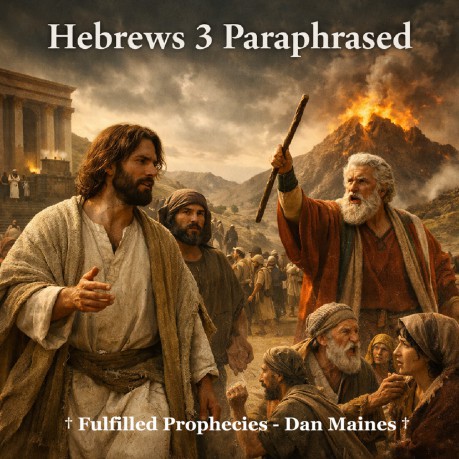
Hebrews 3 Paraphrased Introduction † The writer now turns the focus to Jesus as
greater than Moses. The Jewish believers respected Moses deeply
because he was the mediator of the Law. The point being made is not
that Moses failed, but that Jesus stands above him as the builder and
Son over God's house. This was crucial for first century believers
who were being pressured to return to the old covenant system that
was about to pass away in AD 70 (Matthew 24:1-2). † The warning in this chapter centers on
unbelief. Israel in the wilderness saw God's works but hardened their
hearts. The writer warns the first century believers not to repeat
the same mistake as the old covenant system was reaching its end
(Hebrews 8:13). † Early Christians such as Clement of Rome also
warned believers to remain faithful and not turn back to the old
ways, emphasizing endurance in the faith during the transition period
between the covenants. Hebrews 3:1 Therefore, brothers and sisters who belong to God and share in the
heavenly calling, focus your thoughts on Jesus, the one sent by God
and the high priest of the faith we confess. † The call to consider Jesus points believers
away from the temple system and toward Christ as the true mediator of
the new covenant (Hebrews 4:14). † The heavenly calling refers to the spiritual
kingdom that Christ established, not an earthly national covenant
like Israel had under Moses (Philippians 3:20). † Eusebius wrote that the early Christians saw
Christ as the true fulfillment of everything Moses represented,
recognizing Him as the greater leader of God's people. Hebrews 3:2 He was faithful to the one who appointed Him, just as Moses was
faithful in all God's house. † Moses served faithfully under the old
covenant, but his role was that of a servant within the house, not
the builder of it (Numbers 12:7). † The comparison prepares the reader to see
that Jesus is not simply another prophet like Moses, but the one who
established the house itself (Hebrews 3:3). † Justin Martyr taught that Moses pointed
forward to Christ, showing that the Law was preparing the way for the
Messiah. Hebrews 3:3 Jesus deserves far greater honor than Moses, just as the builder
of a house deserves more honor than the house itself. † The house represents God's covenant people,
while Christ is the builder who established the covenant community
(Ephesians 2:19-22). † Moses served within the system, but Christ
created the system of redemption that God's people now belong to. † Irenaeus wrote that Christ was the one who
structured the entire plan of redemption from the beginning. Hebrews 3:4 Every house is built by someone, but the one who built everything
is God. † This statement reminds the reader that
Christ's work is directly connected with God's authority and power
(John 1:3). † The covenant house of God was not built by
human effort or religious systems, but by God's design through
Christ. † Tertullian emphasized that the church exists
because of God's divine plan rather than human religious traditions. Hebrews 3:5 Moses was faithful as a servant in God's house, speaking about
things that would be revealed later. † Moses' role was prophetic. His ministry
pointed forward to the greater fulfillment that would come in Christ
(Deuteronomy 18:15). † The Law and the prophets were shadows of the
greater reality that was revealed in the new covenant. † Clement of Alexandria wrote that the Law was
a teacher preparing people for Christ. Hebrews 3:6 But Christ is faithful as a Son over God's house. And we are that
house if we hold firmly to the confidence and hope we take pride in. † Christ's authority is greater because He is
the Son, not merely a servant like Moses (John 3:35). † Believers themselves are described as God's
house, meaning the true temple is now the people of God, not the
physical temple in Jerusalem (1 Corinthians 3:16). † The warning to hold firmly reflects the
approaching crisis of the Jewish war and the destruction of the
temple in AD 70. Hebrews 3:7 So as the Holy Spirit says, today if you hear His voice, † The writer quotes Psalm 95 to warn the
believers not to repeat Israel's wilderness rebellion. † The word today emphasizes urgency, meaning
the opportunity to respond to God was present in their own generation
(Psalm 95:7). † Early Christian writers frequently used this
passage to urge believers toward faithfulness during persecution. Hebrews 3:8 Do not harden your hearts like they did during the rebellion,
during the time of testing in the wilderness. † The rebellion refers to Israel's refusal to
trust God even after seeing His miracles (Numbers 14:11). † Hardening the heart describes persistent
unbelief despite clear evidence of God's power. † Barnabas wrote that Israel's wilderness
rebellion serves as a warning for all generations of believers. Hebrews 3:9 That was where your ancestors tested and tried Me even though they
saw what I did for forty years. † Israel witnessed God's works daily yet still
doubted Him. † Miracles alone do not guarantee faith if the
heart is hardened. † Josephus records how Israel repeatedly
complained against God during their wilderness journey. Hebrews 3:10 Because of that, I was angry with that generation and said their
hearts are always wandering away, and they refuse to understand My
ways. † The wandering heart reflects spiritual
rebellion rather than simple confusion. † Israel's failure was not lack of evidence but
refusal to trust God. † Early Christian teachers warned believers
that spiritual drifting begins with unbelief. Hebrews 3:11 So I swore in My anger, they will never enter My rest. † The rest originally referred to entering the
promised land. † In the first century context it pointed to
entering the completed kingdom reality through Christ. † The destruction of Jerusalem marked the final
end of the old covenant system that had resisted Christ. Hebrews 3:12 Be careful, brothers and sisters, that none of you develops an
evil heart of unbelief that turns away from the living God. † The danger being addressed is abandoning
faith and returning to the old covenant system. † The living God stands in contrast to the dead
rituals that could not bring life (Hebrews 10:1). † Tertullian warned that turning away from
Christ meant abandoning the only true source of life. Hebrews 3:13 Encourage one another every day while it is still called today so
that none of you becomes hardened by sin's deception. † The community of believers was essential for
strengthening faith during persecution. † Sin deceives by making unbelief seem
reasonable. † Early church gatherings were centered on
encouragement and endurance during difficult times. Hebrews 3:14 We share in Christ if we hold firmly to the confidence we had from
the beginning until the end. † Sharing in Christ means participating in the
life and salvation He brought. † The end refers to the completion of the
covenant transition that culminated in AD 70. † Clement of Rome urged believers to remain
steadfast until God's purposes were completed. Hebrews 3:15 As it says, today if you hear His voice, do not harden your hearts
like they did in the rebellion. † The repeated warning shows how serious the
danger of unbelief was. † The writer stresses that the same mistake
Israel made could happen again. † The early church consistently used Israel's
history as a lesson for believers. Hebrews 3:16 Who were the ones who heard and rebelled? Were they not all those
who left Egypt under Moses? † The generation that saw the greatest miracles
also produced the greatest rebellion. † Deliverance from Egypt did not guarantee
faithfulness. † Josephus records how Israel repeatedly
complained even after being freed from slavery. Hebrews 3:17 And with whom was He angry for forty years? Was it not with those
who sinned, whose bodies fell in the wilderness? † The wilderness deaths demonstrated the
consequences of persistent unbelief. † The example shows that outward participation
in God's people does not guarantee true faith. † Early Christian teachers used this as a
warning against complacency. Hebrews 3:18 And to whom did He swear they would never enter His rest if not to
those who were disobedient? † Disobedience here is rooted in unbelief. † Trusting God was always the foundation of
entering His rest. † The lesson was clear for the first century
audience facing pressure to abandon Christ. Hebrews 3:19 So we see that they were not able to enter because of unbelief. † Unbelief is the central issue running through
the entire chapter. † Faith in Christ, not loyalty to the old
covenant system, was the only way forward. † Eusebius wrote that the destruction of
Jerusalem confirmed the shift from the old covenant to the new
covenant kingdom. Historical References † Clement of Rome warned believers to remain
faithful and not return to the old covenant system. † Justin Martyr explained that Moses and the
Law pointed forward to Christ as the greater fulfillment. † Irenaeus taught that Christ established the
covenant house that Moses only served within. † Eusebius recorded that early Christians
understood the destruction of Jerusalem as the confirmation of
Christ's prophecy. How It Applies To Us Today † Hebrews 3 reminds us that faith must remain
rooted in Christ, not in religious systems or traditions. † The warning against hardened hearts still
applies today because unbelief can slowly develop when we ignore
God's truth. † Encouraging one another in faith remains
essential because the Christian life was never meant to be lived
alone. † Christ is still the builder and head of God's
house, and believers today are part of that living temple. Q & A Appendix Q: Why does Hebrews compare Jesus with Moses? A: Because Moses was the central figure of the
old covenant, and the writer needed to show that Jesus stands above
him as the Son over God's house (Hebrews 3:3-6). Q: What does it mean that believers are God's
house? A: It means the true temple is now the people of
God themselves rather than a physical building in Jerusalem (1
Corinthians 3:16; Ephesians 2:19-22). Q: What was the warning about unbelief referring
to? A: It warned first century believers not to
repeat Israel's wilderness rebellion by rejecting Christ and
returning to the old covenant system (Hebrews 3:12-13). Q: What is the "house" that Christ is
over in Hebrews 3? A: The house refers to God's people, not a
physical temple. Under the old covenant Moses served within that
house, but Christ is the Son who rules over it. Believers themselves
are now that house because God's presence dwells in His people, not
in a building (Hebrews 3:6; 1 Corinthians 3:16; Ephesians 2:19-22). Q: What is the "rest" mentioned in
Hebrews 3? A: The rest originally referred to Israel
entering the promised land, but it also pointed forward to the
completed covenant rest brought through Christ. The writer warns that
unbelief kept the wilderness generation out of that rest, and the
same danger faced the first century believers if they rejected Christ
(Hebrews 3:11, 18-19; Psalm 95:10-11). Q: Why does the writer repeat the phrase today if
you hear His voice? A: The word today stresses urgency. The
opportunity to respond to God was happening in their own generation.
The writer was urging them not to delay or harden their hearts while
the covenant transition was unfolding in their lifetime (Hebrews
3:7-8, 15; 2 Corinthians 6:2). Q: What lesson does the wilderness generation
teach believers? A: Israel saw God's power but still refused to
trust Him. Their failure shows that unbelief can exist even among
those who have seen God's works. The warning is to remain faithful
and not drift away from the truth (Hebrews 3:12-13; Numbers
14:22-23). † This is the fulfilled perspective we proclaim at
Fulfilled Prophecies † Source Index † Hebrews 3:1-19; Psalm 95:7-11; Numbers 14:11;
Deuteronomy 18:15; Matthew 24:1-2; Hebrews 4:14; Hebrews 8:13;
Hebrews 10:1; John 1:3; John 3:35; 1 Corinthians 3:16; Ephesians
2:19-22; Philippians 3:20 † Clement of Rome, First Epistle to the
Corinthians; Justin Martyr, Dialogue with Trypho; Irenaeus, Against
Heresies; Tertullian, Apology; Eusebius, Ecclesiastical History;
Josephus, Antiquities of the Jews.
By Dan Maines
© Fulfilled Prophecies - Dan
Maines.
Links