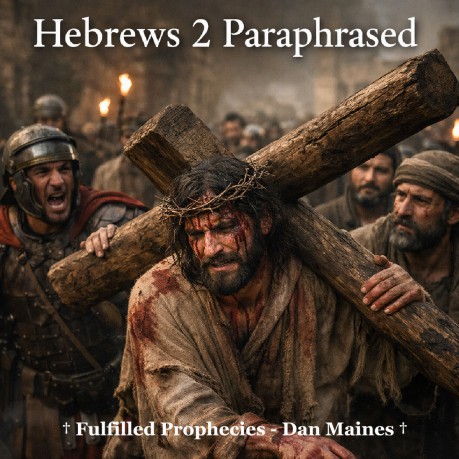
Hebrews 2 Paraphrased Introduction † The writer continues explaining why the
message of the Son must be taken seriously. Because Jesus is greater
than the angels, ignoring his message brings serious consequences.
The chapter shows why the incarnation was necessary, why Christ
shared in our humanity, and how his suffering defeated death and the
devil (Hebrews 1:1-4; Hebrews 2:14). † This chapter also explains the purpose of the
Messiah becoming human. He didn't come as an angel, he came as a man
so he could redeem mankind. That truth connects directly to the
promise given from the beginning that man would rule the world under
God (Genesis 1:26; Psalm 8:4-6). † From the fulfilled perspective, these words
were written to believers living before the judgment of Jerusalem in
AD 70. They were warned not to drift away during the time of
persecution and transition between the covenants (Hebrews 10:25-27). Hebrews 2:1 For that reason we must pay closer attention to what we've heard,
so we don't slowly drift away from it. † The warning is about drifting, not sudden
rebellion. Spiritual neglect leads people away from truth little by
little (Hebrews 3:12). † The message they heard was the gospel
confirmed by Christ and his apostles (Mark 1:14-15). † Ignoring the message of the Son is far more
serious than ignoring the message delivered through angels in the old
covenant (Galatians 3:19). Hebrews 2:2 If the message spoken through angels proved reliable, and every
violation received its proper punishment, † The law given at Sinai was associated with
angelic mediation (Acts 7:53). † The point is simple. If disobedience under
the law brought judgment, rejecting the greater revelation in Christ
is even more serious (Hebrews 10:28-29). † The justice of God under the law proved the
seriousness of his word. Hebrews 2:3 how will we escape if we ignore such a great salvation? It was
first announced by the Lord, and then confirmed to us by those who
heard him. † Jesus himself proclaimed the message of
salvation during his earthly ministry (Luke 4:18-21). † The apostles confirmed that message after his
resurrection (Acts 2:32-36). † The phrase great salvation points to the
fulfillment of God's covenant promises through Christ (Luke 1:68-75). Hebrews 2:4 God also testified to it through signs, wonders, various miracles,
and gifts of the Holy Spirit distributed according to his will. † Miracles confirmed the authority of the
apostles and their message (Acts 5:12). † These signs demonstrated that the kingdom of
God had arrived in Christ (Matthew 12:28). † The miraculous gifts served as confirmation
during the foundational period of the church (Hebrews 2:4). Hebrews 2:5 God didn't subject the coming world, which we're talking about, to
angels. † The world to come refers to the coming
covenant age of the Messiah, not a distant physical planet (Hebrews
12:28). † The kingdom promised to humanity would not be
ruled by angels but restored through Christ (Daniel 7:27). † This points back to God's original design for
mankind to rule under him. Hebrews 2:6 But someone testified somewhere, saying, What is man that you're
mindful of him, or the son of man that you care for him? † The writer quotes Psalm 8, which describes
God's purpose for humanity (Psalm 8:4-6). † The phrase son of man refers to mankind in
general, but is ultimately fulfilled in Christ as the representative
man (Daniel 7:13-14). † The psalm reveals the dignity and purpose God
gave humanity. Hebrews 2:7 You made him for a little while lower than the angels, you crowned
him with glory and honor, † Humanity was created lower than angels in
nature but destined for honor and authority (Genesis 1:26-28). † Jesus temporarily shared that lower condition
when he became human (Philippians 2:7). † His humiliation was part of the redemption
plan. Hebrews 2:8 and you put everything under his authority. When he placed
everything under him, nothing was left outside his control. But right
now we don't yet see everything under his authority. † The promise of dominion began in Genesis but
wasn't fully realized because of sin (Genesis 3:17-19). † Christ restores that authority through his
reign (Matthew 28:18). † The fulfillment of that reign became visible
through the establishment of his kingdom. Hebrews 2:9 But we do see Jesus, who was made lower than the angels for a
short time, now crowned with glory and honor because he suffered
death, so that by God's grace he might taste death for everyone. † Jesus entered human suffering and death to
redeem mankind (Romans 5:8). † His suffering led to exaltation and glory
(Philippians 2:9-11). † The phrase taste death emphasizes the reality
of his sacrificial death. Hebrews 2:10 It was fitting for God, for whom and through whom all things
exist, to bring many sons to glory by making the author of their
salvation perfect through suffering. † Jesus was already morally perfect, but
suffering completed his role as the redeemer (Hebrews 5:8-9). † The phrase many sons points to believers who
share in the new covenant family of God (Romans 8:14-17). † Salvation came through the suffering servant
promised in prophecy (Isaiah 53:10-12). Hebrews 2:11 Both the one who makes people holy and those who are made holy
come from the same source, so he isn't ashamed to call them brothers. † Christ and believers share the same humanity
(John 1:14). † The family language shows the unity between
the Messiah and his people (Romans 8:29). † Through Christ, believers become part of
God's household. Hebrews 2:12 He says, I will proclaim your name to my brothers, in the middle
of the congregation I'll sing your praise. † This quote comes from Psalm 22, a psalm
connected to the suffering Messiah (Psalm 22:22). † After his resurrection, Jesus declared God's
victory among his followers (John 20:17). † The congregation refers to the assembly of
God's people. Hebrews 2:13 And again, I'll put my trust in him. And again, Here I am with the
children God has given me. † These words reflect prophetic passages
describing the Messiah and his people (Isaiah 8:17-18). † The Messiah stands with those God gives him. † It shows the relationship between Christ and
believers as a united family. Hebrews 2:14 Since the children share in flesh and blood, he also shared the
same humanity, so through death he could destroy the one who held the
power of death, that is, the devil. † The incarnation was necessary for redemption
(John 1:14). † Christ defeated the devil by conquering death
through resurrection (1 John 3:8). † The authority of death was broken through the
cross. Hebrews 2:15 And free those who spent their entire lives in slavery because of
their fear of death. † Fear of death held humanity in bondage under
sin (Romans 6:23). † Christ's victory removes that fear for
believers (1 Corinthians 15:54-57). † Eternal life through Christ breaks the power
of death. Hebrews 2:16 It's clear that he doesn't help angels, but he helps the
descendants of Abraham. † Redemption was directed toward humanity, not
angels. † The descendants of Abraham refers to those
who share Abraham's faith (Galatians 3:7). † The promise to Abraham included the nations
(Genesis 12:3). Hebrews 2:17 So he had to become like his brothers in every way, so he could
become a merciful and faithful high priest in matters relating to
God, to make atonement for the sins of the people. † Christ serves as the true high priest of the
new covenant (Hebrews 4:14). † His sacrifice accomplished the atonement that
animal sacrifices couldn't achieve (Hebrews 10:10). † His priesthood is based on his humanity and
sacrifice. Hebrews 2:18 Because he himself suffered when he was tempted, he's able to help
those who are being tempted. † Christ understands human struggle because he
experienced real temptation (Hebrews 4:15). † His victory over temptation provides strength
for believers. † The Messiah's suffering made him a
compassionate mediator. Historical References † Justin Martyr wrote that Christ became man so
he could defeat death and restore mankind to life. † Irenaeus explained that Jesus recapitulated
humanity, becoming what we are so he could restore what Adam lost. † Eusebius recorded that early Christians saw
Christ's incarnation and suffering as the fulfillment of the ancient
prophecies. How It Applies To Us Today † We must hold firmly to the message of Christ
and not drift away from the truth. † Jesus understands human weakness because he
experienced our struggles. † Because Christ defeated death, believers no
longer live in fear. Q & A Appendix Q Why did Jesus have to become human? A Because redemption required a human
representative to defeat sin and death (Hebrews 2:14-17; Romans
5:18-19). Q What does it mean that Jesus destroyed the
devil? A Through his death and resurrection, Christ
broke the power of death and exposed Satan's defeat (1 John 3:8;
Colossians 2:15). Q What does it mean to drift away from the truth? A It refers to slowly neglecting the gospel
message until a person moves away from faith (Hebrews 2:1; Hebrews
3:12). Q Why does Hebrews say the message spoken through
angels was binding? A Because the law given at Sinai carried real
authority and judgment for disobedience. If violations under that
covenant received punishment, ignoring the greater revelation given
through Christ brings even greater accountability (Hebrews 2:2-3;
Acts 7:53; Hebrews 10:28-29). Q What is the world to come mentioned in Hebrews
2:5? A It refers to the covenant age of the Messiah
and his kingdom, not a distant future planet. The writer was speaking
about the new covenant order that Christ established, which replaced
the old covenant system that was passing away in that generation
(Hebrews 2:5; Hebrews 8:13; Hebrews 12:28). Q What does it mean that Jesus tasted death for
everyone? A It means Jesus truly experienced death so he
could defeat it on behalf of humanity. His sacrifice brought
redemption and opened the way for life through him (Hebrews 2:9;
Romans 5:8; 1 Corinthians 15:54-57). Q How does Jesus help believers when they face
temptation? A Because he lived as a man and experienced
suffering and temptation himself, he understands human weakness and
is able to strengthen those who struggle (Hebrews 2:18; Hebrews
4:15-16). Q Why does Hebrews say Jesus calls believers his
brothers? A Because through his work believers are brought
into God's family. He shares in our humanity and brings many sons
into glory through his redemption (Hebrews 2:11-12; Romans 8:29; John
20:17). † Thi is the fulfilled perspective we proclaim at
Fulfilled Prophecies † Source Index † Hebrews 2:1-18 † Justin Martyr, Dialogue with Trypho † Irenaeus, Against Heresies † Eusebius, Ecclesiastical History
By Dan Maines
© Fulfilled Prophecies - Dan
Maines.
Links